The United States is currently facing a staggering deficit of 4.5 million homes, a crisis exacerbated by an antiquated construction industry. Most modern houses are still built entirely by hand, relying on a fragmented web of subcontractors and a rapidly shrinking pool of skilled tradespeople. The result is a system where homes are too slow to build, too expensive to buy, and increasingly scarce in high-demand communities.
Enter Reframe Systems. A Boston-based physical AI startup that believes the solution to the housing crisis isn’t found on a traditional job site, but in localized, robotics-driven manufacturing. This week, the company announced it has secured an additional $40 million in venture-backed equity financing to scale its highly automated homebuilding model across North America.
The round was led by Energy Impact Partners (EIP), with participation from Counterpart Ventures, E12 Ventures, Global Brain, Thin Line Capital, Up Partners, and LACI Impact Fund. Existing backers, including Eclipse, VoLo Earth, Cubit Capital, RA Capital Management, MassMutual Catalyst, and Nor’easter, also returned to support the company’s ambitious expansion.
Here is a deeper look at how Reframe plans to use its fresh capital to industrialize one of the economy’s least productive sectors.
The Amazon Robotics Pedigree
Proptech investors have historically been burned by capital-intensive modular construction startups that overpromised and underdelivered. However, Reframe brings a uniquely proven execution team to the table.
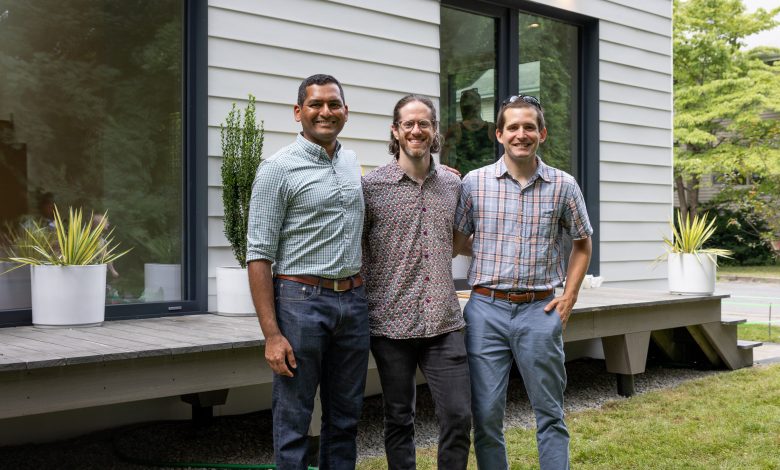
The company was founded in 2022 by Vikas Enti (CEO), Felipe Polido, and Aaron Small. Before turning their attention to the housing market, the trio were prominent leaders at Amazon Robotics, where they helped scale some of the most advanced automation systems on the planet, successfully deploying more than 500,000 robots across Amazon’s massive global fulfillment network.
Now, they are applying those exact same principles of software-orchestrated automation to homebuilding. By replacing fragmented, manual processes with a continuous, robotic-driven manufacturing loop, the team is bringing e-commerce-level logistics to neighborhood development.
The Microfactory Advantage vs. Centralized Modular
A key differentiator for Reframe is its rejection of the massive, centralized factory model that has plagued traditional modular builders. Centralized factories struggle with high overhead, expensive shipping costs for completed modules, and an inability to easily pivot between the varying zoning codes and architectural styles of different municipalities.
Instead, Reframe is building a network of localized “microfactories” situated close to the communities where the homes are actually needed.
The unit economics of these microfactories are strikingly lean. Reframe is currently expanding its production capacity with a new facility in Billerica, Massachusetts, dubbed FAB1. Slated to begin operations on October 5, FAB1 achieved full factory readiness in less than 70 days from the moment the company received the keys. Furthermore, the facility requires less than $5 million in equipment, yet it is designed to churn out up to 500 multifamily units or 250 single-family homes annually.
Physical AI and Pixels to Parts
At the core of Reframe’s operation is its proprietary “Pixels to Parts” software and a heavy reliance on physical AI. The company’s software seamlessly coordinates architectural design directly with the production floor.
Inside the microfactory, robotic systems take over the most repetitive and labor-intensive fabrication tasks. For the final assembly, the system generates digital work instructions. This allows workers of all skill levels—not just specialized, hard-to-find tradespeople—to easily assemble the home components.
The end result? Reframe claims it can deliver homes three times faster and at a 35% lower cost than traditional construction methods, all while adapting dynamically to local zoning requirements and climate conditions.
Early Traction and Climate Resiliency
“The company has moved beyond proving the technology to delivering scaled deployments, winning customers, and building repeatable execution,” said Anil Achyuta, Partner at Energy Impact Partners.
That execution is already visible in the field. Reframe has completed 10 homes to date, eight of which are already occupied, ranging from accessory dwelling units (ADUs) to multi-family properties. The company expects to deliver an additional 114 units over the next year.
Its pipeline highlights the flexibility of the microfactory model. In Massachusetts, Reframe is finalizing 12 units at Adams Circle in Devens, with a massive five-story apartment building in Roxbury and a new development in Thornton, New Hampshire, up next.
The startup is also addressing climate resiliency. In Altadena, California, Reframe is currently finishing an ADU and a wildfire-resilient bungalow to help a family rebuild after devastating local fires.
“After the fires, we were being told that a traditional construction rebuild could take years and could cost far more than we could afford,” noted homeowners Jonathan and Marisol Talbot. “Reframe streamlined the process, secured the permits, coordinated with a contractor, and is completing our new wildfire-resilient home in months… That difference in timeline, cost, and security allowed us to move forward with confidence.”
Accelerating to One Million Homes
“The housing shortage is an abstraction until you’re the person who can’t find a home in the community you want to live in,” Enti explained. “With our model, every home we deliver makes the next one faster and cheaper to build, because our software, robotics and network learn from each deployment.”
With $40 million in new funding, Reframe is aggressively scaling this compounding network effect. Developers are increasingly demanding faster, energy-efficient, and climate-resilient builds, and Reframe is positioning itself to be the premier supplier.
Driven by this surge in demand, the company has officially accelerated its ultimate mission: Reframe is now targeting the construction of one million homes worldwide by 2040, hitting that milestone five years ahead of its original schedule.
Learn more at https://www.reframe.systems/.