



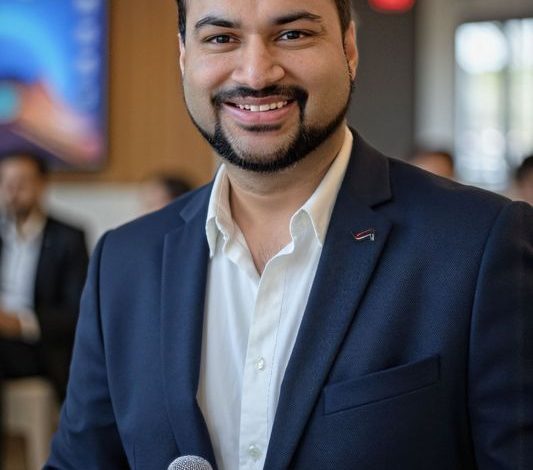
Harsh Verma, recognised for his contributions to AI, cybersecurity, and software engineering, has been nominated for the Tech Excellence Award at the Influencer Magazine Awards 2026. A sought-after voice on human-AI collaboration, he continues to shape how enterprises deploy intelligent systems.
— Harsh Verma, Principal Software Engineer in AI at Palo Alto Networks, Forbes Technology Council Member, Stanford Distinguished Scholar through Stanford Graduate School of Business programmes, and IEEE Senior Member, has been nominated for the Tech Excellence Award at the Influencer Magazine Awards 2026. The nomination recognises his contributions to AI engineering, cybersecurity innovation, and his growing influence as a voice on the future of enterprise AI systems.
The nomination arrives amid increasing visibility of Verma’s work on the intersection of human expertise and AI systems, an area gaining importance as organizations move from experimental AI adoption toward large-scale operational deployment. His most recent publication in The AI Journal, titled How AI Agents Will Collaborate with Human Experts in High-Stakes Environments, sets out his position that the most significant competitive advantage in the coming decade will belong not to the organisations that deploy the most powerful AI models, but to those that design the most effective collaboration between human experts and AI agents.
Recognition Reflecting Broader Industry Relevance in AI & Cybersecurity
Verma has spent over twelve years building and deploying large-scale AI systems in production environments, with a focus on the intersection of AI engineering and enterprise cybersecurity. His work at Palo Alto Networks, one of the world’s leading cybersecurity organisations protecting tens of thousands of organisations across clouds, networks, and mobile devices, has centred on agentic AI architectures: autonomous systems capable of executing security decisions at the speed and scale that modern enterprise require while maintaining control and security across enterprise environments.
Verma’s recognition aligns with a broader shift in enterprise technology, where the focus is moving beyond model performance toward how AI systems are integrated, governed, and used in real-world decision-making environments. His expertise spans generative AI, large language models, AI agents, and enterprise-scale machine learning platforms. “The advantage does not lie with the organisation with the most powerful AI,” Verma writes. “It lies with those that design the most effective collaboration between humans and intelligent agents.”
This perspective reflects a growing consensus across industry and research communities that hybrid human AI systems often outperform fully automated or fully manual approaches, particularly in complex, high-risk environments.
Verma has shared his perspectives through speaking engagements and technical forums publicly on specific topics at UC Berkeley SkyDeck, where his talk on the era of agentic security was published on the university’s official YouTube channel, at TrueML Talks on big data and machine learning practices at Palo Alto Networks, at the Digital Battleground series on quantum and cybersecurity, at FutureAGI’s Powering Cybersecurity with GenAI and Intelligent Agents event, and at Health Tech Week.
He mentors early-stage ventures through UC Berkeley’s SkyDeck accelerator and advises startups on AI strategy, infrastructure, and implementation across the AI and enterprise space contributing to the development of emerging AI-driven ecosystems.
The Research: Why Human and AI Collaboration Defines the Next Era
Verma’s AI Journal publication challenges the framing that has dominated much of the AI adoption conversation. His argument is that AI replacing human experts entirely introduces accountability gaps and removes the contextual reasoning that human judgement provides. Humans reviewing AI outputs after the fact creates response latency that modern enterprise environments cannot sustain.
His position, supported by research from McKinsey, ICT and Health, and Nature, is that hybrid teams, where humans and AI agents work within a shared decision loop with dynamic role distribution, consistently outperform either approach in isolation.
“The advantage does not lie with the organisation with the most powerful AI,” Verma writes. “It goes to the organisation that understands and designs the most effective collaboration between humans and agents.”
That argument connects directly to his broader body of work on what he terms the shift from model building to system architecture as the defining skill of the next generation of AI engineers. In his framing, engineers are no longer primarily responsible for training models from scratch. They are responsible for designing architectures that connect AI across workflows, manage reliability at scale, and build systems capable of evolving as the technology around them changes.
“The challenge is no longer simply building models,” Verma has noted. “The challenge is designing systems that can evolve, reason, integrate with enterprise workflows, and operate reliably at scale.”
The Human Dimension of Engineering Excellence
A consistent thread in Verma’s published work and speaking is the human dimension of AI engineering. Beyond technical skills, he identifies systems thinking, infrastructure awareness, and continuous adaptation as prerequisites for AI engineers operating in enterprise environments. He also highlights communication and stakeholder influence as increasingly important capabilities, a position he acknowledges challenges a profession that has historically rewarded technical precision above all else.
“Make sure the tools you are building are comfortable for the users, so they can leverage it in the very best way,” Verma has said. “The engineers defining the next decade will be those capable of governing and orchestrating AI systems across entire organisations.”
This philosophy is at the centre of his forthcoming book, Engineer Beyond the Code, which makes the case for a holistic approach to AI engineering combining technical depth with leadership, communication, and personal brand. His central argument is that the next wave of AI engineering will belong to those who can govern, orchestrate, and lead intelligent systems as part of a larger ecosystem.
Recognition Across Professional Communities
Verma’s Tech Excellence Award nomination at the Influencer Magazine Awards 2026 adds to a series of recognitions he has received across the industry. In March 2026, he received a Global Recognition Award evaluating contributions across Innovation, Leadership, Service, and AI and Research. He was confirmed as a Forbes Technology Council Member earlier the same year and placed on the Fortuna Global 100 List in AI. He has also been recognised as an IFGICT Fellow, elevated to IEEE Senior Member status, awarded the IOASD Royal Fellowship, and received the Globee Award for Artificial Intelligence, the Noble Technology Award, and the Cybersecurity Excellence Award in recognition of his contributions to innovation, leadership, AI, and cybersecurity. He has completed executive innovation and leadership programmes with both Stanford Graduate School of Business and MIT.
Focus on the Future of AI Engineering
These recognitions reflect a career that has been defined as much by influence and knowledge-sharing as by technical output. Verma writes regularly on AI engineering, governance, and cybersecurity, has been published in Hackernoon and The AI Journal and Forbes technical council platforms. He uplifts the next generation of AI engineers and founders through his mentoring and accelerator work.
As enterprises continue integrating AI into critical operations, recognition of contributors such as Verma reflects a broader industry trend: the emergence of engineers whose influence extends beyond implementation into shaping how AI systems are designed, deployed, and trusted.

About Harsh Verma
Harsh Verma is a Principal Software Engineer in AI at Palo Alto Networks, Forbes Technology Council Member, Stanford Distinguished Scholar through Stanford Graduate School of Business programmes, IEEE Senior Member, and mentor at UC Berkeley’s SkyDeck accelerator. His expertise spans generative AI, large language models, AI agents, cybersecurity AI, distributed systems, and enterprise-scale AI platforms. He is also the author of the forthcoming book Beyond-AI Engineering. Connect with Harsh on LinkedIn at linkedin.com/in/harshverma59.
Contact Info:
Name: Gianmarco
Email: Send Email
Organization: Xraised
Website: http://Xraised.com
Release ID: 89193808
If you detect any issues, problems, or errors in this press release content, kindly contact [email protected] to notify us (it is important to note that this email is the authorized channel for such matters, sending multiple emails to multiple addresses does not necessarily help expedite your request). We will respond and rectify the situation in the next 8 hours.