9:15 AM. Ryan is driving to a client site when his phone rings. The procurement lead wants to confirm payment terms before the contract moves to legal. Ryan has one hand on the wheel. He can’t take notes.
Two hours later, he’s in the client’s conference room. Twelve people around a table. The budget owner mentions a number that changes the scope of the entire deal. Ryan catches it, but by the time the conversation moves to timelines, he’s already lost the exact phrasing.
By 5 PM, he’s back at his desk on a Zoom sync with his internal team. Three conversations across the day. Three sets of decisions. And the only record is whatever Ryan can piece together from memory.
Ryan’s day is not unusual. It’s the standard operating rhythm for account executives, consultants, project managers, and anyone whose job involves more talking than typing. The question professionals like Ryan are now asking: are there dedicated AI note-taking devices? Which is best?
One product has emerged as the clearest answer to that question. This is a hands-on look at Plaud Note Pro, what it does well, where it falls short, and whether the category itself is worth paying attention to.
The Core Argument: Why a Dedicated Device?
Before evaluating any specific product, the premise needs to hold up. Why would anyone buy a separate piece of hardware when phones record audio, AI chatbots summarize text, and Zoom already offers built-in transcription?
The short answer: none of those tools cover a full workday.
A phone microphone is designed to pick up one voice at arm’s length. Place it on a conference table and the two people closest to it come through clearly. Everyone else is muffled. In Ryan’s twelve-person meeting, half the room would be inaudible.
AI chat tools like ChatGPT can summarize text, but they don’t record anything. You still have to capture the audio, transcribe it, and paste the text in manually. That’s a workflow, not a solution. It adds a step after every meeting instead of removing one.
Video conferencing transcription (Zoom, Teams, Google Meet) works inside those platforms. But it has no reach beyond the screen. Ryan’s client call from the car? Not on Zoom. His in-person meeting at the client office? No meeting link to join.
A dedicated device closes these gaps because it operates independently. It doesn’t need a platform, a laptop, or a stable internet connection during the recording. It captures audio in any physical space, processes it with its own AI engine, and delivers structured output. That’s the premise. Whether it delivers on that promise is the question this review answers.
What Plaud Note Pro Actually Is
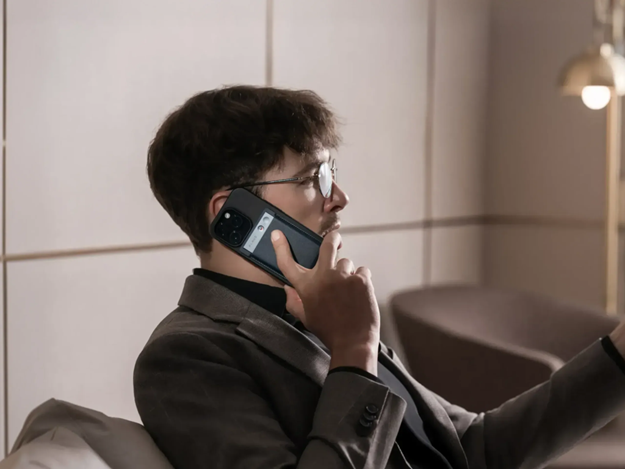
Plaud Note Pro is a credit-card-sized device (85.6 x 54.1 x 2.99 mm, 30 grams) made from aluminum alloy and Corning Gorilla Glass. It records conversations in two modes: placed on a table for in-person meetings, or attached magnetically to a phone case for calls.
The microphone system uses a 4 MEMS array plus 1 VPU with AI-Beamforming, designed to pick up voices from up to 5 meters away while filtering background noise. Smart dual-mode recording detects whether the device is capturing a phone call or a room conversation and adjusts automatically.
After recording, Plaud Intelligence, the platform’s AI engine, processes the audio into transcripts with speaker identification, topic-based summaries, and extracted action items across 112 languages. Output syncs across Plaud App (mobile) and Plaud Desktop, which also captures online meetings without bots.
Battery life runs 30 hours in Enhance mode, 50 hours in Endurance mode. Storage is 64 GB. The price is $189, with 300 minutes per month of free AI transcription included.
Real-World Performance
We tested Plaud Note Pro across the scenarios that match Ryan’s workday. Not lab conditions. Real rooms, real calls, real noise.
Phone call recording. With the device attached to the phone case, we took a 22-minute client call while driving. Smart dual-mode picked up the switch to phone mode without any manual input. Both sides of the conversation came through in the transcript. The AI summary extracted three deadline changes and a pricing question as separate action items. This is the scenario that no software tool handles, and it worked cleanly.
In-person meeting, 8-10 people. We placed the device at the center of an oval conference table. The person at the far end sat roughly four meters away. Every voice was captured clearly. The AI summary grouped the discussion by topic: budget, timeline, technical blockers. A colleague took notes manually in the same meeting and identified three action items. Plaud Intelligence found seven. Four came from cross-talk neither of us caught in real time.
Noisy environment. A coffee shop meeting between two people with ambient music and other conversations in the background. The transcript was usable but noticeably noisier than the conference room recording. Speaker identification held, but the AI occasionally attributed a nearby table’s voice to the conversation. Acceptable for informal catch-ups, not reliable enough for precise documentation.
AI summary quality. Summaries were structured by topic rather than timeline, which made them immediately useful for forwarding to a team. For internal communications, we sent summaries without editing. For client-facing use, a human review pass was still necessary to adjust tone and phrasing.
The Gaps
The subscription model catches people off guard. The device records and stores audio without any plan. But AI transcription and summaries require Plaud Intelligence, which runs on the free Plaud Starter Plan (300 minutes/month). At Ryan’s pace of four to five meetings per day, those minutes run out in the first week. Heavy users should plan for Plaud Pro Plan from day one.
Cloud processing is required for AI features. Plaud Intelligence processes recordings through cloud-based servers. The platform complies with SOC 2, HIPAA, GDPR, and EN 18031 standards, but organizations with strict on-premise-only data policies need to verify compatibility before purchasing.
Background noise in uncontrolled environments is a weakness. The device performs well in conference rooms and quiet spaces. In loud public settings, transcription accuracy drops. It’s a limitation of physics more than engineering, but it’s real.
Who It’s For
Professionals who move between phone calls, in-person meetings, and screen-based calls throughout the day. Account executives. Consultants. Project managers. Anyone whose conversations happen in more than one format and who currently reconstructs the details from memory.
Medical professionals recording patient consultations with consent. Legal teams capturing depositions and client discussions. Students recording full-day lecture schedules.
The common thread: you need to capture conversations that happen outside a screen, at a quality your phone can’t deliver, with AI output that raw audio can’t provide.
Who It’s Not For
Professionals whose meetings are entirely on Zoom, Teams, or Google Meet. Plaud Desktop handles online meetings without hardware, and built-in platform transcription may be sufficient.
Occasional users who record fewer than a few hours per month. The $189 hardware cost and potential subscription fee are harder to justify at low volume.
Anyone who needs recordings to stay entirely on-premise. The AI features require cloud processing.
Verdict
The question isn’t whether dedicated AI note-taking devices exist. They do, and the category is maturing. The question is whether the current hardware justifies the investment.
For someone whose day looks like Ryan’s, the answer is yes. Plaud Note Pro covers phone calls, in-person meetings, and multi-speaker conference rooms with a level of audio quality and AI output that no phone, no chatbot, and no meeting platform can match across all three. The ecosystem, combining hardware with Plaud Desktop for online meetings, means one account handles every conversation format.
In the spaces where it was designed to work, conference rooms, client offices, phone calls, structured meeting environments, Plaud Note Pro is the most capable dedicated AI note taker available in 2026. Over 2,000,000 users on the platform, plus recognition from Forbes Vetted 2026 and the iF DESIGN AWARD 2026, suggest the market agrees.