The AI cowork platform category has exploded in 2026. Where teams once relied on cloud-based chat tools bolted onto simple task runners, they now expect desktop-native, multi-agent platforms that can read documents, fill forms, send emails, and coordinate complex workflows — all without shipping sensitive data to a third-party server.
Two open-source platforms lead the field: Eigent and OpenClaw while Claude Cowork, Anthropic’s proprietary offering, rounds out the comparison as the most well-known closed alternative. All three claim to deliver AI-powered workflows, but they make very different bets on architecture, openness, and who they actually serve.
This guide cuts through the marketing. We’ll compare them across every dimension that matters: features, deployment, privacy, performance, and cost, so you can make a confident decision in under 10 minutes.
⚡ QUICK VERDICT TL;DR If you want the short answer: Eigent wins for teams that need true multi-agent orchestration, full on-premise deployment, and open-source freedom. OpenClaw is strong for browser-heavy automation. Claude Cowork excels for single-user Claude API workflows but lacks the open-source depth.
1. The Landscape: Why “Open-Source AI Cowork” Matters More Than Ever
Until recently, “AI desktop automation” meant running a Python script or configuring a brittle RPA workflow. The arrival of large language models changed the equation: agents can now reason, plan, and adapt in ways that rigid rule-based tools never could.
But with that power came a new tension: cloud dependency. Most early AI agent tools sent every task, document, and prompt to a vendor’s servers. For anyone in finance, legal, healthcare, or government, industries that handle regulated data, that was a non-starter.
The result is a fast-growing search for platforms that deliver LLM-powered automation without the cloud liability. Search volumes for terms like “private AI desktop automation”, “self-hosted AI agent”, and “local LLM desktop automation” have been climbing steadily throughout 2025 and into 2026.
Eigent and OpenClaw are the two open-source contenders trying to fill that gap. Claude Cowork enters the comparison as the proprietary incumbent, powerful, but closed. Here’s what each of them actually is.
2. Platform Overviews: Who Built What and Why
Eigent — The Multi-Agent Productivity Engine
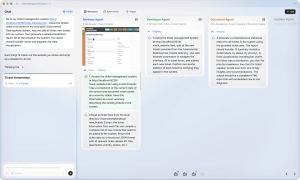
Eigent (eigent.ai) is an open-source desktop automation platform built on the CAMEL-AI multi-agent framework. Its core premise is simple but powerful: instead of a single AI assistant responding to prompts, Eigent deploys a coordinated team of specialized agents that work in parallel — one browsing the web, one processing documents, one writing emails — all supervised by an orchestrator.
Key characteristics: desktop-native app (Windows and Mac), full self-hosting support, local LLM compatibility via Ollama, a modular Skills system for extending agent capabilities, and MCP (Model Context Protocol) for connecting external tools like Slack, Notion, and GitHub.
Top GAIA benchmark performer. Free and fully open-source. No data leaves your machine unless you configure it to.
OpenClaw — The Personal AI Assistant Specialist
OpenClaw is a chat-centric personal AI assistant that runs locally on your device and connects with the messaging platforms you already use, such as WhatsApp, Telegram, Discord, Slack, Signal, and iMessage. Its functionality can be expanded through a community-driven skill marketplace and a workflow system called Lobster. In essence, it’s like having an AI assistant that operates directly within your chat apps.
Claude Cowork — Anthropic’s Proprietary Productivity Layer
Claude Cowork is Anthropic’s vision of AI-assisted productivity: Claude-powered agents working alongside users in a structured workspace. It integrates tightly with the Claude API and offers excellent single-agent performance, especially for writing, analysis, and research tasks.
The critical distinction: Claude Cowork is fully proprietary and closed-source. It cannot be self-hosted, forked, or audited. Local LLM support does not exist — every task routes through Anthropic’s cloud infrastructure. For teams who need transparency, data control, or the ability to run offline, this is a hard blocker.
3. Head-to-Head Feature Comparison
| Feature / Criterion | Eigent | OpenClaw | Claude Cowork |
| Fully Open-Source | ✅ Yes | ✅ Yes | ❌ No |
| Desktop-Native App | ✅ Yes | ❌ No | ✅ Yes |
| True Self-Hosting | ✅ Full | ✅ Yes | ⚠️ Limited |
| Local LLM Support (Ollama etc) | ✅ Native | ⚠️ Basic | ❌ No |
| Multi-Agent Orchestration | ✅ Core Feature | ⚠️ Limited | ⚠️ Limited |
| Browser Automation | ✅ Yes | ✅ Excellent | ⚠️ Basic |
| Document Processing (PDF/Excel) | ✅ Yes | ⚠️ Basic | ✅ Good |
| Email Automation | ✅ Yes | ⚠️ Partial | ✅ Yes |
| Form Filling Automation | ✅ Yes | ✅ Strong | ⚠️ Basic |
| MCP Tool Integration | ✅ Native | ⚠️ Limited | ✅ Yes |
| Modular Skills System | ✅ Yes | ❌ No | ❌ No |
| Human-in-the-Loop Controls | ✅ Built-in | ⚠️ Manual | ✅ Yes |
| Persistent Agent Memory | ✅ Yes | ❌ No | ⚠️ Session Only |
| GAIA Benchmark Performance | ✅ Top Ranked | N/A | N/A |
| Free to Use | ✅ Yes | ✅ Yes | ⚠️ API Costs |
| Enterprise / On-Premise Deploy | ✅ Full Support | ⚠️ Partial | ❌ Limited |
| Privacy: Data Stays On-Device | ✅ Yes | ✅ Yes | ⚠️ Cloud Default |
| Active OSS Community | ✅ Strong | ✅ Active | ❌ Closed Source |
4. Deep-Dive: Where Each Platform Wins
Where Eigent Leads
Eigent’s biggest moat is its multi-agent architecture. Real-world business workflows are rarely single-step. Processing a batch of invoices means simultaneously extracting data, validating against a database, flagging anomalies, and writing a summary report. Eigent runs these as coordinated parallel agents rather than sequential single-agent steps — significantly reducing total task time.
The Skills system is another underrated advantage. Instead of hardcoding automation logic, skills are installable modules that give agents domain-specific capabilities. Need to process a legal PDF? Install the PDF skill. Need to populate a spreadsheet? The xlsx skill handles it. This modularity means Eigent extends to new use cases without requiring platform updates.
Finally, the local deployment story is strongest with Eigent. The combination of Ollama support, on-premise deployment, and the MCP framework means enterprises can run a complete multi-agent automation stack without a single API call leaving their network perimeter.
Where OpenClaw Leads
OpenClaw is mainly accessed through messaging platforms. You interact with your AI assistant in apps like WhatsApp, Telegram, Discord, or Slack in the same way you would chat with another person. If you prefer a more graphical environment, it also provides a web-based canvas workspace as well as a TUI (terminal user interface). Dedicated companion apps are available for macOS, iOS, and Android.
This design has a clear benefit: if you already spend a lot of time in these messaging apps, there’s almost no learning curve. However, it also comes with a drawback — when workflows involve many steps, representing everything as chat messages can make them harder to understand, track, and debug.
Where Claude Cowork Leads
Claude Cowork is the smoothest experience for users who are already deep in Anthropic’s ecosystem. Claude’s reasoning quality especially for analysis, writing, and nuanced research tasks is market-leading, and Claude Cowork surfaces that capability in a well-designed workspace interface.
For individuals or small teams doing primarily knowledge work (research, drafting, summarisation), and who aren’t concerned about local deployment, Claude Cowork offers an elegant, low-friction experience.
5. Who Should Use Which Platform?
| Your Situation | Best Choice | Why |
| Enterprise team with compliance requirements | Eigent | Full on-premise, local LLM, no data leaves the building |
| Developer building browser automation pipelines | OpenClaw | Best-in-class headless browser automation, light footprint |
| Solo knowledge worker using Claude daily | Claude Cowork | Tightest Claude integration, cleanest single-user UX |
| Team needing parallel multi-agent workflows | Eigent | Only platform with native parallel multi-agent orchestration |
| Company processing high volumes of documents/PDFs | Eigent | Skills system + multi-modal agent purpose-built for this |
| Startup wanting free, self-hostable AI automation | Eigent | Fully open-source, zero API cost with local LLMs |
| Team automating web form submissions at scale | OpenClaw | Form filling is OpenClaw’s strongest native use case |
| Regulated industry (legal, finance, healthcare) | Eigent | Air-gapped deploy option, strongest privacy architecture |
| Team already using Notion, Slack, GitHub integrations | Eigent | MCP integration hub connects all three natively |
| Non-technical users who need quick setup | Claude Cowork | Polished UX, minimal config for standard tasks |
6. The Privacy Question: Where Does Your Data Actually Go?
In 2026, data privacy is not a checkbox, it’s a procurement requirement. Here’s the honest picture for each platform:
- Eigent: Data stays on your machine by default. With local LLM configuration (Ollama + Llama 3 or Mistral), not a single token of your input data is transmitted to any external server. For enterprise deployments, a fully air-gapped option is available. This is the strongest privacy posture of the three.
- OpenClaw:
OpenClaw is clear about its security model: it isn’t designed for multi-tenant environments or adversarial settings. Instead, it targets personal or trusted-user scenarios, with features like gateway authentication, sandboxed filesystem access, and UI-based execution approvals.
These controls may be sufficient for a solo developer running it locally. However, for team deployments, regulated data, or environments that require auditing and compliance, OpenClaw’s “personal-use” design becomes a limitation rather than a benefit. - Claude Cowork: The default architecture routes prompts through Anthropic’s API. Anthropic has strong privacy policies and does not train on API data by default, but the data does leave your network. This disqualifies Claude Cowork for many regulated use cases without a specific enterprise agreement.
🔒 PRIVACY VERDICT For any use case involving personally identifiable information, confidential documents, financial records, or patient data, Eigent with local LLM configuration is the only choice of the three that is deployment-safe without additional legal agreements.
7. Real Cost Comparison (Not Just “Free vs Paid”)
Eigent and OpenClaw are open-source and free. Claude Cowork is proprietary and usage-billed. Here’s the real cost breakdown:
- Eigent: Free and open-source. With local LLMs, ongoing inference cost is zero beyond your hardware. Cloud LLM costs apply only if you choose to use them. Enterprise support plans are available. Total cost for a self-hosted team: essentially $0/month in software costs.
- OpenClaw: Free and open-source core. Like Eigent, LLM costs depend on your model choice. Infrastructure costs for running a server are similar.
- Claude Cowork: Fully proprietary, with all usage routed through Anthropic’s paid Claude API. At scale (thousands of agent tasks per month), API costs become significant $15–$75/month per active user depending on usage intensity. There is no self-hosted or free-tier path.
Winner on cost for high-volume enterprise use: Eigent, by a significant margin, especially when using local LLMs.
8. Frequently Asked Questions
Is Eigent free to use?
Yes. Eigent is fully open-source under a permissive license. You can self-host it at no cost. There are optional enterprise support tiers, but the core platform is free forever.
Can Eigent work completely offline?
Yes. When configured with a local LLM (via Ollama running Llama 3, Mistral, or similar), Eigent can operate entirely offline. No internet connection is required for task execution. This makes it suitable for air-gapped enterprise environments.
How is Eigent different from OpenClaw?
Eigent is a full multi-agent desktop automation platform. OpenClaw specialises in browser automation. Eigent handles the broader workflow including document processing, email automation, form filling, and multi-tool coordination. If your use case is primarily web scraping or browser-based form submission, OpenClaw is excellent. For everything else, Eigent is more capable.
Does Eigent support the Claude API?
Yes. Eigent supports Claude, GPT-4, Mistral, Llama, and any OpenAI-compatible API. You can mix models — for example, using a local Llama model for routine tasks and the Claude API for complex reasoning tasks — all within the same workflow.
What is the GAIA benchmark and why does it matter?
The GAIA (General AI Assistants) benchmark measures how well AI agents handle real-world tasks that require multi-step reasoning, tool use, and web interaction. Eigent ranks among the top-performing open-source agents on this benchmark, providing an independent signal of task-completion quality.
Is Claude Cowork open source?
No. Claude Cowork is fully proprietary and closed-source. It cannot be self-hosted, forked, or run offline. All functionality is tied to Anthropic’s cloud API. If open-source or data sovereignty is a requirement, Eigent or OpenClaw are the only viable options in this comparison.
9. The Verdict: Our Recommendation
For most teams evaluating open-source AI cowork platforms in 2026, Eigent is the clear recommendation particularly for anyone who values:
- True multi-agent parallel workflows (not sequential single-agent)
- Full on-premise or local LLM deployment with zero data leaving the network
- A modular, extensible platform via the Skills system
- Cost efficiency at scale with local inference
- Integration breadth via MCP (Slack, Notion, GitHub, Asana, and more)
OpenClaw remains the best choice if your automation needs are primarily browser-based. It’s fast, focused, and well-documented for that specific use case.
Claude Cowork is suitable for individual knowledge workers already in Anthropic’s ecosystem — but only if closed-source, cloud-only operation is acceptable for their use case.
But if you’re building for a team, need real enterprise readiness, and want the flexibility of an open-source platform you can actually own — Eigent is where the category is heading.
🚀 GET STARTED Get started with Eigent at eigent.ai free to download, fully open-source, and deployable in under 10 minutes on Windows or Mac and Linux.