Every business wants to spend as little money as possible to make as much money as possible. As a matter of fact, global ROI for emails, SMS, and push notifications combined stands at a staggering 79x.
As a result, choosing the right tools and platforms to deliver omnichannel communication is essential. Omnisend and Klaviyo both promise strong returns, but we’ll see how they compare against each other in terms of ROI.
Klaviyo offers detailed analytics, reporting, and advanced segmentation that are best suited for data-focused teams. Omnisend, on the other hand, delivers powerful features without the complexity, which makes it more approachable for growing businesses focused on revenue.
Pricing models
Your marketing budget determines which features you can access, and in this comparison, it’s imperative to understand what you’re paying for.
Omnisend starts at $16/month for 251-500 contacts, compared to Klaviyo’s $20/month for the same amount of contacts. That’s a 22% difference for the same list size. At 5,000 contacts and more, Omnisend’s Standard plan costs $88, while Klaviyo’s Marketing plan hits $110.
Both Klaviyo and Omnisend charge based on how many contacts you have, and the monthly price grows with your subscriber base. However, the price jumps are more dramatic with Klaviyo, as extra features like SMS, support, and advanced analytics require you to upgrade plans.
Omnisend, on the other hand, keeps things affordable and user-friendly. Their paid plans are often cheaper than Klaviyo’s for the same number of contacts, and even on a free plan, all standard features are available for users. Omnisend also includes $1 of free SMS credits to try when you sign up for a Free or Standard plan, and bonus SMS credits every month on a PRO plan, equal to your monthly payment. So you get to try out SMS without using your own money.
Another huge plus for Omnisend is how they handle SMS in general. They let you top up your SMS credits in small amounts, whereas Klaviyo forces you to buy expensive blocks of credits that expire every month. If you don’t use them, you lose them. Omnisend, on the other hand, lets you roll the unused credits over, so you keep what you paid for.
To top it off, if upon signing up to Omnisend your monthly plan is $250 or more, you qualify for a no-cost migration service. They move your contacts, templates, segments, automations, and more, for you. Klaviyo can also handle migration for you, but they hand over the process to their third-party agencies who charge their own fees.
When we’re talking about ROI, Omnisend saves growing businesses a lot of wasted time and money.
Sales tracking and attribution
Both platforms track sales, but they show you the data differently. Klaviyo offers extremely detailed reports with high-tier plans, and you can see nearly every metric you can imagine, but it takes know-how to interpret and understand all the data.
On standard paid plans, Klaviyo does offer basic and easier to understand analytics and reports, but Omnisend offers the same value for a lower price, as well as more readable data.
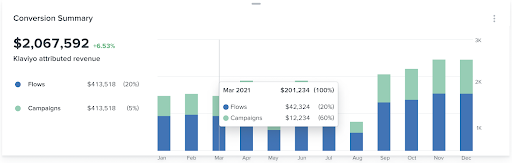
Image via Klaviyo
Omnisend gives you the answers you need immediately in a more user-friendly interface. You open the dashboard and see exactly how much money your emails and automations made.
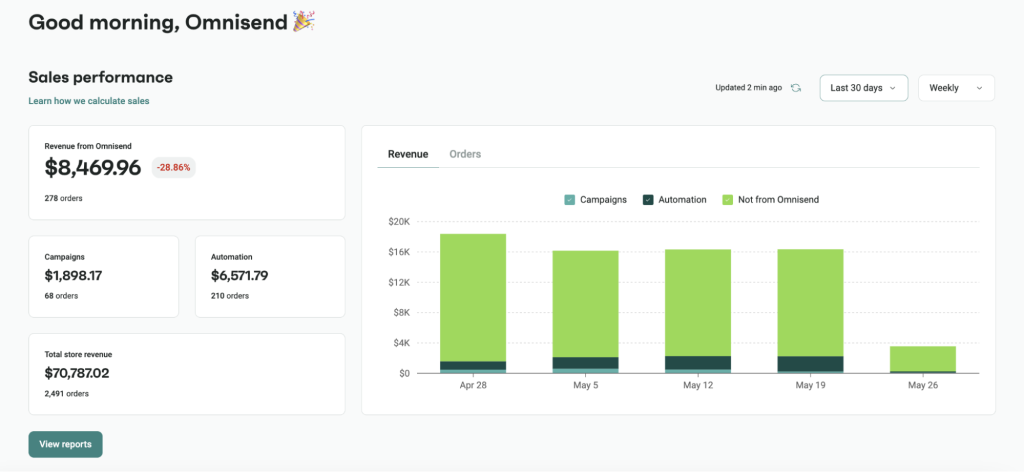
Image via Omnisend
To sum up, both tools show accurate sales attribution by campaigns and automations alike. The difference is, if you want deeper data analysis, you’d have to upgrade to a higher plan with Klaviyo. As far as standard reporting is concerned, Omnisend offers the same value for a more affordable price.
Segmentation and personalization
Grouping your customers for a more personalized approach is key to increasing your overall email marketing ROI. Sending generic emails to everyone no longer cuts it that well, so you need a tool that allows for segmentation and audience filtering. Both tools allow you to do that, but the process is not the same.
Klaviyo is known for its granular and detailed segmentation. It allows you to create extremely complex lists based on tiny details. Building these segments, however, requires expertise and comes with a steep learning curve. You often need to memorize specific rules and logic to get it right. It’s a heavyweight and time-intensive process to master.
Omnisend takes a different path: it’s powerful without being clunky. You get unlimited segments even on the free plan, and the best part is the AI segment builder. If you enter a prompt, for example “VIP customers who haven’t bought in the last 60 days”, the tool will automatically build the segment for you in seconds.
While it’s still not as developed to create highly complex segments, it’s extremely useful for building many different high-value subscriber groups. You can apply the 80/20 rule here that states 80% of results come from 20% of effort. While Klaviyo’s segmentation capabilities are incomparable, they’re also rather niche.
The speed matters more for growing brands looking to maximize their ROI. When you have a massive customer list, you don’t want to spend hours setting up niche segments. Omnisend lets you handle large, complex audiences quickly so you can send the campaigns to those who are most likely to engage.
Which makes data easier to understand?
In the starter plans, both platforms provide a similar degree of data, the main difference is the design and placement. But when it comes to higher plans, Klaviyo takes the obvious lead. The main question is whether you need (and can understand) that level of data for the cost it comes with.
Klaviyo’s campaign reports come with an overview section that shows open rates, click rates, active-on-site rates, and engagement. Then, you can switch tabs to access recipient activity, link activity, conversions, and deliverability info. It’s easy to access and understand.
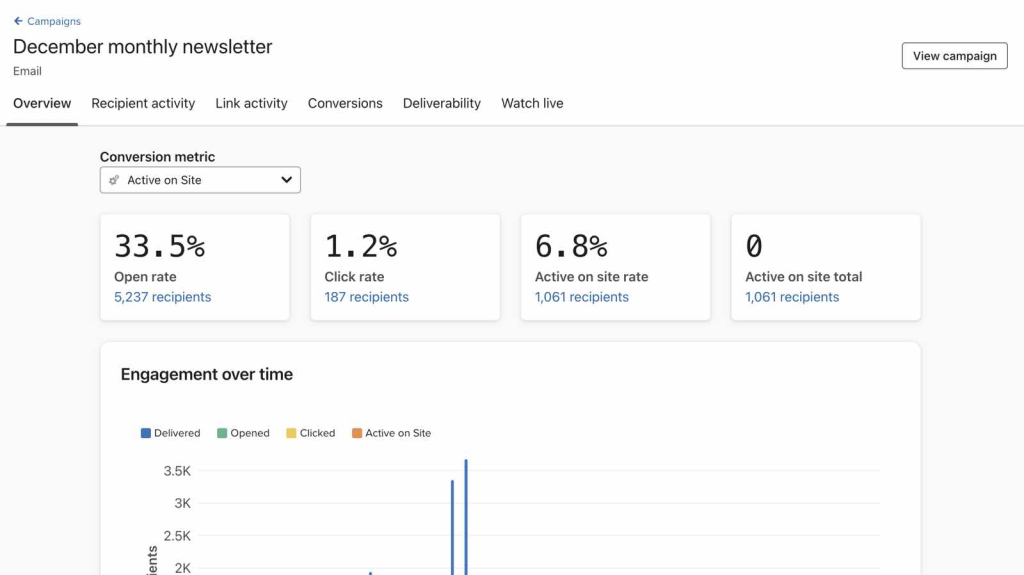
Image via Klaviyo
Omnisend also provides a comprehensive reports page for your campaigns and automations. First, there’s an overview page where you can see sales numbers, number of placed orders, revenue per placed order, revenue per message, engagement, deliverability, segment performance, and more. Then, you can switch to check ordered products, link activity, and contact activity. There’s also an option to analyze a click map.
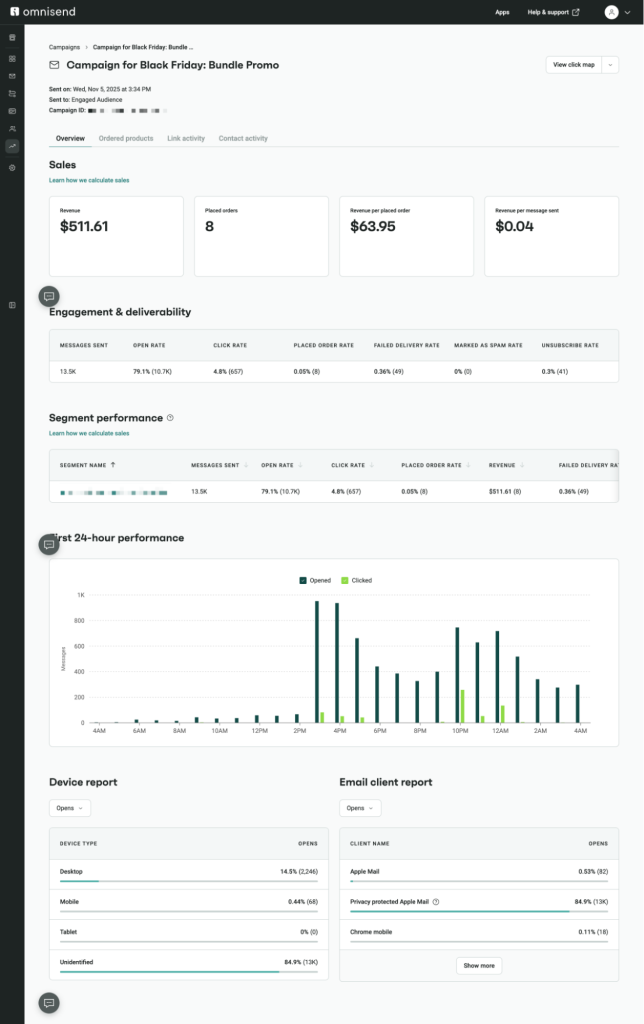
Image via Omnisend
All in all, it’s easy to understand data in both platforms, and they offer roughly the same amount of insight in the standard tiers. But, once again, it begs the question if you should pay more for Klaviyo’s identical functionality to Omnisend’s. Maximizing ROI is just as much about saving money as it is about earning money.
Is Klaviyo or Omnisend better for data-driven decisions?
Most modern businesses are either data-driven by now or are aspiring to become one. In email marketing, being data-driven means utilizing A/B tests, checking CTA placements, adjusting design elements, discovering best send times, optimizing conversion rates, and so on.
To fulfill these standard adjustments, both platforms provide a good basis even on the lower plans. As such, it comes down to who you are and what your business resources are. If you’re a technical person, Klaviyo’s interface and potential capabilities could work better for you. If you’re an everyday marketing professional or a non-tech business owner, Omnisend may be more convenient and familiar to you.
Enterprise businesses, for example, that have data scientist teams at hand and want to act on deep data that’s hardly accessible otherwise, Klaviyo is the logical choice. But most businesses, regardless of their size, don’t need these complex solutions. Therefore, Omnisend becomes a stronger alternative, offering advanced analytics without overcharging you.
Omnisend vs. Klaviyo: Verdict
Klaviyo is a strong tool if you have a full-time data team and an unlimited budget. It offers depth that more technical users love, but for most businesses, that depth comes at a steep price in both money and time.
Omnisend wins on ROI, and here are the facts to back it up:
- It provides more features at a lower price.
- It offers free migration services for users switching from Klaviyo to Omnisend.
- It gives you the same (or more) powerful marketing channels (email, SMS, push notifications), but makes them easier to use and more affordable.
- It fits large, growing brands perfectly because it allows for global growth without SMS limitations.
If you want a tool that saves you money, helps you work faster, and doesn’t take away what you paid for, Omnisend is the better choice.