

A practical framework for choosing autonomous penetration testing across web apps, APIs, and CI/CD pipelines
Your team ships to production every afternoon. A feature merges, the pipeline turns green, and the change is live before the next stand-up. Security testing that runs once a year sees none of it. That gap is why engineering leaders keep hunting for the best autonomous pentesting tools: software that probes an application the way an attacker would, on the same cadence the team ships. A dozen vendors now wear the “autonomous” label, and capabilities vary a lot. This guide gives you a framework for choosing one, then ranks six platforms by fit for a team that deploys daily.
What is autonomous penetration testing?
Autonomous penetration testing hands an offensive security engagement to AI agents. Many buyers search for it as AI penetration testing; both names describe the same approach. The agents run the arc an attacker follows: reconnaissance, mapping the app, building an exploit, chaining weaknesses, and validating impact. What sets the category apart from a scanner is exploitation. An autonomous tool tries to break in and proves the result, whereas a scanner only matches known issues. For an engineering team, the appeal is cadence: agents run on demand or on a schedule, so testing keeps pace with code, not an annual calendar.
What autonomous pentesting gives a team that ships daily
The upside shows up fast once agents work against a real application.
- First finding in minutes: agents begin probing within minutes of a scope grant, so results land the same day, not weeks into a booked engagement.
- Coverage on every deploy: tests fire when code changes, closing the window between annual pentests.
- Proof instead of noise: findings arrive with a working exploit and reproduction steps, so triage skips the argument over whether an alert is real.
- A lower price per assessment: automation drops the cost of a single test well under a manual engagement, so frequent checks stay affordable.
Where autonomous pentesting still falls short
No agent replaces a seasoned researcher, and buyers who skip the limits get burned.
- Business logic still needs a human: agents miss some context-specific flaws that a researcher chasing a hunch would find.
- Guardrails are not optional: an agent let loose in production without scope limits and a kill switch is a threat to uptime.
- Validation cuts noise but never to zero: an independent check lowers false positives, though none erases them, so plan for review.
- Coverage tilts by surface: some platforms lead on networks and identity, others on web and APIs, and few cover both with equal depth.
How to choose an autonomous pentesting tool
Score each tool on the criteria that matter for a team shipping daily, before a demo.
- Validated exploitability: does the tool prove each finding with a working exploit and reproduction steps, or hand you a CVSS score to chase down?
- Business-logic depth: can it reason through broken access control and multi-step auth flows, past simple signature matches?
- Continuous coverage tied to deploys: will it trigger on every release through CI/CD, or run once and go quiet until you remember it?
- Remediation verification: after you patch, does it retest and confirm the fix held?
- Developer-native output: do fixes reach engineers where they work, in the IDE or a pull request, or land as a PDF nobody opens?
- Production safety and governance: does it ship a kill switch and an audit trail aligned to a standard like OWASP APTS?
Tips from the field
Veteran application-security leads use a few checks to separate a real autonomous pentesting tool from a scanner wearing the label:
- Test the retest, not the scan: during a trial, fix one real finding and watch whether the tool re-runs the exact exploit to confirm the patch rather than rescanning for the signature.
- Send a fix through your own IDE: ask for a finding delivered as a code-level fix into the editor your engineers use, then count how many they paste and ship without edits.
- Wire it into one pipeline first: point the tool at one service’s CI/CD before rolling it across the org, to learn its noise level and blast radius at low stakes.
- Ask for the reasoning trail: a real agent shows its decision path from recon to exploit. A scanner with marketing on top shows a CVE list.
The 6 best autonomous pentesting platforms
Six platforms cover most credible shortlists for autonomous penetration testing. They rank here by fit for a team that ships to production daily and needs security to keep pace.
Astra Security for teams that ship to production daily
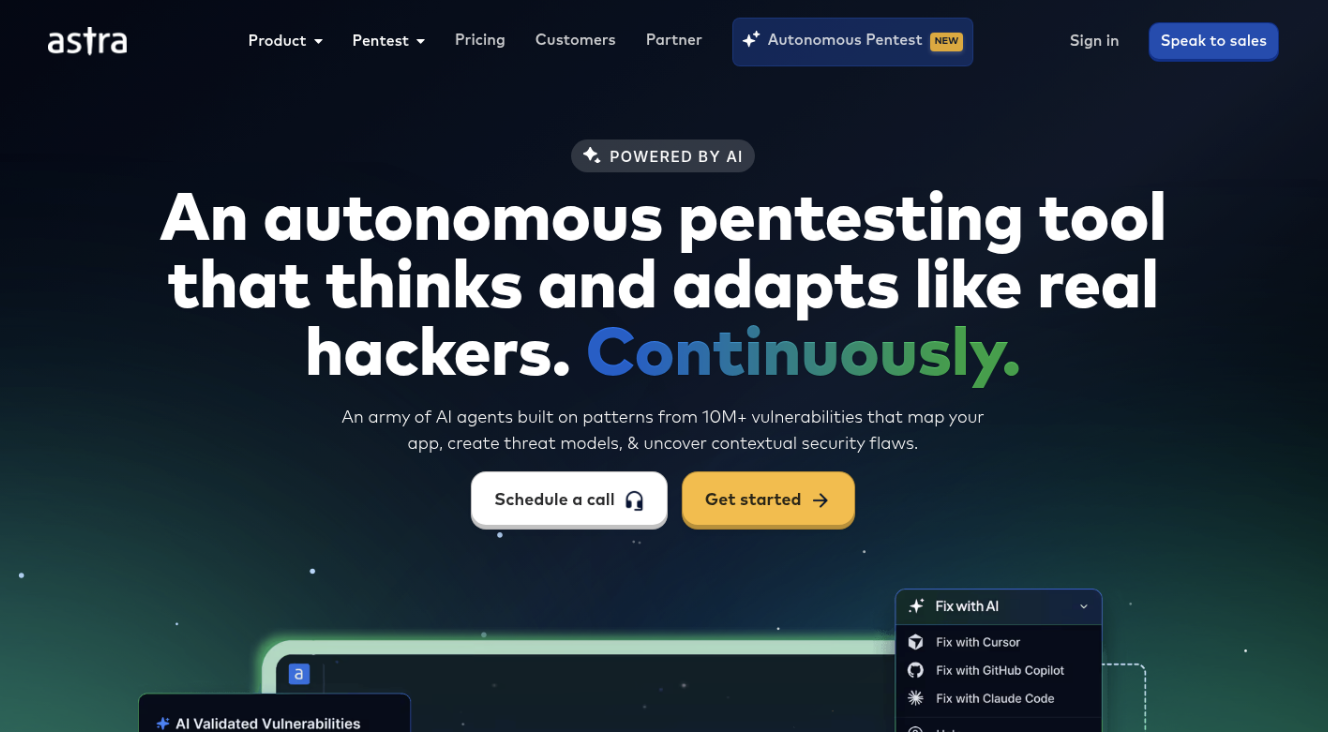
Astra runs autonomous pentesting as one layer of a continuous offensive security platform, and it wires into the pipeline through GitHub Actions, GitLab CI, Jenkins, and Bitbucket so a test fires on every deploy. Its agents cover web applications and APIs. Pentest Auto, the entry tier of the Astra Pentest platform, starts at $2,999 per year.
- Fixes delivered into the IDE: once an agent proves a vulnerability, Astra writes a fix for that codebase and hands it over as a ready-to-paste prompt inside IDE assistants such as Cursor and GitHub Copilot through MCP.
- Independent validation before reporting: a separate AI Validator agent sits apart from the discovery agents and independently confirms exploitability before a finding reaches the dashboard. After remediation, Astra supports rescanning to verify that identified vulnerabilities have been addressed. Astra delivers only validated findings (near-zero false positives) after independent AI and expert review.
- Scope to weigh: the agents test web apps and APIs at present, while cloud infrastructure stays a roadmap item, so a team that wants autonomous cloud checks today won’t get them from the agents yet.
XBOW for autonomous web and API exploitation

XBOW is a pure autonomous platform that explores web apps and their APIs like an attacker and proves exploitability before it surfaces a finding. Each test costs $4,000 to $8,000, and XBOW quotes continuous coverage against usage.
- Parallel specialized agents: under a single coordinator, hundreds of throwaway agents each work one attack vector, charting the attack surface and stitching weaknesses into chains before a deterministic validator signs off on every result.
- Release-gate API: engineers fire a pentest straight from the pipeline to gate a release, and XBOW packages each finding as a case file that carries the attack path plus a working exploit.
- Where it stops short: the tool holds to web and APIs, skips internal networks and cloud, and each black-box run drives a single credential set, which leaves BOLA and cross-role IDOR out of sight. XBOW caps you at one retest per 30-day cycle.
NodeZero (Horizon3.ai) for internal network and identity paths
For infrastructure, NodeZero draws more citations than any other autonomous pentesting platform, and it launches genuine attacks against external and internal networks, Active Directory, and cloud accounts. Horizon3.ai quotes on request, and outside estimates peg a mid-market deployment near $50,000 to $80,000 a year.
- Full kill-chain on infrastructure: the agent finds hosts, grabs credentials, pivots across the network, and links weaknesses into a demonstrated impact, then pairs every finding with proof of exploit plus a retest that runs in one click.
- Rapid response to known exploited bugs: it maps CISA KEV entries against your environment and flags exploitable exposure fast.
- Where it lags for app teams: its web and API pentesting still ships as early access and stays lightweight next to a specialist app scanner, and because NodeZero produces no automated code fixes, developers write each patch themselves.
Aikido Security for all-in-one AppSec coverage
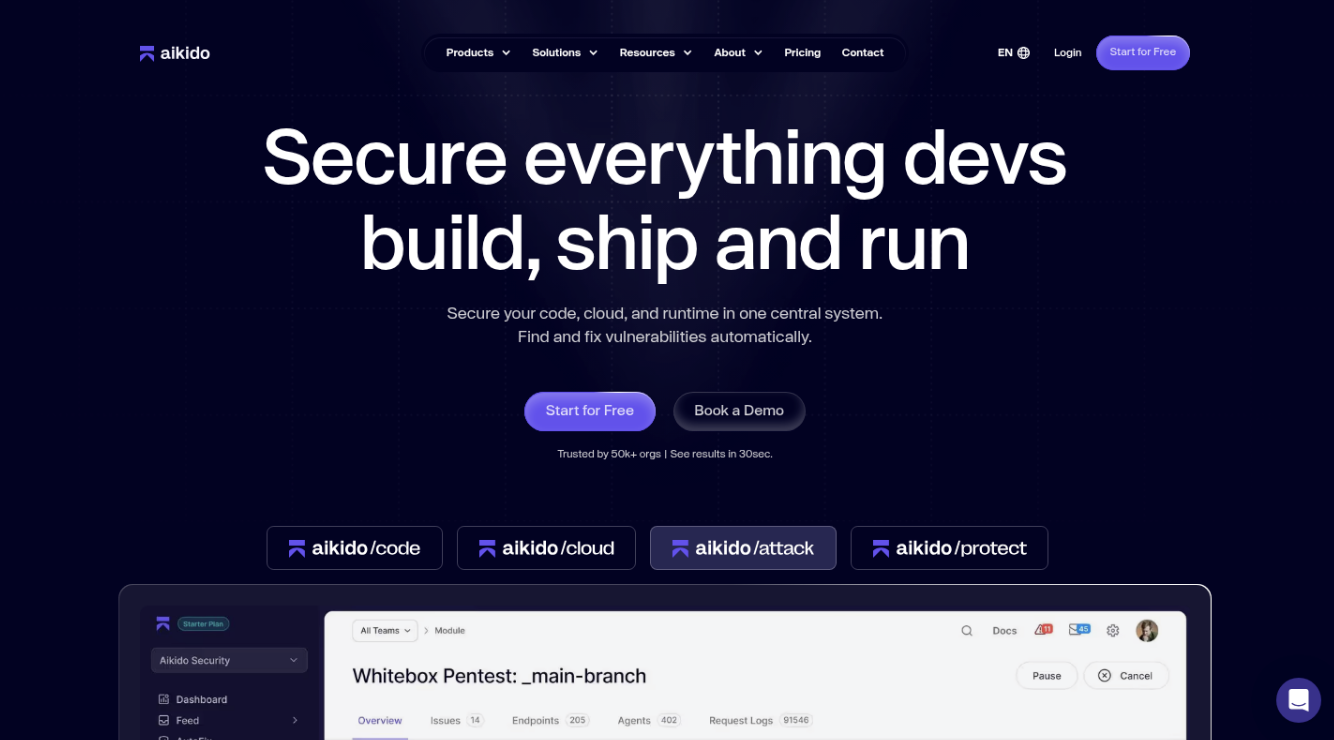
Aikido tucks autonomous pentesting into a wider code-to-runtime AppSec platform where Aikido Attack drives the AI pentesting and Aikido Infinite launches a fresh pentest whenever code ships. Pricing is public, from a free tier up to about $1,050 per month for the platform, with AI pentests around $4,000.
- White-box reasoning: agents read source, run grey- and black-box tests, and re-exploit to confirm findings, while AutoFix opens remediation pull requests.
- One console for many scans: pentest results sit next to SAST, SCA, secrets, and DAST output, which suits teams that want fewer tools.
- Where depth thins out: reviewers point out that the AI pentest works as one piece of a wider stack instead of the flagship, and each run halts at a confirmed finding unless you change the default, so a person has to trigger any deeper chained exploitation.
Pentera for enterprise security validation
Pentera runs automated security validation, emulating real attacks against production to test whether exposures and controls hold. It leans toward the enterprise, with quote-only pricing that third-party estimates place around $50,000 to $150,000 per year.
- Deep network and identity emulation: a mature attack engine carries an AI layer that reshapes payloads to reach external and internal networks, cloud, and Active Directory, and it mimics ransomware behavior inside controlled conditions.
- Findings routed to remediation: Pentera Resolve turns results into assigned, re-checked tasks with a replay trail.
- Where web teams feel the gap: its deterministic core can’t turn up novel paths outside the playbook, and it skips deep business-logic testing on authenticated web and API surfaces, which leaves app-heavy teams with less value than network teams see.
Penligent for natural-language tool orchestration
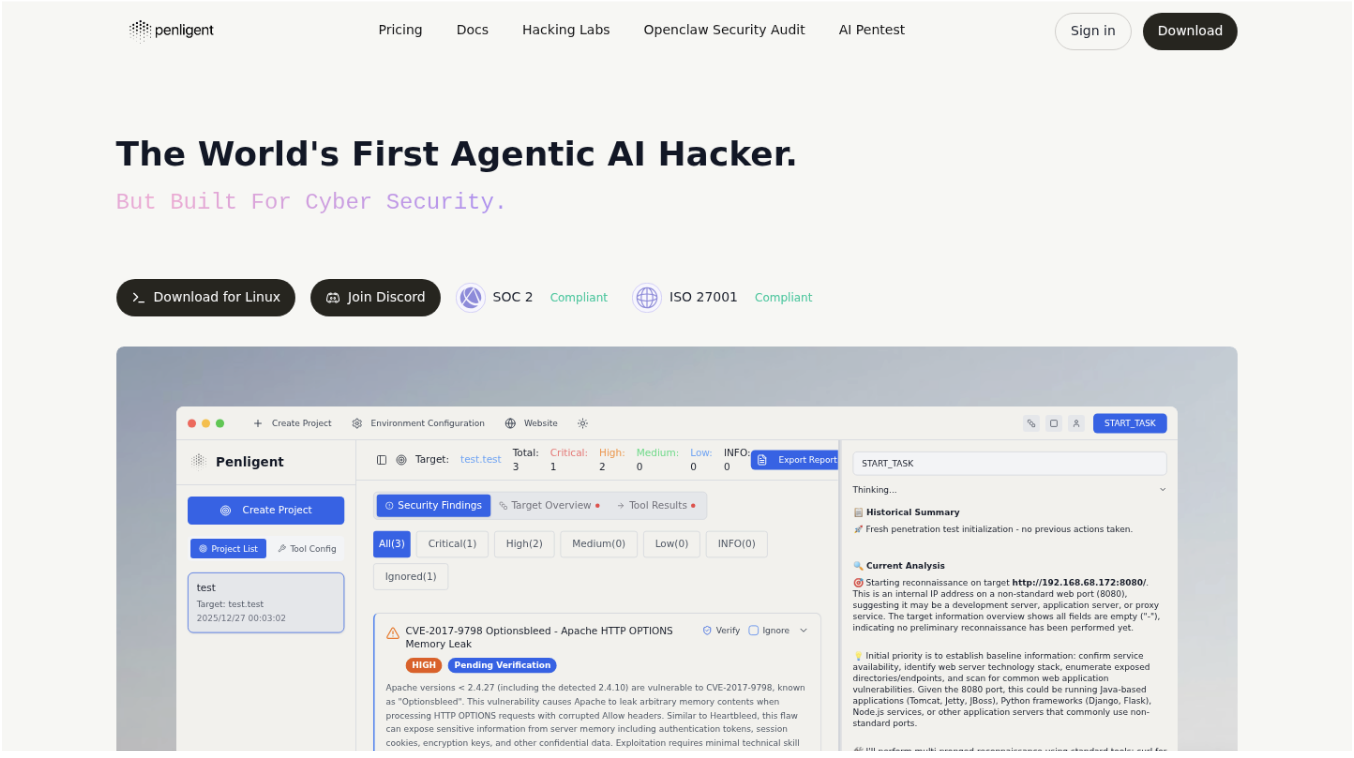
Penligent orchestrates more than 200 security tools through natural-language tasking, driving an assessment from asset discovery to report. Pricing is public, with a free tier and a Pro plan from $49.90 per month on a credit model.
- One prompt, many tools: it wires together Nmap, Metasploit, Burp Suite, and SQLMap end to end, then generates a proof of concept with one click.
- Human checkpoints in the loop: a person approves key decisions, and reports come out compliance-ready.
- Where maturity shows: the platform is new, with a thin set of enterprise-scale case studies, and its CLI-first workflow asks more of less technical users.
Choosing the best autonomous pentesting tools for a team that ships daily
The best autonomous pentesting tools share one trait: they prove a finding, then help you close it. For a team merging to production every day, the deciding factor is how far that help reaches into the workflow. NodeZero and Pentera bring network depth, while XBOW and Aikido push on web and API exploitation. Astra earns the top spot for engineering teams because its agents deliver code-level remediation guidance into the IDE through MCP while its validation process helps confirm findings before they reach developers. Today its autonomous testing spans web apps and APIs, and it strengthens the work of human pentesters instead of standing in for them. Astra’s State of Pentesting 2026 research counted a critical vulnerability every 48 seconds last year, and speed like that argues for testing on every deploy.
Choosing an autonomous pentesting tool: key questions
How do you add autonomous pentesting to a CI/CD pipeline?
Most platforms ship a plugin or an API call you drop into the pipeline, so a test triggers when code merges. Wire it into one service first to gauge how noisy it is before rolling wider. Set the run to gate a release, or let it report without blocking while the team tunes thresholds. Point results at the tracker your engineers already read, so a proven finding opens a ticket with the attack path attached. Begin on staging, then promote the check to production once you trust it.
How soon does an autonomous pentest return its first finding?
Often the same day. Agents get moving within minutes of a green light, so early results arrive in hours rather than the weeks a booked manual engagement takes to begin. Depth takes longer, since chaining a full attack path and validating it runs past the first hit. Treat any vendor’s speed multiple as a claim to test on a target like yours, and ask what the vendor counts as a finding. For a team shipping daily, that head start decides whether you catch a flaw this release or next year.
What is the difference between authenticated and black-box autonomous testing?
Black-box testing starts with no credentials and probes the surface an anonymous attacker sees. Authenticated testing signs in as one or more roles and reaches the business logic behind the login, where broken access control and IDOR live. A black-box-first pass exercises one login at a time, so role-to-role flaws like BOLA can hide until you supply an account per role. For real coverage, give the agents test accounts for each role you support. The login page hides most of the interesting bugs, so authenticated depth is where an autonomous pentest earns its keep.
Does autonomous pentesting run on-premises or only as SaaS?
Both models exist, and the right one follows your constraints. Most app-focused platforms run as SaaS, since the agents reach a web target over the internet the way an attacker would. A network engine that tests an internal estate needs a presence inside your network, so it ships a container or a virtual appliance you host. Regulated shops sometimes want the whole stack self-hosted. Ask where the agent executes, whether a self-hosted build exists, and how the vendor isolates one customer from another before you commit.
How do autonomous pentesting tools confirm that a fix worked?
The better tools retest. After you patch, a validation step re-runs the original exploit against the fixed code and confirms it no longer works, then closes the finding. Astra runs this as a separate validation agent, and it delivers the fix itself as a code-level prompt into the IDE through MCP.
Where do autonomous pentesting platforms store test data and results?
It varies by vendor, so read the data terms before a trial. Findings, proof-of-exploit captures, and any harvested credentials sit in the platform’s cloud tenant for most SaaS tools, while self-hosted deployments keep everything on your own infrastructure. Ask how long the vendor retains results, who on their side can read them, and whether you can export and purge on demand. For regulated data, confirm the region the storage sits in. Astra keeps findings in your dashboard with reproduction steps an auditor can replay, and its reports map to the frameworks your audit needs.
How does autonomous pentesting fit with an exposure management program?
Exposure management keeps a running inventory of your attack surface and ranks what sits most exposed. Autonomous pentesting takes the next step on the assets that matter, proving which exposures an attacker can reach and exploit. One tells you what’s open; the other tells you what’s breakable. Feed the exposure tool’s asset list into the pentest engine so testing follows real risk, then send proven findings back to set remediation priority. Astra runs continuous autonomous testing across web and API surfaces, so exposure data turns into validated proof instead of a longer worklist.
Does autonomous pentesting replace a bug bounty program?
No, the two cover different ground. A bug bounty rewards outside researchers who report what they stumble on, on their own timeline and against your live surface. Autonomous pentesting runs on your schedule, works through the surface in order, and hands you proof with reproduction steps on every deploy. Bounties still surface creative, one-off logic bugs that a program pays for after the fact. Run the agents for steady coverage between releases, and keep a bounty open for the odd case a researcher spots that no schedule would catch.