The market for anime-style character tools is crowded, but most creators aren’t actually looking for “more options.” They want fewer broken workflows.
If you’ve ever tried to build an original character (OC) across multiple images—different outfits, different angles, different moods—you’ve seen the same problem: the character drifts. Hair changes, face ratios shift, colors wander, and the “same” OC becomes a new person every generation.
OCMaker AI positions itself as a one-stop platform for creators who want to design anime characters, iterate quickly, and keep identity consistent across variations—without living inside a complicated node graph or stitching together five separate tools.
What OCMaker AI is trying to solve (and why it matters)
For most working creators, the goal isn’t just a single good image. It’s repeatability:
- A consistent OC you can post weekly
- A pose set you can reuse for thumbnails, panels, or character sheets
- A lightweight pipeline that doesn’t turn “one idea” into “three hours of cleanup”
That’s the real benchmark for OC tools in 2026: can you stay on-model long enough to build a series?
Platform overview: what you actually get
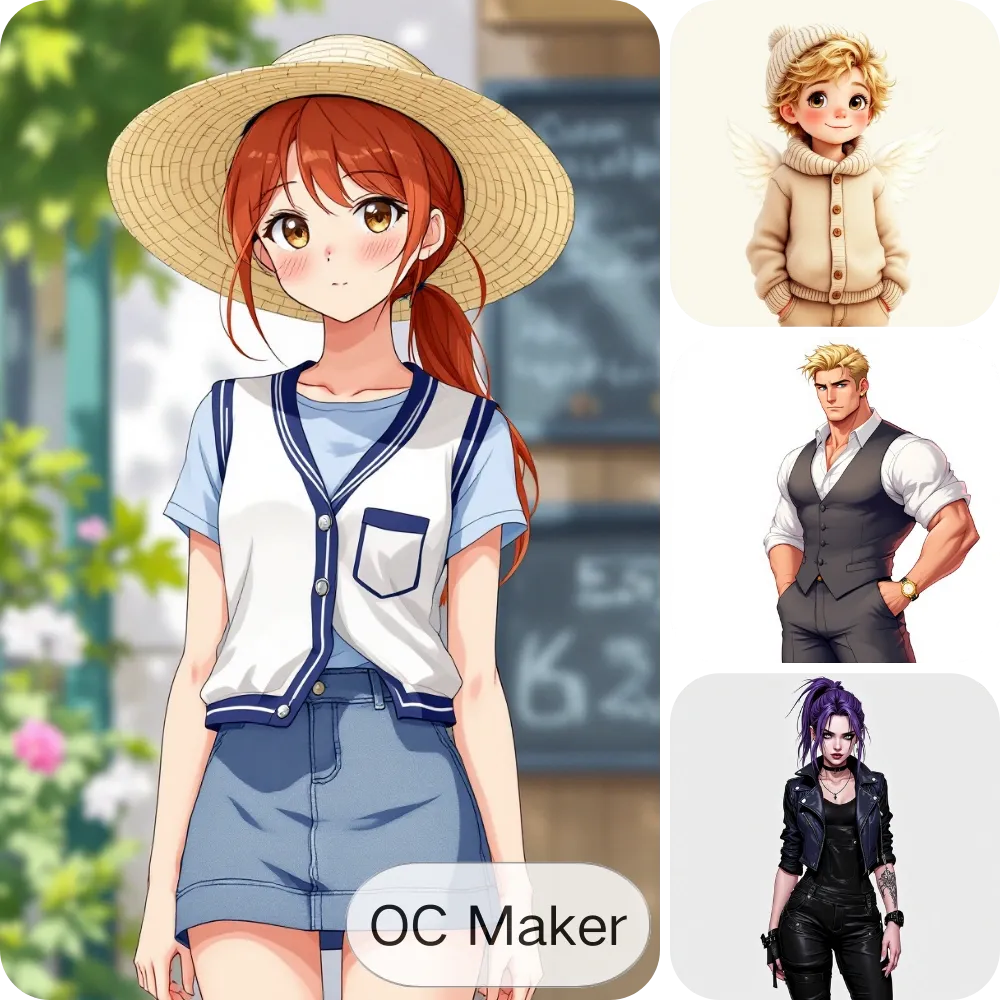
The easiest way to understand the platform is as a toolkit, not a single generator. On its homepage, OCMaker AI highlights core building blocks like text-to-image, inpainting/outpainting, character reference/consistency workflows, and video-related tools as part of a broader “one-stop” creation suite.
If you’re evaluating it as a creator, these are the practical buckets that matter:
- Concepting: generating a new OC from a prompt (or refining from a reference)
- Iteration: changing outfits, expressions, lighting, backgrounds
- Consistency: keeping the OC recognizable across changes
- Production: exporting clean assets you can actually use downstream
Once you look at it this way, it becomes clear who the platform is for: people shipping character content (not just experimenting).
Where OCMaker feels strongest: consistency-first workflows
The most convincing part of the product story is the focus on locked identity and controlled variations. You don’t need “infinite styles” if you can’t preserve your character’s face, palette, and proportions from one render to the next.
That’s why the product’s “pose” angle is worth attention—because posing is where most consistency systems fall apart first.
Here’s a simple way to map OCMaker AI’s value by creator type:
| Creator goal | What they need most | Why it’s hard elsewhere | Where OCMaker tends to fit |
| OC social series | Identity + quick variations | Drift across posts | Repeatable “same character” iterations |
| VTuber / avatar planning | Pose sets + expressions | Inconsistent face ratios | Pose-driven exploration |
| Manga / webtoon prep | Consistent angles + outfits | Off-model panels | “On-model” iteration mindset |
| Game / visual novel concepts | Multiple looks for one character | Style shifts between drafts | Fast ideation with continuity |
A closer look at pose control—the detail that can make or break the result
Pose control isn’t a “nice to have.” It’s how you turn a character into a usable asset library.
OCMaker’s pose page explicitly frames the tool around character-locked consistency (keeping identity stable across new poses/outfits) and the ability to generate a wide variety of poses while staying recognizable. It also describes saving results to a pose library for reuse.
If you want the most direct entry point to that workflow, start with the OC pose generator and evaluate it like a production tool, not a demo.
What you can actually test in 15 minutes
Instead of generating random “cool art,” test like you’re building an OC pack:
- Generate (or upload) one OC identity you actually like.
- Run 3 poses: neutral standing, dynamic action, and a low-angle/cinematic shot.
- Change one variable at a time: outfit or expression or lighting—never all three at once.
- Check for the “silent failures”: hands, face ratio drift, inconsistent bangs/eye shape, palette shifts.
That process tells you more than 50 one-off generations.
Better results, fewer prompts: practical workflow tips
Most consistency problems are prompt problems—just not in the way people assume. The fix is usually constraints, not more adjectives.
- Lock identity with a short “character card.” Keep it stable: hair color + hairstyle + eye color + one signature detail.
- Separate identity from scene. Put background/camera/lighting in a second sentence so it doesn’t mutate the face.
- Use “negative intent” in plain English. Example: “No face changes, no different hairstyle, no age shift.”
- Iterate like a designer. Change one thing per generation. You’ll learn what the model respects.
Trust, licensing, and the “don’t skip this” step
If you’re using any AI art tool for publishing or monetization, treat it like software in your stack:
- Read the platform’s terms and licensing notes before commercial use decisions.
- Avoid uploading sensitive or private images unless you’re comfortable with the stated data handling.
- For client work, keep a simple paper trail: prompts used, dates, and which outputs were delivered.
This isn’t about paranoia—it’s about professionalism.
Pros and Cons (the honest version)
Pros
- Strong product direction around repeatability and identity consistency
- Clear “suite” approach: creation + refinement + pose/variation workflows
- Pose-first mindset fits real creator needs (thumbnails, references, series assets)
Cons
- Like most generators, results can still fail on hands, extreme angles, and high-motion anatomy
- You’ll get the best outputs only if you adopt a controlled workflow (not random prompting)
- If you only want “one perfect image,” the platform may feel like more structure than you need
Final verdict
If your goal is to build an OC you can reuse—across poses, outfits, and content formats—OCMaker AI is worth a serious look. Its positioning is less about novelty and more about a creator-friendly pipeline: generate, refine, stay consistent, repeat.
The key is to evaluate it the way you’d evaluate any production tool: consistency over time, not one lucky generation.