The video game industry has long operated under a blockade of capital and technical complexity. To build a “AAA” title, a high-budget, high-profile game, studios require hundreds of millions of dollars, armies of specialized 3D artists, and years of grueling development time. It is an industry of walled gardens, where only the wealthiest entities can afford to build immersive worlds.
Moonlake AI, a San Francisco-based applied research lab, intends to dismantle those walls.
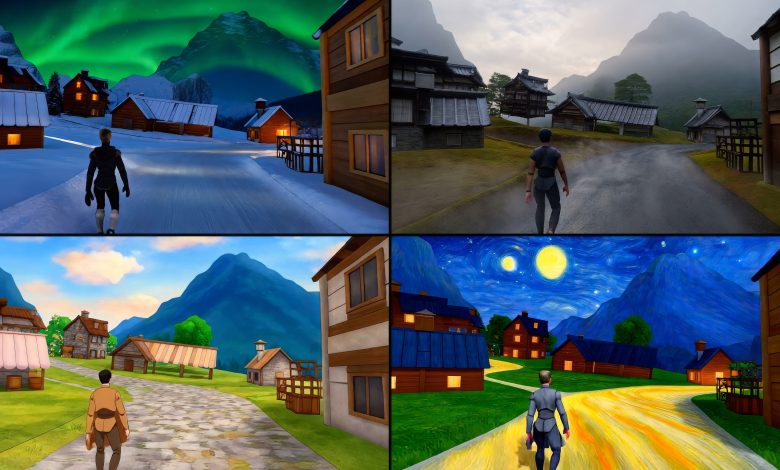
Today, the company unveiled Reverie, its Generative Game Engine (GGE), a system designed to build interactive worlds 100x faster than current standards. Backed by a $28 million seed round from heavyweights like AIX Ventures, Threshold Ventures, and Nvidia Ventures, Moonlake isn’t just trying to speed up development; they are attempting to solve the biggest hurdle in generative AI: consistency. Watch how it works here: https://www.youtube.com/watch?v=zMPX5YlfirQ
The “Hollywood Moat”
For decades, game development has paralleled the old Hollywood studio system: high barriers to entry and massive centralized control.
“Before handheld video cameras, filmmaking was only reserved for well-funded Hollywood studios,” explains Fan Yun Sun, co-founder of Moonlake AI. “The gaming world is still running off that model of extremely high moats. This new model brings us one step closer to giving anyone the tools needed to create their own world or game.”
Currently, creating a responsive environment is a logistical nightmare. If a developer wants a wall to crumble realistically when hit, it requires complex physics engines, 3D modeling, and rigid coding. If they want to change the weather, it often requires re-rendering entire scenes. This creates a creative bottleneck where worlds are either beautiful but static, or dynamic but visually simplistic.
Solving the “Drift” Problem
We have seen an explosion of generative video models recently, but they all suffer from a fatal flaw for gaming: they hallucinate. In a video generation model, objects might shift, morph, or vanish between frames. In a passive video, this is a glitch; in an interactive game, it breaks the experience entirely.
Moonlake claims their GGE is the first programmable world model for real-time interactive content. Unlike standard video-only generation, Moonlake’s engine is conditioned on structural 3D signals. This allows the system to “remember” the state of the world.
If a player destroys an object, it stays destroyed. If the environment shifts due to story elements, it doesn’t snap back to its original form a few seconds later.
“The missing piece in generative worlds is control,” says Sharon Lee, co-founder of Moonlake AI. “Our new GGE will allow creators to specify what changes, why it changes, and how long it persists, so the world feels authored, not random.”
Empowering the Non-Technical Creator
The ultimate promise of Moonlake’s technology is democratization. By acting as a layer on top of existing interactive experiences, the GGE allows creators to “author” complex behaviors—such as elemental damage or weather shifts—without needing deep coding knowledge or a degree in 3D topology.
This has implications far beyond entertainment. A persistent, physically consistent generative world is the “Holy Grail” for:
- Robotics: Training robots in simulated environments that react unpredictably but realistically.
- Virtual Reality: Creating immersive spaces that adapt to the user in real-time.
- AI Training: Providing dynamic playgrounds for reinforcement learning agents.
The Pedigree Behind the Tech
The technology is ambitious, but the team suggests they have the technical horsepower to back it up. Moonlake AI is staffed by a cadre of researchers from Stanford’s AI Lab.
With significant backing from AIX Ventures, Threshold Ventures, and Nvidia Ventures, the venture arm of the company powering the global AI infrastructure, Moonlake is well-positioned to access the compute and strategic partnerships necessary to bring this to market.
Moonlake AI’s Generative Game Engine is set to open its doors for beta access in Q1 2026.
Moonlake is also hosting a game hackathon with a16z and The AI Collective on Wednesday January 14. The hackathon will bring together builders, gamers, and world-crafters together for a day of interactive world creation with its first ever generative game engine.
Winning projects will be debuted on The Dome, a 100-ft immersive park rising in San Jose, an arena where players can step inside Moonlake-built interactive worlds at unprecedented scale. Interested developers can sign up here: https://partiful.com/e/JbKr33S4uNPY2zHuiR2I