As tech companies and VCs pour billions into “Physical AI”, one company stands out as the one who’s cracked the code: Waymo.
The reason isn’t just the millions of miles driven or the multi-billion-dollar parent company; it’s the flywheel. Waymo has famously perfected an “outer learning loop”, a sophisticated internal Critic system that automatically identifies suboptimal driving moments in the real world and instantly converts them into training data for its next model. For years, this has been the ultimate technical moat: if your car makes a mistake, it never makes that same mistake again.
But for the thousands of other robotics and AV startups, that loop is broken. They have the data, but they lack the proprietary infrastructure to actually use it.
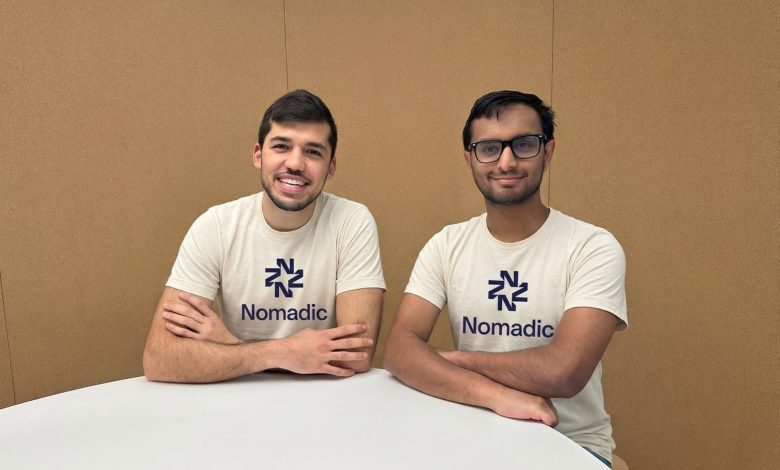
Nomadic, a San Francisco-based startup emerging from stealth today with $8.4 million in seed funding, wants to democratize that secret sauce. Led by TQ Ventures, along with Pear VC, Google’s Jeff Dean and executives from OpenAI, Nomadic is building the infrastructure to turn raw video into a self-correcting feedback loop for the rest of the industry.
Bridging the Infrastructure Gap
“Teams are sitting on a goldmine of video and sensor data, but most of it never becomes usable training signal,” says Mustafa Bal, co-founder and CEO of Nomadic.
The problem is what engineers call the “unwatched video” bottleneck. A robotics fleet might collect 10,000 hours of footage a week, but only 1% of it contains the rare edge cases. Without a Waymo-sized army of engineers and custom internal tools, most of that data just sits in a cold storage grave.
Nomadic’s platform acts as the visual data engine that analyzes massive video datasets simultaneously to automatically flag failures, search for patterns across thousands of hours of footage, and crucially structure that data so it’s ready to be fed back into a training model immediately.
Deep AI Pedigree
The market for Physical AI is getting crowded in 2026, but Nomadic’s founders bring the kind of heavy-duty optimization background that suggests they can actually handle the petabyte-scale data loads they’re promising.
Bal, a Harvard CS graduate, was a core contributor to Microsoft’s DeepSpeed, the open-source library that essentially unlocked the ability to train the world’s largest LLMs. His co-founder and CTO, Varun Krishnan, is a U.S. Chess Master and optimization researcher who cut his teeth at Snowflake.
They aren’t just building a labeling tool; they are building a high-performance spatial intelligence layer designed to handle multi-sensor uploads (LiDAR, cameras, and logs) in a way that feels native to modern AI workflows.
Democratizing the Loop
By landing early customers like Zoox, Mitsubishi Electric, and Zendar, Nomadic is proving that there is a massive appetite for these features.
“Physical AI is going to be won by the teams that can learn fastest from the real world,” says Andrew Marks, Co-founding Partner of TQ Ventures.
In 2026, as humanoids move into factories and autonomous delivery enters its next phase of scaling, the technical “haves” and “have-nots” will be separated by the speed of their feedback loops. If Nomadic can successfully offer that loop to any team with a camera and a dream, the gap between the tech giants and the rest of the robotics world might finally start to close.
Nomadic says the funds will go toward scaling its engineering team and expanding its natural-language search capabilities.
Robotics and AV companies can learn more at: https://www.nomadicai.com/.