The rise of vibe coding has spurred a spike in app creation, flooding the market and app stores with more subscription apps than ever before.
But while the mobile app economy is booming, new data from RevenueCat, a company that manages $1 billion per month in app subscription transactions, representing approximately 20% of all subscription app revenue globally, suggests that success is becoming increasingly difficult to come by.
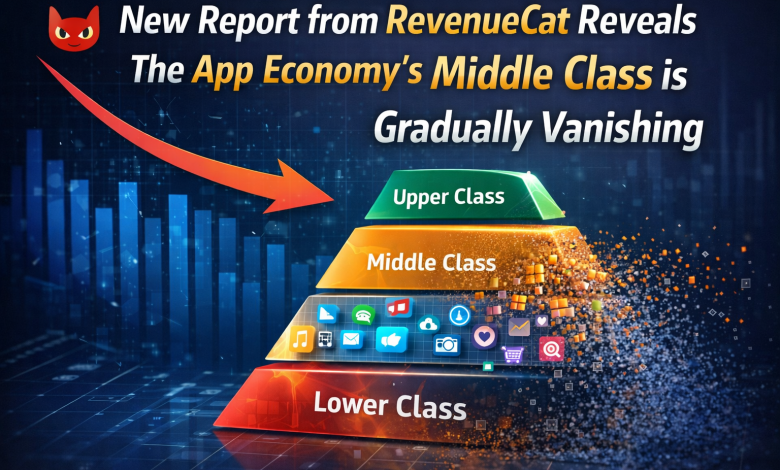
According to Part 1 of RevenueCat’s 2026 State of Subscription Apps report, which analyzed more than 115,000 apps generating over $16 billion in subscription revenue, there is a widening gap in the app industry between top performers and everyone else. In many ways, the app ecosystem is beginning to resemble a broader economic phenomenon: the disappearance of the middle class.
The report shows that the app economy rich are getting richer, with the top 25% of subscription apps growing revenue 80% year over year (YOY). This rate of scale eclipses the moderate growth (~5%) of apps in the middle ground and creates an increasingly difficult to surmount divide between the top and bottom with the bottom 25% of apps shrinking by 33%.
This means as millions of apps compete for attention across Apple’s App Store, Google Play and other stores, they are facing an increasingly cut throat market. Already, even making it to the vanishing middle ground is aspirational, with the share of newly launched apps reaching $1,000 in monthly recurring revenue within their first two years declining from 19% last year to 17% this year.
In order for subscription apps – whether newly launched or market veterans – to avoid dying by default, they need to concentrate on more than creative ideas and exceptional features. Instead, the key to success lies in a focus on the behind-the-scenes business mechanics that truly pull revenue levers.
App creators shouldn’t be afraid of charging for features.
It isn’t a radical line of thought to assume that the best way to ease users into your app experience is to let them trial features for free. For years, the freemium model dominated mobile apps. Users could download a product for free, explore its basic features, and upgrade later if they found value.
But RevenueCat’s report finds that giving a free ride actually equates to leaving money on the table.
Apps that use hard paywalls—requiring a subscription before the product can be fully accessed—convert about five times more users initially than freemium apps. Median conversion rates for hard paywalls are roughly 10.7 percent, compared with 2.1 percent for freemium models.
And, those hard paywalled apps retain their higher user base at the same rate as freemium apps maintain theirs. After about a year the retention rates between the two models are nearly identical.
Higher-priced apps see higher realized lifetime value (RLTV) in the short term–but not necessarily long-term loyalty.
App growth strategy isn’t always a one-size fits all. Instead, the report finds that different pricing strategies come with different trade offs.
While high-priced apps achieve nearly 6x the RLTV of lower priced apps in the first year ($62.19 per user versus $10.69), in the long term, users tend to remain loyal to lower priced apps more often. The report reveals that low priced apps see a 36% median retention rate compared to high priced apps’ 23% rate.
This remains true across both monthly and weekly plan durations, with low priced apps seeing a 10.8% monthly retention rate and a 1.3% weekly retention rate compared to high priced apps’ 6.1% and 1%.
It depends on the app teams’ goals whether revenue per user or user retention is more important, depending on their decided cost structure and industry dynamics. At the end of the day app success isn’t based solely on what competition is doing, it’s based on what’s best for each individual app’s unique base.
The new reality of the app economy.
With the middle hollowing out, apps who fail to scale are increasingly in danger of becoming obsolete.
For developers and growth executives, the lesson is clear. Success in the subscription economy no longer comes from simply launching an app and hoping users stick around. It requires a built out monetization strategy, designed for each apps’ unique market and users.