The inaugural Hatch “State of Sleep” report uncovers the snooze habits, bedtime routines, and regional quirks shaping how Americans wake up and wind-down, revealing a simple truth: we’ve mastered mornings, but not bedtime.
PALO ALTO, Calif., March 9, 2026 /PRNewswire/ — What time did you actually go to bed last night? If the answer is somewhere between “when I meant to” and “much later than that,” you’re in very good company. Today, Hatch, the sleep-wellness company behind the beloved Restore smart sleep clock, released its inaugural “State of Sleep” report — a wide-ranging look at the real bedtime habits, morning rituals, and sleep behaviors revealing how Americans actually wind-down and wake up.
The report arrives at a moment when sleep has become one of the fastest-growing segments within the wellness space, expanding at a 12.6% annual growth rate from 2019 to 2024*, yet 37% of U.S. adults still don’t get the recommended seven hours of sleep per night**. Hatch created the “State of Sleep” report to better understand how modern life is shaping real-world sleep behavior, and what habits actually help people rest more consistently.
Drawn from millions of anonymized usage patterns on Hatch Restore devices over the past year, the report reveals a striking national pattern: Americans are highly disciplined about waking up, but surprisingly inconsistent about going to bed.
The Bedtime Gap: We Plan Our Mornings, But Not Our Nights
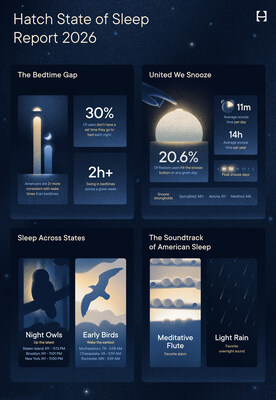
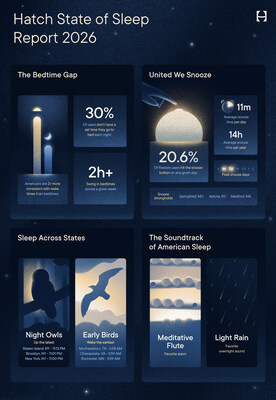
The report’s most telling find is the growing gap between structured mornings and unstructured evenings. Americans are remarkably regimented about their alarm times, but when it comes to actually getting into bed, all bets are off.
Americans are:
- 2× more consistent with wake times than bedtimes
- 30.2% of US Restore users have no consistent bedtime
- Nearly half (43.2%) have bedtimes that swing by 2+ hours across a given week
The pattern makes intuitive sense: we wake up when we have to, but we go to sleep when we get around to it. The opportunity, as Hatch sees it, is helping people close that gap by building a bedtime ritual that’s as consistent as their morning alarm.
“The data shows something we see every day: Americans are incredibly good at planning their mornings, but bedtime is still the first thing that gets sacrificed,” said Ann Crady Weiss, co-founder and CEO of Hatch. “We live in a culture that tells us when to start working, when to answer messages, and when to be available, but almost never when we’re allowed to stop. Sleep isn’t a discipline problem. It’s a permission problem. When people create a real wind-down ritual, mornings get easier because the nervous system finally has a chance to power down.”
United We Snooze
If there’s one habit that unites the country, it’s the snooze button:
- Roughly 1 in 5 (20.6%) Restore users hit the snooze button on any given day
- The average user delays their alarm 11 minutes per alarm day
- That adds up to ~13.8 hours of snoozing per year — almost two full workdays
- Monday and Tuesday tie for America’s peak snooze day
Some cities don’t just hit snooze — they commit to it. Springfield, MO leads the nation in daily snoozing, with nearly 30% of alarms getting a second (or third) tap before the day officially begins. Astoria, NY and Medford, MA are right behind, with Cambridge, MA and Somerville, MA also landing near the top making Greater Boston one of America’s true snooze strongholds.
From Midwest metros to Northeast college hubs and commuter-heavy suburbs, the pattern is clear: even the most ambitious cities can’t resist “just a few more minutes.” The alarm may ring, but in these cities, it rarely wins on the first try.
|
1. Springfield, MO 2 .Astoria, NY 3 . Medford, MA 4. Cambridge, MA 5. Somerville, MA
|
6. Fort Collins, CO 7. Tallahassee, FL 8. Fort Wayne, IN 9. Chandler, AZ 10. Annapolis, MD
|
Importantly, sleep experts note that snoozing itself isn’t inherently bad. It’s often a natural biological response to waking during lighter stages of sleep — especially when bedtime is inconsistent.
Sleep Across The States: A Nation of Early Birds and Night Owls
Beyond the snooze button, Hatch data shows that where you live shapes when you wake up — and when you finally call it a night.
Earliest to Rise: Tennessee Leads America’s 5 AM Club
While the national average alarm rings at 6:30 AM, some cities are part of the 5 AM club. Murfreesboro, TN leads the nation with a 5:58 AM average wake up – 32 minutes ahead of the rest of the country – just edging out Chesapeake, VA and Rochester, MN who wake up at 5:59 AM. The pattern suggests that in military-adjacent and healthcare-driven communities, early mornings aren’t just common, they’re cultural. From Colorado Springs and Chandler to Phoenix and Aurora, Western and Sun Belt cities show up prominently among the earliest risers. In these cities, the day starts early and the alarm doesn’t wait.
|
|
|
Last to Bed: New York is the Nation’s Night Owl Capital
If the early risers are spread across the country, the night owls are firmly rooted in New York. Staten Island ranks last-to-bed at 11:13 PM, followed by Brooklyn (11:01 PM) and New York, NY (11:00 PM) – three NYC boroughs in the top three. The legend holds: the city that never sleeps is statistically the last to even try. Close behind is a cluster of college towns, including Athens, GA (10:59 PM), Chapel Hill, NC (10:58 PM), and College Station, TX (10:56 PM) – places where academic calendars and late-night study sessions shape the rhythm of the evening. Washington, D.C. (10:55 PM) and Miami, FL (10:53 PM) round out the top ten, reinforcing a broader pattern: in cities fueled by ambition, academics, and nightlife, the lights stay on longer. The average wind down time is 10:37 PM.
|
|
|
The Soundtrack of American Sleep
When it comes to alarms and overnight sound, two tracks stand in a category of their own. The most popular alarm in the U.S. — by a wide margin — is “Meditative Flute,” a whimsical blend of flute and gentle strings. On the other end of the night, “Light Rain” dominates as the nation’s top sleep sound. In both cases, the #1 track has more than double the reach of the runner-up — clear favorites in a country that otherwise shows wide variation in sleep behavior.
Bedtime itself is more eclectic. Unlike alarms and sleep sounds, unwind preferences are more evenly distributed, suggesting that winding down is both personal and exploratory. The top Unwind Channel nationwide is “Meditations for a Racing Mind,” designed to calm overactive thoughts before sleep. Other leading channels include immersive “Reading Soundscapes” and “Sunset Sound Baths,” a warm blend of singing bowls and layered textures.
Turning Insight Into Action
In response to the findings from the inaugural “State of Sleep” report, Hatch is making several habit-building tools more accessible to all Restore users beginning March 9.
Recognizing that consistency — not perfection — is the biggest barrier to better sleep, Hatch is unlocking a set of features previously available only through Hatch+:
- Cue to Unwind – customizable light and sound reminders designed to signal bedtime and help build a consistent wind-down ritual — a gentle cue that the day is done
- Goodnight, Phone – a built-in accountability feature that encourages users to set a phone-down goal, receive a heads-up before bedtime, and track screen-free wins over time
- For You Tab – an in-app destination featuring weekly content recommendations, sleep insights, and guided tips based on user habits
“What the data reinforced for us is that most people don’t need more information about sleep — they need support building simple, repeatable routines,” said Ann Crady Weiss. “And those routines have to feel good enough to come back to night after night. We want to remove friction wherever we can and help make winding down feel natural and better yet, enjoyable.”
The Takeaway
Americans are navigating sleep the same way they navigate most things: doing their best in a culture that rarely slows down.
The Hatch “State of Sleep” report makes one thing clear: the real opportunity isn’t more discipline in the morning — it’s more intention at night. We plan our mornings, but we rarely plan our rest. Closing the nation’s growing “Bedtime Gap” may be less about willpower and more about building a consistent wind-down routine that gives the body permission to power down.
Methodology: Data is based on anonymized usage patterns from Hatch Restore devices in the United States over a 12-month period. Geographic analysis is limited to U.S. cities with 100 or more active devices. Bedtime is defined as the start of a user’s bed routine. All data is aggregated and anonymized.
*According to the 2025 Global Wellness Economy Monitor
**According to 2022 data from the Centers for Disease Control and Prevention.

 View original content to download multimedia:https://www.prnewswire.com/news-releases/new-hatch-sleep-report-finds-america-needs-to-go-to-bed-302707510.html
SOURCE Hatch Baby, Inc.