

LEMONT, Ill.–(BUSINESS WIRE)–Every second, scientific experiments produce a flood of data — so much that transmitting and analyzing it can slow down even the most advanced research. To help scientists better manage this data deluge, researchers at the U.S. Department of Energy’s (DOE) Argonne National Laboratory have developed a new computer chip that rapidly compresses and processes the huge amounts of data generated by advanced X-ray detectors, like those at the Advanced Photon Source (APS), a DOE Office of Science user facility at Argonne. By compressing data right at the source, this technology makes experiments faster, more efficient and more insightful than ever.
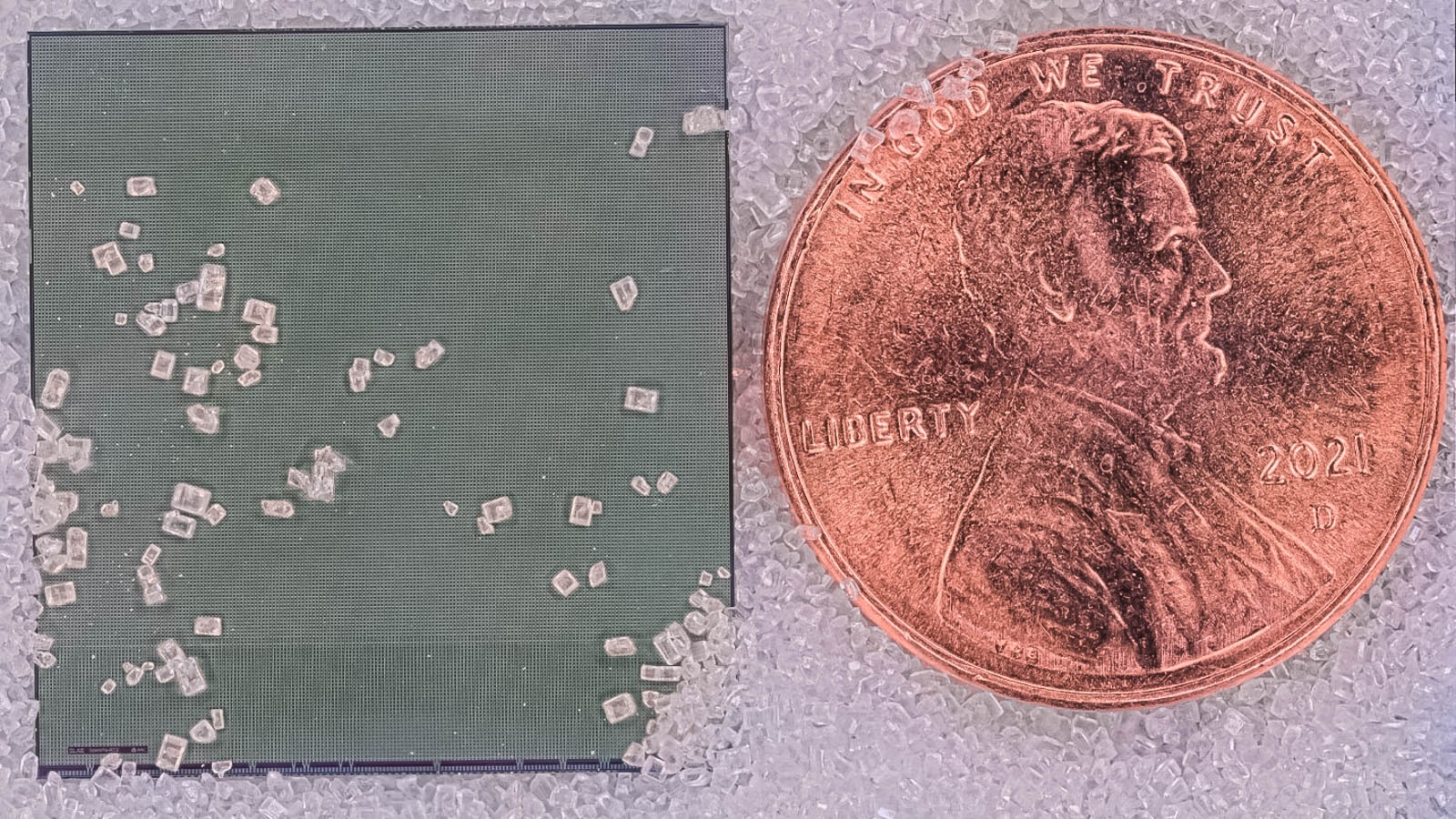

When X-rays or electrons hit a sample, detectors capture the resulting signals — much like a digital camera captures light to produce photos. These signals are converted into electrical pulses and then digitized into numbers that computers can process. But with modern detectors, the amount of data generated is enormous. This can overwhelm computer systems and slow down research.
“Our goal is to bring more computing right where the data is generated,” said physicist Antonino Miceli of Argonne and the University of Chicago. “In our earlier work, we showed how advanced mathematical techniques could shrink data while keeping the important parts for analysis. Now, using new chip technology and improvements in microelectronics, we’ve built a chip that puts the math right inside the detector.”
Building on their work, the team has now implemented a fast, compact matrix-math processor into the detector chip itself. Instead of sending every pixel off the instrument, the chip distills each image into a compact set of numbers that preserves the most important features for scientists. The output is always the same size and streams in real time, making it easier to manage and send.
Tests and design studies show this on-chip approach can reduce data by about 100 to 200 times, while running at speeds of up to a million frames per second. That means less data to move, lower power use and fewer cables, making experiments cheaper, more efficient and easier to scale up.
By combining smart data compression with fast hardware, scientists can get answers in real time and adjust their experiments right away. This helps speed up the cycle of discovery and makes the most of every minute at the beamline. The Argonne team is now working to move this chip from the design stage to large-scale fabrication and use in real experiments.
The results of this research were published in the Journal of Instrumentation.
Contacts
Christopher J. Kramer
Head of External Communications
Argonne National Laboratory
Office: 630.252.5580
Email: [email protected]
