For decades, the video game industry has operated behind a towering financial wall: bringing rich, interactive 3D worlds to life has required millions of dollars and years of grueling development.
This has historically only been possible by assembling armies of specialized engineers, 3D artists, and riggers. Even building a basic, playable prototype could drain a small indie studio’s entire budget before a single player ever had the chance to test the game.
Because of these prohibitive costs and massive time sinks, independent developers and passionate prosumers have often been forced to scale back their ambitions. The industry’s most innovative ideas are frequently left on the cutting room floor simply because the solo creator couldn’t afford the years of runway required to build them in legacy engines.
Now, a frontier research lab is tearing down those walls, offering a lifeline to creators who have the vision but lack the traditional studio budget.
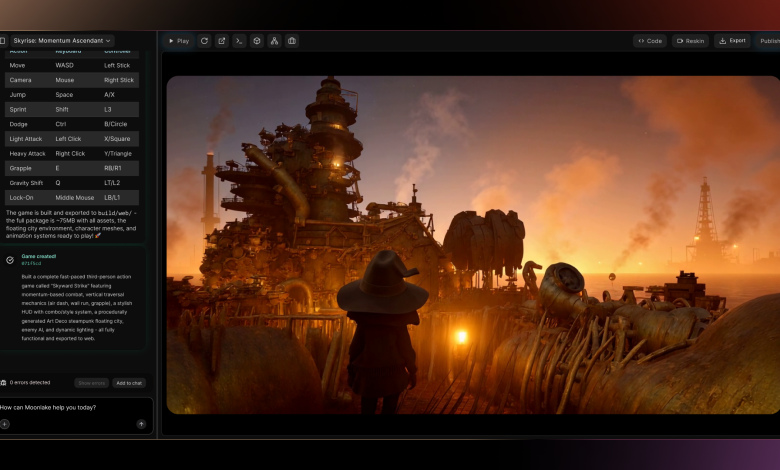
Moonlake AI, a heavily backed startup specializing in multimodal reasoning models, announced today the open beta launch of its first world-modeling agent. Powered by the company’s Generative Game Engine, the AI agent allows creators to build interactive, playable worlds up to 100x faster and cheaper than traditional methods.
Solving the Indie Developer’s Biggest Hurdle: Time
Even with recent advancements in generative AI, the day-to-day reality of indie game development remains a grueling marathon. Solo developers and small teams spend agonizing months modeling environments, rendering assets, and scripting basic behaviors. By the time they have a playable prototype to test whether the core gameplay loop is actually fun, they are often burnt out or out of funding.
“Building games is fundamentally a product-market fit problem,” explains Fan-Yun Sun, CEO of Moonlake AI. “Developers and creators constantly wonder whether players will enjoy what took them months or years of effort to make. Moonlake’s agent changes that dynamic by enabling ideas to come to life in minutes and, in one click, get feedback from real players.”
By collapsing the timeline from concept to playable prototype, Moonlake allows indie developers to rapidly iterate and test their ideas, a luxury previously reserved only for well-funded studios.
The Holy Grail: Persistent Control Without the Code
While early generative AI models could create stunning static concept art or short video clips, they historically failed at the core requirement of a video game: interactivity.
This is because diffusion models can create objects, but the underlying gaming engine doesn’t understand what the purpose or function of that object is.
Moonlake solves this coherence problem through a multimodal reasoning stack that acts as an autonomous agent. Instead of simply generating video frames, Moonlake creates stable, programmable rules that dictate how environments respond to user inputs.
“The missing piece in world modeling is control,” says Sharon Lee, Co-founder of Moonlake AI. “We built this so creators can define what changes, why it changes, and how long it persists, so the world feels designed, not random.”
For indie developers fiercely protective of their artistic vision, this element of control is vital. It allows them to maintain creative direction while offloading the tedious, manual labor of world-building to the AI.
Investors recognize this as a foundational shift. Chris Manning, General Partner at AIX Ventures and a Professor of Machine Learning at Stanford University, notes, “The bottleneck in digital creation has always been the linear relationship between world complexity and manual labor. Moonlake’s programmable world models break this scaling law, achieving a 100x gain in production efficiency by moving the heavy lifting into the model’s inference layer.”
The Convergence of Game Building and Game Playing
By making game building as easy as talking to a chatbot, Moonlake is blurring the lines between video game development and playing.
The company believes prosumers and early adopters will find more enjoyment from the video game creation process as they will ultimately playing the final product.
One alpha user noted the stark contrast in setup times: “Setting up a VR project used to take me hours; Moonlake did it in two minutes. It felt like magic. This is rocket fuel for people like me. It’s going to 10x my workflow. Unreal and Unity are not fun to use. With Moonlake, I had fun.”
Empowering the Next Generation of Creators
Having just surpassed 10,000 users on its waitlist, Moonlake is now opening its doors. While the waitlist includes developers from giants like EA, Sony, and Microsoft, the most profound impact of this technology will undoubtedly be felt by the solo developers, small indie teams, and hobbyists who can finally punch far above their weight class.
To ensure server stability, Moonlake is gating its beta rollout, accepting 100 users per day in cohorts. But perhaps the most disruptive aspect of Moonlake’s launch is its pricing. Operating on a highly accessible SaaS model, subscriptions start at just $15 per month, scaling based on usage.
At that price point, the technology isn’t just a tool for established studios trying to cut costs; it is a lifeline for the bedroom coder, the visionary artist, and the indie team trying to build the next breakout hit. By arming anyone with the output capabilities of an entire game studio, Moonlake isn’t just changing how games are made, they are radically expanding who gets to make them.
Moonlake also noted that it will have a marketplace for creators to share the worlds they’ve built, which it believes will become more valuable as more and more users build on its platform.
Creators can request access to the beta at https://www.moonlakeai.com/.