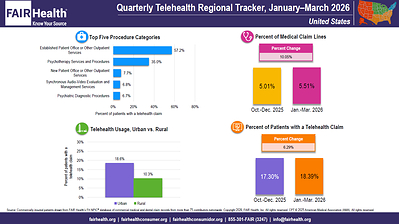
NEW YORK, June 15, 2026 /PRNewswire/ — With today’s release of first quarter 2026 telehealth data (January-March), FAIR Health launches its Quarterly Telehealth Regional Tracker, the successor to its Monthly Telehealth Regional Tracker. A free, interactive map of the US census regions allows the user to view an infographic on telehealth in a specific quarter in the nation as a whole or in individual regions. The charts in the infographics include the top five diagnostic categories by age group, percent of medical claim lines, percent of patients with a telehealth claim, urban versus rural telehealth usage and the top five procedure categories. The data represent the commercially insured population, excluding Medicare Fee-for-Service, Medicare Advantage and Medicaid.
Among the key findings for telehealth in the first quarter of 2026:
Top Five Diagnostic Categories by Age Group
Mental health conditions constituted the top diagnostic category nationally and in every region, both overall and in every age group. This diagnostic category, however, was lowest in the youngest age group (0-9) and oldest age group (65 and older). For example, at the national level, the overall share of patients with a telehealth claim for a mental health condition was 52.1 percent, but the share for children 0-9 was 26.9 percent and the share for adults 65 and older was 22.0 percent.
Overall, overweight and obesity ranked third nationally and in the Midwest and Northeast, and fifth in the South and West. At the national level, overweight and obesity ranked in the top five in three age groups: 19-30, 31-40 and 41-50.
Percent of Medical Claim Lines
Telehealth utilization as measured by percent of medical claim lines1 increased nationally and in all four regions from the fourth quarter of 2025 (October-December) to the first quarter of 2026. Nationally, the relative increase was 10.1 percent, from 5.01 percent of medical claim lines in the fourth quarter to 5.51 percent in the first quarter. The relative increase was 12.0 percent in the Midwest, 11.8 percent in the Northeast, 9.0 percent in the South and 8.1 percent in the West.
Percent of Patients with a Telehealth Claim
The percentage of patients with a telehealth claim also increased nationally and in all four regions from the fourth quarter of 2025 to the first quarter of 2026. Nationally, that percentage increased from 17.3 percent in the fourth quarter to 18.4 percent in the first quarter, a 6.3 percent rise. The largest relative increase was in the Northeast, at 7.3 percent; in the Midwest, it was 6.8 percent; in the South, it was 5.9 percent; and in the West, it was 4.7 percent.
Urban Versus Rural
Telehealth utilization measured as a percentage of patients with a telehealth claim was higher in urban than rural areas nationally and in every region.2 Nationally, 18.6 percent of patients in urban areas had a telehealth claim, compared to 10.3 percent in rural areas. However, national growth from the fourth quarter of 2025 to the first quarter of 2026 was greater in rural areas (7.8 percent) than in urban areas (6.2 percent).
Top Five Procedure Categories
Established patient office or other outpatient services ranked as the number one procedure category nationally and in every region. Psychotherapy services and procedures ranked as the number two procedure category nationally and in every region.
For the Quarterly Telehealth Regional Tracker, click here.
Follow us on X @FAIRHealth
About FAIR Health
FAIR Health’s mission is to supply objective, unbiased information for all stakeholders to improve healthcare quality, access and affordability. It holds the nation’s largest collection of commercial healthcare claims data, which is growing at a rate of more than four billion claim records a year. A national Qualified Entity certified by CMS, FAIR Health also receives all claims for individuals enrolled in traditional Medicare Parts A, B and D. As a testament to its reliability and objectivity, FAIR Health’s data products—including pricing benchmarks and custom analytics—are widely used by commercial insurers and self-insurers, providers, hospitals and healthcare systems, government, researchers and more. FAIR Health has been designated an official data source for state health programs, including workers’ compensation and personal injury protection (PIP) programs, and surprise billing laws that protect consumers. FAIR Health’s free consumer website and mobile app, available in English and Spanish, enable consumers to estimate and plan for their healthcare expenses and offer a rich educational platform on health insurance. The website has been honored by the White House Summit on Smart Disclosure, the Agency for Healthcare Research and Quality (AHRQ), URAC, the eHealthcare Leadership Awards, appPicker, Employee Benefit News and Kiplinger’s Personal Finance. FAIR Health is a national, 501(c)(3) nonprofit organization. For more information on FAIR Health, visit fairhealth.org.
1 A claim line is an individual service or procedure listed on an insurance claim.
2 Each telehealth service was attributed to a rural/urban designation in a region based on the patient’s medical service area, which FAIR Health determines based on the unique geographical pattern of services utilized by the patient.
Contact:
Rachel Kent
Executive Director of Communications and Marketing
FAIR Health
646-396-0795
[email protected]
 View original content to download multimedia:https://www.prnewswire.com/news-releases/mental-health-conditions-the-top-ranking-telehealth-diagnostic-category-in-every-age-group-in-first-quarter-2026-302800084.html
SOURCE FAIR Health