SEOUL, South Korea, Feb. 25, 2026 /PRNewswire/ — LG Display, the world’s leading innovator of display technologies, today announced that all of its large-sized OLED panels, including those for TVs and monitors, have been recognized for their “perfect dimming technology” – earning the industry’s first “100% dimming consistency” verification from UL Solutions, a global leader in applied safety science. This performance, as validated by UL Solutions, objectively demonstrates the superiority of OLED’s pixel-level dimming.
Dimming consistency refers to a measurement method that evaluates, in percentage terms, how effectively a display reproduces content based on its brightness performance. A reference area is set in the center of the screen and is gradually reduced from 1/10 of the panel to 11/1000, 5/1000, and finally 2/1000. The results are expressed as a percentage: if the maximum and minimum brightness values remain the same throughout the process, dimming consistency is 100%. Conversely, as the value decreases, it means that there is light intensity variation within the same screen. In such cases, brightness differs depending on the position of the light source, even for the same color.
LG Display’s OLED maintained the same brightness performance even as the test reference area decreased, achieving a dimming consistency rate of 100%. In contrast, LCD-based panels became dimmer as the test reference area shrank, with dimming consistency dropping from a maximum of 83% to as low as 43%.
This is due to differences in emission methods. Because OLED panels emit light at the pixel level, with pixels measuring only about 0.1 mm², they can maintain brightness even when the test reference area is reduced, reproducing natural colors and clearly distinguishing color boundaries. This means they can faithfully express the content creator’s original intent.
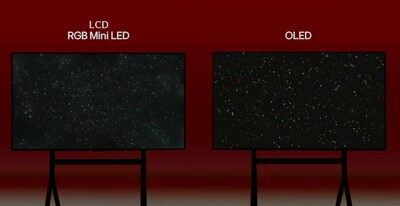
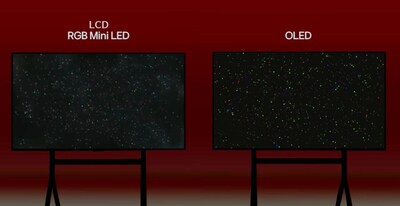
By comparison, RGB Mini LED, the latest LCD TV technology, relies on backlight blocks that are 160,000 to 830,000 times larger than the pixels of an OLED panel, revealing limitations in reproducing natural colors. As brightness diminishes toward the edges of the backlight blocks, it becomes difficult to clearly distinguish color boundaries, resulting in reduced color accuracy. Light bleeding, known as the halo effect, may also occur.
With the halo effect, light leaks from the boundaries of the backlight blocks of an LCD panel, causing the image to appear hazy. For example, when a bright star in a dark sky is smaller than the area of a backlight block, the boundary between the starlight and the dark sky may not be rendered clearly, making the image appear blurred.
This further highlights OLED as the optimal display for connecting humans and AI. In the AI era, high luminance, high resolution, and high color gamut performance are essential – enabling brighter, sharper, and more accurate color reproduction. Having achieved 100% dimming consistency, OLED can deliver the rich visual information generated by AI in a natural and precise manner.
LG Display plans to further strengthen its large-sized OLED leadership based on this world-leading OLED technology. The company’s new OLED TV panel applies its proprietary “Primary RGB Tandem 2.0” technology, which emits light by stacking the three primary colors of light – red, green, and blue – in independent layers. It delivers a peak luminance of up to 4,500 nits (one nit equals the brightness of a single candle) and incorporates technology that absorbs and disperses light rather than reflecting it, achieving the lowest reflectance level (0.3%) among existing displays.
Hyeon-woo Lee, Head of LG Display’s Large Display Business Unit, said, “We have objectively identified why OLED appears brighter and clearer. Through this verification, we can more clearly explain to customers that OLED’s pixel dimming technology, which maintains 100% dimming consistency, is the optimal choice in the AI era.”
About LG Display
LG Display Co., Ltd. [NYSE: LPL, KRX: 034220] is the world’s leading innovator of display technologies, including thin-film transistor liquid crystal and OLED displays. The company manufactures display panels in a broad range of sizes and specifications primarily for use in TVs, notebook computers, desktop monitors, automobiles, and various other applications, including tablets and mobile devices. LG Display currently operates manufacturing facilities in Korea and China, and back-end assembly facilities in Korea, China, and Vietnam. The company has approximately 70,707 employees operating worldwide. For more news and information about LG Display, please visit www.lgdisplay.com.
Media Contact:
Joo Yeon Jennifer Ha, Team Leader, Communication Team
Email: [email protected]
 View original content to download multimedia:https://www.prnewswire.com/news-releases/lg-display-earns-industrys-first-100-dimming-consistency-verification-302696837.html
SOURCE LG Display