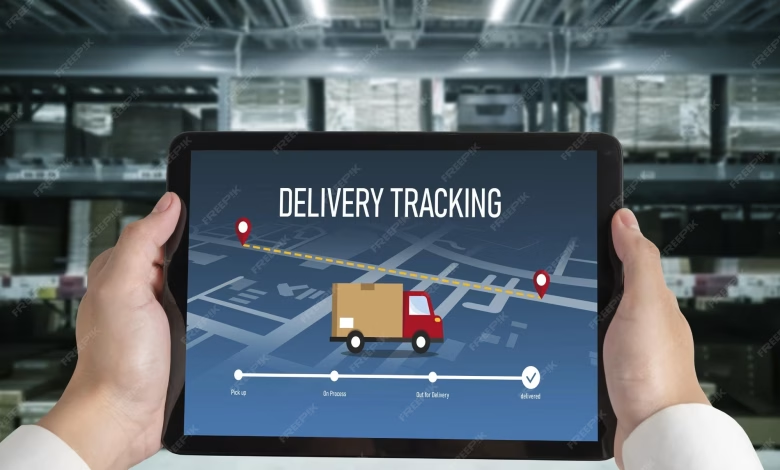
For most consumers, an order status update looks deceptively simple. “In transit.” “Out for delivery.” “Delayed.” Behind those short messages, however, sits a vast amount of fragmented, often inconsistent data. Carriers use different systems, languages, and status codes. Updates arrive late, out of sequence, or not at all. This is where artificial intelligence is quietly stepping in, transforming parcel tracking from a static log into a dynamic, interpretable system.
Why order statuses are harder to read than they look
Modern e-commerce logistics operate across borders, platforms, and transport networks. A single parcel can move through several warehouses, change carriers multiple times, and pass through customs systems that were never designed to communicate with one another. Each step generates data, but that data is rarely uniform.
Traditional tracking systems simply display raw updates as they arrive. AI-driven systems, by contrast, interpret them. Instead of showing isolated events, machine learning models analyze patterns, historical outcomes, and contextual signals to understand what an update actually means. A status that looks alarming to a customer may, in reality, be routine. AI helps separate real issues from normal logistical noise.
From raw data to meaningful insight
The core advantage of AI in tracking lies in its ability to contextualize information. Machine learning models can compare a parcel’s current behaviour to millions of similar shipments handled in the past. If a package pauses at a specific hub for 48 hours, AI can determine whether that pause historically leads to delays or resolves itself without issue.
This allows tracking platforms to move beyond passive reporting. Instead of simply stating where a package is, AI can explain what is likely happening and what to expect next. That shift fundamentally changes the customer experience, replacing uncertainty with informed anticipation.
Predictive tracking and expectation management
One of the most powerful applications of AI in logistics is prediction. By analysing carrier performance, regional congestion, seasonal demand, and external factors such as weather or customs backlogs, AI systems can refine delivery estimates in real time.
This predictive layer matters because consumer frustration rarely comes from waiting itself. It comes from not knowing how long the wait will last. When AI recalculates expectations dynamically, users are less likely to assume failure when a shipment slows down. Trust increases, even when delivery times do not improve.
Platforms like Ordertracker apply this kind of intelligence to consolidate and interpret tracking data across multiple couriers. By using AI to harmonize inconsistent updates, they help present a clearer narrative of a parcel’s journey rather than a confusing list of disconnected statuses. Ordertracker also leverages historical shipment data to reduce false alarms, helping users understand whether a delay is exceptional or expected. In that sense, Ordertracker functions less like a tracker and more like a translator between logistics systems and human expectations.
Reducing operational noise for businesses
 AI-driven tracking not only benefits consumers. For retailers and logistics teams, unclear order statuses generate massive operational costs. Customer support tickets, refund requests, and duplicate shipments often stem from confusion rather than actual delivery failures.
By decoding order data more accurately, AI reduces unnecessary interventions. Support teams can focus on genuine exceptions instead of fielding questions caused by ambiguous updates. Retailers gain clearer visibility into where bottlenecks actually occur, allowing them to address systemic issues rather than reacting to symptoms.
Ordertracker, used by both consumers and businesses, illustrates how AI can serve as a stabilizing layer across fragmented logistics networks. Its ability to interpret data from dozens of carriers helps reduce friction across the entire post-purchase experience.
AI as the future interface of logistics
The long-term shift is clear. Tracking is no longer just about location. It is about interpretation, prediction, and communication. AI is becoming the interface that explains complex physical systems in ways people can understand.
As e-commerce volumes continue to grow and delivery networks become more complex, raw data alone will no longer be sufficient. Consumers will expect clarity, not just updates. Businesses will demand insight, not just logs.
AI does not move packages faster. What it does is make the waiting intelligible. And in a world where patience is shaped by information, that may be just as important as speed itself.