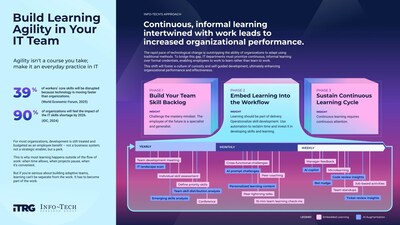
Many organizations still treat learning as a benefit instead of a business discipline, even as IT skills evolve faster than traditional training cycles can keep pace. New insights from Info-Tech Research Group indicate that episodic training models are widening the gap between current capabilities and future demands. The firm’s newly released blueprint, Build Learning Agility in Your IT Team, details a structured, three-phase framework that enables IT leaders to embed continuous learning directly into daily workflows and operational rhythms.
ARLINGTON, Va., Feb. 13, 2026 /PRNewswire/ – IT teams are under mounting pressure to deliver innovation while adapting to rapidly shifting technology demands. Core IT responsibilities now change approximately every 18 months, yet many organizations still approach learning as a periodic initiative rather than as part of operational execution. Info-Tech Research Group identifies this disconnect as a primary driver of persistent skill gaps and slowed execution. The global research and advisory firm’s recently published blueprint, Build Learning Agility in Your IT Team, outlines how CIOs can shift from reactive upskilling to operationalizing continuous learning inside daily delivery.
Info-Tech’s IT Talent Trends 2025 report found that 93% of respondents believe IT skills must evolve within the next five years to meet future demands. Despite this urgency, development programs often operate outside the flow of work, feedback cycles remain delayed, and learning expectations are inconsistently defined. The result is growing skills latency, the delay between identifying capability gaps and applying new expertise in live delivery.
“Learning cannot solely sit outside the work if IT is expected to lead transformation,” says Heather Leier-Murray, Research Director at Info-Tech Research Group. “When responsibilities shift every 18 months, CIOs need to embed learning directly into workflows so capability development can keep pace with execution and change.”
Key Challenges IT Leaders Face in Building Learning Agility
Most IT teams are not failing because they lack investment in training; they are constrained by how learning is structured and applied. Info-Tech’s research identifies several structural barriers that stall sustained capability growth, including:
- Training delivered episodically and outside daily workflows, limiting retention and practical application.
- Rigid skills mapping frameworks that cannot adapt quickly enough to shifting technology priorities.
- Delayed performance feedback cycles that slow capability development.
- Overreliance on individual subject matter experts due to limited visibility into team-wide skill distribution.
Info-Tech’s Strategic Framework for Embedding Learning in IT
To address these challenges, the firm’s Build Learning Agility in Your IT Team blueprint recommends a structured, phased approach designed to integrate learning directly into IT operations and business delivery:
- Phase 1: Build a Team Skill Backlog
IT leaders assess individual depth and breadth, map team-wide skill distribution, conduct a strategic gap analysis aligned to future initiatives, and create a prioritized development backlog tied to business context. - Phase 2: Embed Learning Into the Workflow
Teams identify core operational processes and intentionally map learning touchpoints, peer-based rituals, AI-supported knowledge acceleration, and feedback loops into weekly, monthly, quarterly, and annual rhythms. - Phase 3: Sustain Continuous Learning Cycle
Leaders establish recurring reassessment cadences, actively manage and reprioritize the development backlog, formalize recognition practices, and align capability refresh cycles with evolving organizational strategy.
“This phased approach reframes learning as an operational system rather than an isolated HR initiative and aligns skill development directly with business execution and measurable outcomes,” adds Leier-Murray.
By embedding learning into incident management, project workflows, retrospectives, and service processes, IT teams can reduce the time between identifying a capability need and applying new expertise in real delivery environments. This strengthens resilience, reduces the risk of dependency, and positions IT to meet expanding executive expectations with greater agility. Organizations that institutionalize learning as part of delivery can reduce skills latency and build adaptive IT teams equipped for sustained technological change.
For exclusive and timely commentary from Info-Tech’s experts, including Heather Leier-Murray, and full access to the Build Learning Agility in Your IT Team blueprint, please contact [email protected].
About Info-Tech Research Group
Info-Tech Research Group is one of the world’s leading and fastest-growing research and advisory firms, serving over 30,000 IT, HR, and marketing professionals around the globe. As a trusted product and service leader, the company delivers unbiased, highly relevant research and industry-leading advisory support to help leaders make strategic, timely, and well-informed decisions. For nearly 30 years, Info-Tech has partnered closely with teams to provide everything they need, from actionable tools to expert guidance, ensuring they deliver measurable results for their organizations.
To learn more about Info-Tech’s HR research and advisory services, visit McLean & Company, and for data-driven software buying insights and vendor evaluations, visit the firm’s SoftwareReviews platform.
Media professionals can register for unrestricted access to research across IT, HR, and software, and hundreds of industry analysts through the firm’s Media Insiders program. To gain access, contact [email protected].
For information about Info-Tech Research Group or to access the latest research, visit infotech.com and connect via LinkedIn and X.
 View original content to download multimedia:https://www.prnewswire.com/news-releases/learning-programs-fail-in-it-when-treated-as-perks-instead-of-strategy-reveals-info-tech-research-group-302687735.html
SOURCE Info-Tech Research Group