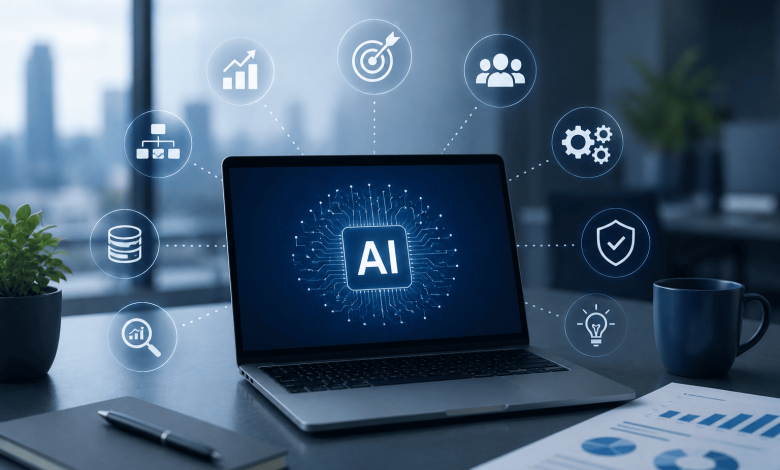
Artificial intelligence has reached an interesting stage. A couple of years ago, businesses were asking whether AI would change the way they worked. Today, the conversation has shifted. Most leaders accept that it will. The real question is where it fits and, just as importantly, where it doesn’t.
That’s a distinction many organisations miss.
There’s a tendency to view AI as a solution looking for a problem. A new tool launches, competitors start talking about it, and suddenly every board meeting includes a discussion about chatbots or automation. The businesses seeing the strongest return on investment have taken a different route. They haven’t started with AI. They’ve started with operational problems and worked backwards.
If your organisation recognises several of the signs below, it may be time to explore what a software development agency can build specifically around your business rather than relying on another off-the-shelf platform.
1. Your Team Is Constantly Busy, Yet Progress Feels Slow
Being busy has become a badge of honour in many organisations. Unfortunately, being busy doesn’t always mean being productive.
Employees jump between systems, copy data into spreadsheets, chase approvals, answer repetitive emails and spend hours on administrative work that adds very little value. None of these activities seem particularly significant in isolation. Together, they quietly consume hundreds of working hours every month.
One operations director summed it up perfectly during a workshop: “We’re not short of people. We’re short of time because our people spend half the day moving information around.”
That’s often the first indication that AI could create genuine value. Not by replacing employees, but by removing the repetitive work surrounding them.
2. Your Software Doesn’t Work Together
Growth usually brings more software.
A CRM gets added for sales. Finance introduces an ERP system. Customer support adopts its own platform, while marketing uses entirely different tools again. Individually, every system serves a purpose. Collectively, they create silos.
The hidden cost isn’t the software licence. It’s the manual effort required to connect everything.
Many businesses assume AI should solve this problem. In the real world, it all begins with integration. When systems communicate and share trusted data, intelligent automation is so much more powerful. Without that foundation, AI just speeds up the processing of bad information.
3. Customers Expect Faster Service Than Your Processes Allow
Customer expectations haven’t changed because businesses decided they should. They’ve changed because companies like Amazon, Netflix, and Uber have redefined what good service feels like.
That creates pressure across every industry.
Customers want quicker responses, more accurate updates and less lag. Hiring additional staff may relieve some of that pressure, but it rarely addresses the underlying issue if employees are still spending much of their day completing repetitive tasks.
The most effective AI projects don’t remove people from customer service. They remove routine work, allowing experienced employees to focus on conversations where human judgement genuinely matters.
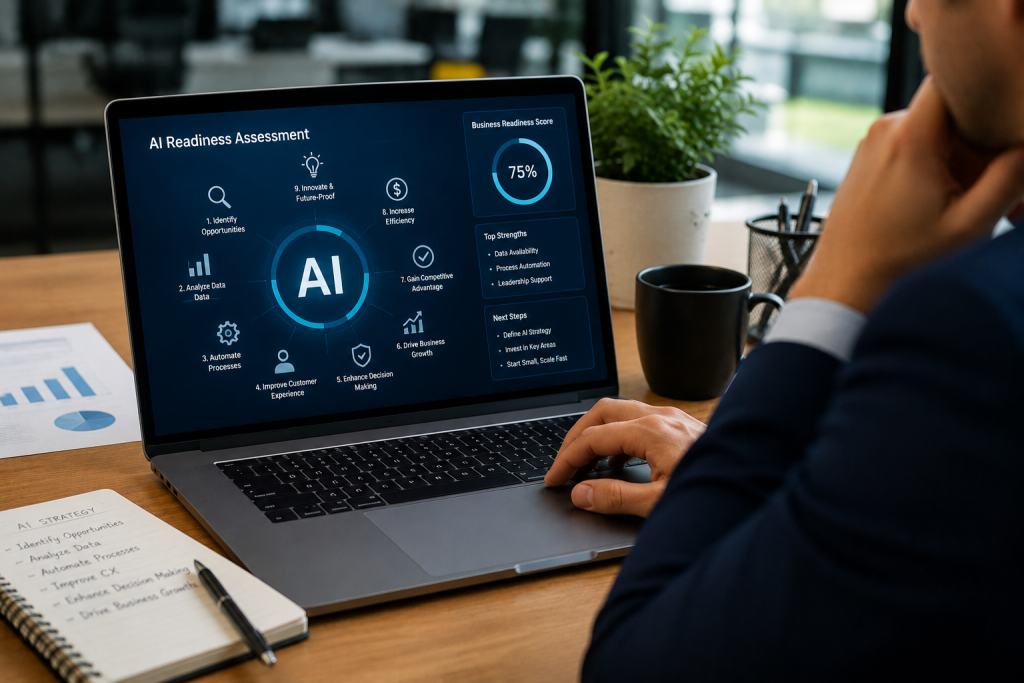
Common Misconception
AI is primarily about reducing headcount
This remains one of the biggest myths surrounding artificial intelligence.
Businesses often assume AI delivers value by replacing employees. In practice, the strongest implementations do exactly the opposite. They make experienced people more effective.
Think about a finance manager spending two hours every Monday compiling reports, or a sales executive manually updating five different systems after every customer meeting. Those aren’t strategic activities. They’re administrative ones.
When AI removes those repetitive tasks, businesses don’t lose expertise. They finally get more value from it.
4. Reporting Takes Longer Than Making Decisions
Many leadership teams spend days preparing reports and only an hour discussing them.
That’s usually a warning sign.
If managers need to export spreadsheets from multiple systems, validate figures manually and reconcile conflicting information before every board meeting, the organisation doesn’t have an AI problem. It has a data problem.
One mistake businesses regularly make is assuming AI can compensate for poor-quality data. It can’t. Better technology doesn’t fix unreliable information. It simply analyses it more quickly.
Reliable data should always come before intelligent automation.
5. Growth Is Exposing Weak Processes
Growth has a habit of revealing operational weaknesses that smaller businesses can comfortably ignore.
Approval chains become longer. Customer enquiries increase. Projects take longer to complete, and employees begin creating workarounds simply to keep everything moving.
Many leaders interpret this as a staffing issue.
Quite often, it isn’t.
It’s a process issue.
This is usually the stage where an experienced AI automation agency can provide the greatest value, not by adding more software but by redesigning workflows that have become increasingly difficult to manage as the business expands.
Mistakes Businesses Commonly Make
The biggest mistake isn’t adopting AI too late. It’s adopting it before understanding the problem it’s supposed to solve.
Companies frequently invest in AI because competitors have announced similar initiatives or because the technology dominates industry headlines. Six months later, utilisation is low, and enthusiasm has faded, not because the technology failed, but because nobody identified a meaningful business objective from the start.
Another common mistake is trying to automate everything at once. The organisations seeing the best results usually begin with a single process, such as invoice processing, customer enquiries or document management. Once employees experience measurable improvements, confidence grows naturally, and wider adoption becomes far easier.
6. Too Much Knowledge Lives Inside Individual Employees
Every organisation has people who simply know how things work.
They remember exceptions. They understand undocumented processes and have built years of practical experience.
That expertise is invaluable, but it also creates risk.
When key employees leave, much of that knowledge leaves with them.
Custom AI can help document recurring workflows, identify decision patterns and make institutional knowledge available across the wider organisation. It’s not about replacing experienced people. It’s about making their expertise easier to share.
What Businesses Should Do Instead
Rather than asking, “Where can we use AI?”, ask a much simpler question.
Which tasks frustrate your employees every single week?
The answers tend to reveal genuine automation opportunities.
Repeated data entry. Manual approvals. Invoice matching. Contract reviews. Customer follow-ups. Inventory reconciliation.
Notice how none of these examples begin with technology. They begin with operational friction.
That’s where worthwhile AI projects almost always start.
7. You Keep Hiring to Solve Administrative Problems
Growth requires recruitment, but hiring more people shouldn’t be the default answer to inefficient processes.
If every increase in workload requires another administrator, coordinator, or operations assistant, it’s worth questioning whether people are solving the right problem.
The objective isn’t reducing headcount.
It’s allowing talented people to spend more of their time creating value and less time supporting manual processes that technology could easily do.
8. Standard Software No Longer Reflects How Your Business Works
Off-the-shelf software is designed around common business processes.
Successful businesses rarely operate in common ways.
Perhaps your pricing model is unique. Your approval workflow may have been designed around industry regulations, or your customer onboarding process has become a competitive differentiator. Sooner or later, off-the-shelf software starts to make your business conform to its limitations, rather than the other way around.
That’s often the point where custom AI development becomes commercially sensible.
9. Leadership Wants Better Decisions, Not More Dashboards
Most executives aren’t asking for more reports.
They’re asking for better answers.
Which customers are becoming less profitable? Where are operational bottlenecks developing? Which suppliers present the greatest risk? Which projects deserve further investment?
AI won’t eliminate uncertainty. Business has never worked that way.
What it can do is identify patterns, highlight emerging risks and surface insights far earlier than manual analysis typically allows. For leadership teams making decisions every day, that speed can become a genuine competitive advantage.
Final Thoughts
The organisations benefiting most from AI aren’t necessarily the largest or the most technologically advanced. They’re the ones willing to challenge inefficient ways of working before investing in new technology.
Artificial intelligence isn’t a strategy in itself. It’s a capability that becomes valuable when applied to clearly defined business problems.
When repetitive work consumes skilled employees’ time, disconnected systems slow decision-making, and growth begins exposing operational weaknesses, AI stops being an interesting experiment. It becomes a practical investment.
That’s where working with an experienced software development agency makes sense, not to implement AI for its own sake, but to build solutions that fit the way your business actually works.