Project Will Develop and Validate Capabilities to Support Lunar Resource Extraction and Artemis Base Camp Construction
SEATTLE, Feb. 4, 2026 /PRNewswire/ — Interlune, a natural resources company, today provided additional details regarding its lunar trenching and excavation technology development project funded through a NASA Small Business Technology Transfer (STTR) Phase I contract. STTR funding supports several NASA missions, including Artemis mission objectives and long-term lunar sustainability goals under the agency’s Space Technology Mission Directorate (STMD).
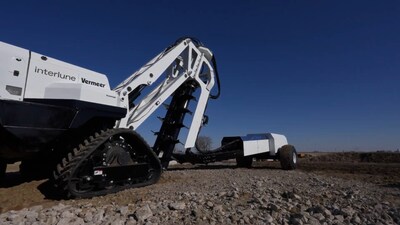
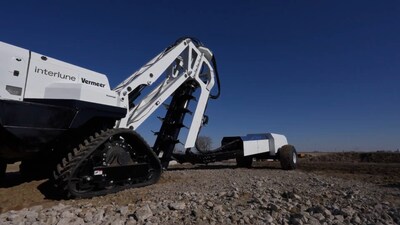
The $150,000 contract will focus on developing analytical models, engineering standards, and testing hardware to inform the future design of Interlune’s multipurpose lunar trenching and excavation technology. Interlune and the Colorado School of Mines will focus on reducing tractive force, power consumption, and dust compared to traditional trench-digging techniques. The expected outcome is a design that can be used across multiple commercial and government applications, including Interlune’s helium-3 harvesting operations and site preparation for NASA’s Artemis Moon Base.
“We need to be great at excavating large quantities of lunar regolith, and that translates well to surface preparation activities needed at Artemis Base Camp,” said Rob Meyerson, Interlune co-founder and CEO. “This award is yet another example of how industry and government are working together to develop essential capabilities for U.S. leadership in an in-space economy.”
The Interlune harvesting system involves four key processes – excavating, sorting, extracting, and separating – with proprietary technology at every step. This project focuses on the first process: excavation. Interlune will initially apply this technology to harvest helium-3 from the Moon, then expand to other resources, including industrial metals, rare Earth elements, and rocket propellants. In addition to harvesting natural resources, Interlune technology is applicable to excavation and construction on the Moon and beyond.
The project scope includes:
- Model and Analysis Development: Physics-based analytical models will predict system loads and performance, measuring characteristics like excavation force, regolith throughput, and the overall effectiveness of the machinery, from the tool’s angle of entry to how quickly it “bites,” using as little power as possible with as little wear-and-tear as possible. These models will also help to create lunar geological engineering standards.
- Prototype Testing and Validation: Interlune will test a prototype in simulated regolith at the Colorado School of Mines. The tests will validate analytical models, characterize risks like wear and binding, and inform the design of future systems.
- Scalability Study and Concept of Operations (ConOps): A feasibility study will assess the technology’s scalability from small-scale to full-scale for Artemis use cases. Additionally, Interlune will develop a ConOps for how the technology will be used in various other applications.
Led by commercial and civil space program veterans, Interlune brings decades of expertise in space systems, large-scale systems integration, and a deep understanding of lunar geology and geotechnical engineering. Interlune and Vermeer announced a long-term partnership to develop novel excavation technology and unveiled a full-scale prototype last May. Last September, Interlune announced plans to develop and test its own regolith simulants at a new research center based in Houston.
Helium-3 is extremely scarce on Earth but abundant on the Moon. Currently, there is tremendous demand for the isotope, primarily driven by the quantum computing industry. Other applications include weapons detection, medical imaging, and fusion energy.
Interlune has raised $18 million to date and secured more than half a billion dollars in helium-3 purchase orders and government contracts.
Small Business Technology Transfer is a U.S. federal program (paired with the Small Business Innovation Research (SBIR) program) that funds research and development (R&D) by requiring small businesses to partner with universities or research institutions to commercialize new technologies, offering seed funding for innovation that serves a government need and has commercial potential.
About Interlune
Interlune is a privately funded natural resources company committed to sustainable and responsible harvesting of natural resources from space to benefit humanity. Based in Seattle, Interlune was founded in 2020 by a team of highly experienced government and industry experts. Aiming to be the first U.S. company to commercialize resources from space, Interlune has developed patent-pending technology that harvests materials from the lunar soil, or regolith, using the smallest, most energy-efficient machinery of its kind. Over time, Interlune will harvest additional resources—including industrial metals, rare earth elements, and water—to support a long-term presence on the Moon and a robust in-space economy. The company has raised $18 million to date and has received contracts from NASA, the National Science Foundation (NSF), the U.S. Department of Energy, the Texas Space Commission, as well as several commercial customers. Follow Interlune on LinkedIn, X, and Instagram.
Company Press Contact:
Jani Strand
General Partner
Perch Partners
[email protected]

 View original content to download multimedia:https://www.prnewswire.com/news-releases/interlune-announces-details-of-nasa-sttr-project-to-advance-scalable-multipurpose-lunar-trenching-and-excavation-technology-302679189.html
SOURCE Interlune