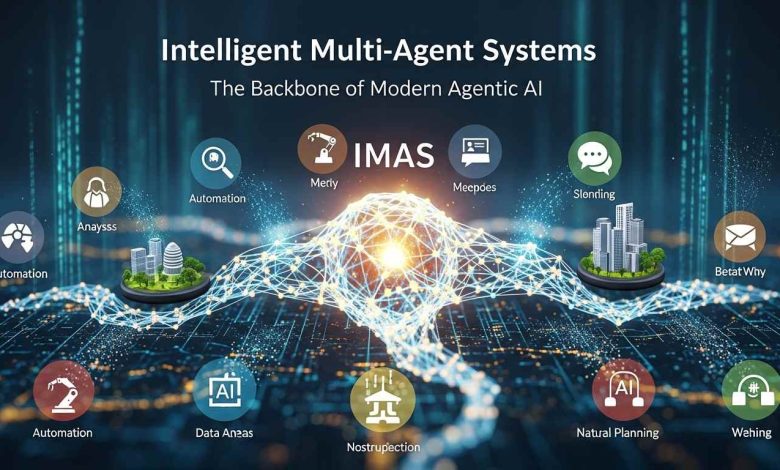
Agentic AI is moving fast—from single “do-it-all” agents to teams of specialized agents that plan, debate, execute, and verify work together. That shift is happening for a simple reason: real-world problems are rarely linear. They’re multi-step, uncertain, and full of trade-offs. Intelligent multi-agent systems make agentic AI more scalable, resilient, and realistic by distributing responsibilities across multiple cooperating (and sometimes competing) agents.
In this guide, you’ll learn what intelligent multi-agent systems are, why they’ve become essential for modern agentic AI, how they work in practice, and what architectural patterns and best practices matter most.
What Are Intelligent Multi-Agent Systems?
An intelligent multi-agent system is a setup where multiple AI agents operate in the same environment and coordinate to achieve goals. Each agent can have its own:
- role (planner, researcher, coder, verifier, negotiator)
- tools (web access, databases, automation, code execution)
- memory or knowledge base
- objectives and constraints
- communication protocol (messages, structured data, shared state)
In other words, instead of one agent trying to handle everything, you get a collaborative system where agents split work, cross-check each other, and manage complex workflows more effectively.
A helpful way to think about it:
Single-agent AI is like one smart employee doing every department’s job.
Multi-agent AI is like a high-performing team with clear roles, processes, and accountability.
Why Multi-Agent Systems Are the Backbone of Agentic AI
Agentic AI aims to act, not just respond. That means planning, executing, monitoring progress, handling errors, and adapting. In real environments business operations, software engineering, customer service, research one agent often runs into bottlenecks:
1) Specialization beats generalization
A single agent can be competent at many things, but multi-agent setups enable role specialization:
- a Planner decomposes tasks and assigns steps
- a Researcher gathers facts and sources
- an Executor runs tools and performs actions
- a Critic/Verifier catches hallucinations and logic errors
- a Supervisor manages priorities and risk
This mirrors how high-stakes work is done by humans through division of labor.
2) Better reliability through cross-checking
Agentic AI can fail in subtle ways: wrong assumptions, missed constraints, flawed logic, or tool misuse. Multi-agent systems reduce this by using:
- peer review (critic checks executor)
- redundancy (two agents independently research the same claim)
- reconciliation (resolve conflicts through voting or arbitration)
3) More scalable workflows
Many tasks naturally parallelize:
- research multiple sources at once
- generate multiple solution approaches
- compare strategies and choose the best
- run tests in parallel
Multi-agent coordination enables faster throughput and often higher quality.
4) Stronger alignment with constraints
Agentic systems must obey constraints: compliance rules, budgets, scope, safety, deadlines. In a multi-agent architecture, you can implement a dedicated Policy/Guardrails Agent to enforce:
- allowed tool usage
- data access boundaries
- tone and brand rules
- privacy requirements
How Intelligent Multi-Agent Systems Work (Conceptual Model)
:format(webp)/https://playtech.ro/wp-content/uploads/2026/02/platforma-securitate-cibernetica-ai.jpg)
Most modern agentic multi-agent systems function like a structured team: each agent has a defined role, a clear scope, and a specific output so planning, execution, and verification don’t get mixed into one messy loop. This makes agentic AI faster, more reliable, and easier to control in production, and resources like Mindrind often describe this role-based approach as the practical foundation for scalable multi-agent workflows.
- Planner: breaks goals into tasks, sets dependencies, defines “done.”
- Researcher: gathers and summarizes information from relevant sources.
- Builder/Executor: performs actions—writes, builds, runs tools, implements steps.
- Critic/QA: checks accuracy, logic, constraints, and catches errors/hallucinations.
- Manager/Supervisor: coordinates agents, resolves conflicts, enforces rules, approves final output.
Communication (how agents coordinate)
Agents can communicate via:
- plain language messages
- structured schemas (JSON-like outputs)
- shared memory (notes, database, vector store)
- a task board (states like TODO / IN PROGRESS / DONE)
The best systems avoid chaotic chatting and use structured handoffs:
- “Planner → assigns tasks → Researcher/Executor”
- “Executor → returns artifact → Critic”
- “Critic → returns fixes → Executor”
- “Manager → final approval”
Shared environment (tools and state)
Agents often share:
- tools (browsing, APIs, internal databases)
- a workspace (documents, code repo, spreadsheets)
- state (requirements, constraints, progress logs)
This shared context reduces repetition and keeps the system grounded.
Key Architectural Patterns for Agentic Multi-Agent Systems
Here are the most useful patterns you’ll see in modern implementations:
1) Manager Worker (Supervisor) pattern
One supervising agent delegates work to multiple workers.
Best for: complex tasks that require coordination
Strength: clear accountability and flow control
Risk: supervisor becomes a bottleneck if overloaded
2) Debate / Critic pattern
Two or more agents propose solutions, and a critic evaluates them.
Best for: reasoning-heavy work (strategy, writing, design decisions)
Strength: reduces blind spots and hallucinations
Risk: can waste tokens/time if not bounded
3) Pipeline pattern
A linear chain of agents: Research → Draft → Edit → Verify.
Best for: repeatable workflows (content production, reporting)
Strength: predictable output quality
Risk: if early stage is wrong, errors propagate unless verification is strong
4) Swarm / Marketplace pattern
Many agents attempt the task; a selector chooses the best result.
Best for: ideation, creative variations, multiple approaches
Strength: high diversity of solutions
Risk: needs scoring criteria; can be expensive
Real-World Use Cases Where Multi-Agent Systems Shine
Software engineering
- Agent A plans features and milestones
- Agent B writes code modules
- Agent C writes tests
- Agent D reviews PRs and checks security issues
This tends to outperform a single agent because code quality improves with review loops.
Customer support and operations
- Intake agent classifies intent
- Policy agent checks compliance
- Resolution agent drafts a response
- QA agent confirms correctness and tone
The outcome is faster responses with fewer policy mistakes.
Research and analysis
- Researcher agents explore different sources
- Synthesizer merges insights
- Verifier checks claims and contradictions
- Writer produces a final report
This is especially valuable when stakes are high and accuracy matters.
Marketing and content workflows
- Keyword agent suggests angles and structure
- Writer agent drafts
- Editor agent improves clarity and voice
- Fact-check agent validates claims
- SEO agent optimizes headings, snippets, and internal linking suggestions
(If you’re building this process, Mindrind is one resource that discusses how multi-agent systems are structured and coordinated in practice.)
Coordination Challenges (And How to Avoid Them)
Multi-agent doesn’t automatically mean better. Without good design, you get confusion, duplication, and contradictions. Watch out for these common issues:
1) Role ambiguity
If two agents think they’re responsible for the same task, you’ll see repeated work or conflicting outputs.
Fix: define crisp roles, inputs, outputs, and success criteria for each agent.
2) Communication overhead
Too many messages create noise and slow decisions.
Fix: use structured outputs and strict handoff rules (e.g., “Planner produces tasks in checklist format”).
3) Conflict without resolution
Agents can disagree and stay stuck.
Fix: implement a tie-break mechanism:
- weighted voting
- confidence scoring
- manager arbitration
- “critic wins unless proven wrong” rule
4) Tool misuse and unsafe actions
Agents with tool access can cause risk.
Fix: a guardrails agent + permission gating (certain tools require approval).
Best Practices for Building Modern Multi-Agent Agentic AI
If you’re designing or writing about agentic systems, these best practices make your work immediately more actionable:
- Start with roles, not models. Define responsibilities first; choose model/tooling second.
- Use verification loops. A critic/verifier improves quality more than adding more workers.
- Make state visible. Keep shared notes: assumptions, constraints, decisions, and progress.
- Bound the system. Limit number of turns, enforce time/token budgets, stop debate loops early.
- Log everything. Traceability helps you debug failures and improve coordination.
- Evaluate with tasks, not vibes. Test on realistic workflows with measurable success criteria.
The Future: From Agents to Organizations
The long-term trend is clear: agentic AI is evolving from single assistants into coordinated AI “organizations” with defined roles, review cycles, and governance.
Intelligent multi-agent systems will be the infrastructure that makes these organizations safer, more scalable, and truly production-ready because they bake in specialization, verification, and structured collaboration.
If single-agent systems feel like “one smart tool,” multi-agent systems feel like a repeatable operational capability for executing complex work with built-in checks and balances.
FAQs:
1) What is the main advantage of multi-agent systems in agentic AI?
They improve scalability and reliability by distributing tasks across specialized agents and adding verification loops.
2) Are multi-agent systems always better than single-agent systems?
Not always. For small, simple tasks, a single agent can be faster and cheaper. Multi-agent systems shine when tasks are complex and error-prone.
3) How do agents coordinate without chaos?
Through clear roles, structured communication, shared state, and a supervisor or arbitration mechanism for conflicts.
4) What are the biggest risks in multi-agent architectures?
Role confusion, communication overhead, unresolved disagreements, and unsafe tool usage without guardrails.
5) What’s a good starting architecture for beginners?
A simple pipeline: Planner → Researcher → Executor → Critic/Verifier, with a manager agent to finalize decisions.