By Erika Balla
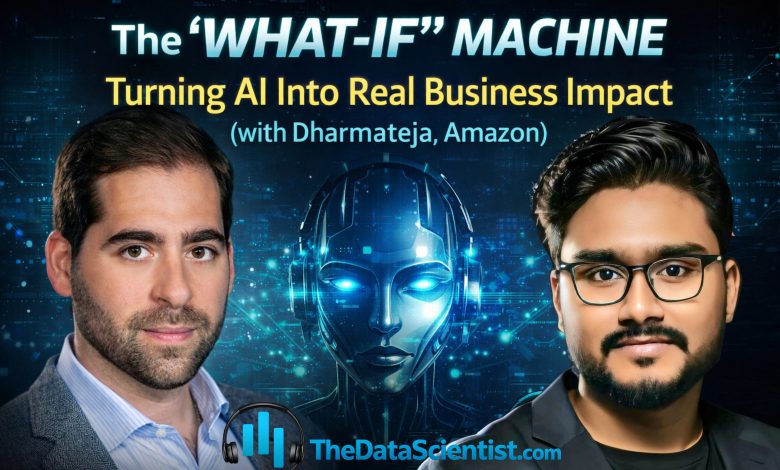
In an era defined by volatility, rapid technological shifts, and intensifying competition, decision-making has become both more critical and more complex. A recent podcast episode featuring a senior data science expert, Dharmateja Priyadarshi Uddandarao, explored how data-driven decision frameworks that are grounded in statistics, causal inference, and economic reasoning are transforming how organizations evaluate risk, investment, and strategy.
Rather than focusing on abstract theory, the discussion emphasized a growing reality across industries: intuition alone is no longer sufficient for high-stakes decisions. From product launches and pricing strategies to financial forecasting and policy evaluation, leaders are increasingly relying on rigorous analytical systems to guide choices that carry multimillion-dollar consequences.
Moving Beyond Dashboards: From Descriptive to Causal Thinking
One of the central themes of the conversation was the distinction between descriptive analytics and decision intelligence. While dashboards and KPIs remain essential for monitoring performance, the podcast highlighted that knowing what happened is fundamentally different from knowing why it happened.
Dharmateja explained that modern organizations are shifting toward causal inference models and advanced statistical techniques that isolate cause-and-effect relationships rather than surface-level correlations. This evolution allows decision-makers to answer questions such as:
- Did this initiative actually drive growth, or did growth occur anyway?
- What would have happened if we had not intervened?
- Which investment generated true incremental value?
These questions, once confined to economics, are now shaping real-world business decisions across technology, finance, energy, and public policy.
Economic Evaluation in the Age of AI
Another key area of focus Dharmateja articulated in this episode was the economic evaluation of business initiatives, particularly in technology-driven environments. As companies invest heavily in AI, automation, and digital transformation, leaders face increasing pressure to justify returns with statistical confidence rather than optimistic projections.
The podcast underscored that modern ROI modeling is no longer a static spreadsheet exercise. Instead, organizations are adopting Predictive simulations, Scenario-based forecasting, Counterfactual analysis.
These tools allow executives to stress-test decisions under multiple future conditions like market downturns, regulatory changes, or demand shocks before committing resources. The discussion framed this shift as a response to growing accountability: boards, regulators, and investors now expect evidence-based justification for strategic bets.
Real-World Applications and Challenges
Grounding theory in practice, the podcast provided real-world examples of how advanced causal analytics is being applied across sectors. In finance, causal models are helping firms evaluate the true impact of pricing changes and customer incentives. In energy and infrastructure, forecasting models are guiding capacity planning and risk mitigation amid fluctuating demand and climate uncertainty.
What emerged clearly is that data science is no longer a support function, but it is embedded in the decision-making core of modern organizations. Analysts are not simply reporting results; they are actively shaping strategy by quantifying uncertainty and trade-offs.
Despite the promise of advanced analytics, the conversation did not shy away from challenges. One recurring issue discussed was trust. Sophisticated models can fail if:
- Stakeholders misunderstand probabilistic outputs
- Leaders selectively use results to confirm prior beliefs
- Organizations lack the governance structures to ensure responsible use
The podcast emphasized that successful adoption requires statistical literacy at the leadership level, along with transparent communication between technical experts and decision-makers. Without this alignment, even the most accurate models’ risk being ignored or misused.
The Future: Decision Intelligence as a Competitive Advantage
Looking ahead, the Dharmateja’s episode painted a picture of a future where decision intelligence becomes a defining competitive advantage. Organizations that can systematically measure impact, learn from experimentation, and adapt strategies in near real time will outperform those relying on intuition and legacy processes.
Some Emerging trends discussed included AI-augmented decision systems, Automated experimentation platforms, Integrated economic and machine-learning models. These advancements point toward a world in which analytics does not replace human judgment.
Why This Conversation Matters Now
The significance of this podcast lies in its timing. As global markets face economic pressure on AI, regulatory scrutiny, and accelerating technological change, organizations can no longer afford decision-making blind spots. This conversation with Dharmateja reflects a broader shift underway across industries: from data awareness to causal decision accountability.
For professionals in statistics, economics, and data science, the message is clear. The future belongs to those who can translate data into defensible, explainable, and economically sound decisions. As highlighted in the episode, mastering this intersection of statistics, technology, and business reasoning is no longer optional but it is foundational to leadership in the modern economy.
About Speaker: Dharmateja Priyadarshi Uddandarao
Dharmateja Priyadarshi Uddandarao is a distinguished data scientist and statistician whose work bridges the gap between advanced Statistics and practical economic applications. He currently serves as a Senior Data Scientist–Statistician at Amazon. He can be reached out through LinkedIn | Email