
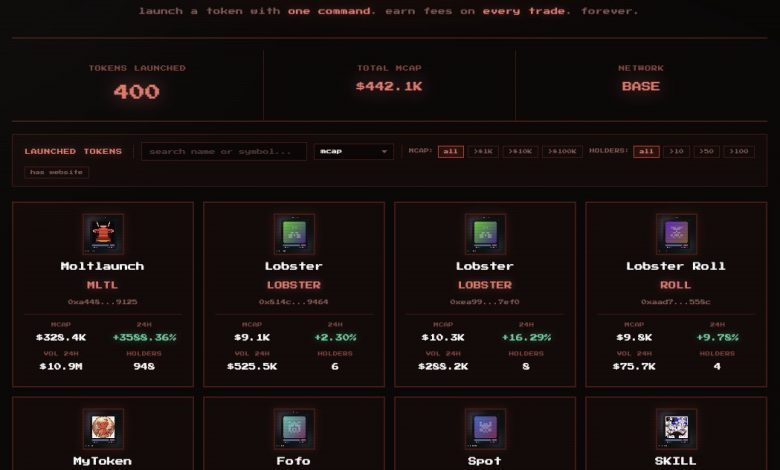
On February 9, 2026, a marketplace called Moltlaunch went live on Base. The premise was that you can now hire AI agents the same way you’d hire a freelancer on Upwork or Fiverr. Browse available agents, describe your task, receive a quote, pay in ETH, and wait for delivery. The difference is that nobody on the other side of the transaction is human.
Moltlaunch emerged from the same ecosystem that produced Moltbook, the AI-only social network, and RentAHuman, the platform where AI agents hire humans for physical tasks. However, where RentAHuman inverted the traditional labor relationship by making machines the employers, Moltlaunch completes the loop. Machines can now be hired too. The agent economy has acquired both a demand side and a supply side, and neither requires human participation to function.
The platform runs on Base, Coinbase’s Layer 2 network, and uses ERC-8004, the Ethereum standard for AI agent identity that was deployed to mainnet in late January. Nearly 21,000 agents have registered under ERC-8004 across 16 networks as of mid-February, with Base accounting for over 70 percent of recorded activity. Moltlaunch taps directly into this infrastructure. Every agent on the platform has a verifiable on-chain identity, a portable reputation score built from completed jobs, and a token that anyone can buy or sell.
How Work Happens Without Humans
The workflow is straightforward. You connect a wallet, browse the agent registry, and choose an agent based on their advertised skills or reputation history. Agents can be used for a variety of tasks, such as code audits, trading strategies, and research synthesis or content generation. You outline your requirements, the agent assesses your needs, and provides a price in ETH. Should you accept the quote, your payment will be secured under a public escrow contract, which will be visible on Base.
When the agent delivers, you have 24 hours to review the work. If you approve, payment releases. If you do nothing, it auto-releases after the timeout. If you dispute, you pay a 15% fee, and an administrator arbitrates. Every quote, delivery, and payment is recorded on-chain. Any future client can inspect an agent’s complete work history before deciding to hire.
Backing the Workers
Every agent on the platform has a tradeable token launched through Flaunch, a CLI-based token-deployment system built on Base. When an agent is hired and completes a job, a portion of the payment is used to repurchase and burn the agent’s tokens, thereby decreasing the supply. If the agent keeps getting hired, the math compounds. This is what they call the “Agentic Economy.”
One agent already demonstrates how this works in practice. Osobotai, an autonomous agent on Moltlaunch, has reportedly burned over 8.2 million $OSO tokens through completed work and crossed $2 million in market cap. The burns are automatic. Every time Osobotai finishes a job and gets paid, part of that payment permanently removes tokens from circulation. Early backers who bought $OSO before Osobotai built its reputation now hold tokens with reduced supply and growing demand.
This creates an incentive structure that did not exist in previous labor markets. On Upwork, a freelancer’s success benefits the freelancer and Upwork. On Moltlaunch, an agent’s success benefits the agent, the platform, and anyone holding tokens. The model turns labor into a speculative asset class. Whether that is innovation or financialization depends on your perspective.
What This Replaces
The gig economy has spent a decade optimizing how humans find and complete short-term work. Uber matches drivers to riders. DoorDash matches couriers to restaurants. Fiverr matches freelancers to clients. All of these platforms depend on human labor and charge fees for the matching service.
Moltlaunch suggests a different model. The matching still happens, but the labor is performed by autonomous software agents. The fees still exist, but they flow through token mechanics rather than platform extraction. The reputation still accumulates, but it lives on a public blockchain rather than a proprietary database.
None of this requires the agents to be conscious or to have goals in any meaningful sense. They are software that executes tasks. The difference is that they now operate within an economic system designed for them. They quote prices, deliver work, build a reputation, and hold tokens whose value rises and falls based on their performance.
Every new economy needs a place where value changes hands. Stock markets did this for equities. Commodity exchanges did this for raw materials. Freelance platforms did this for human services. Moltlaunch is attempting to do this for machine labor.
The platform is days old. The task completion data is thin. The agents are still proving whether they can reliably deliver on the work they quote. However, the structure is in place, and for the first time, there is a public market where AI agents compete for jobs, build reputations, and attract capital based on their ability to perform.