
The clinical staff often spends a lot of time working on administrative tasks and documentation. A significant portion of that time is allocated to locating the necessary mobile medical equipment. And that’s when the lack of automated oversight frequently requires that healthcare facilities maintain many critical devices in surplus, just in case.
Wider adoption of IoT systems in hospitals may be one of the steps to resolve this operational issue.
Optimizing Asset Management via Real-Time Location Systems (RTLS)
The most readily impactful application of IoT within hospital operations is the deployment of Real-Time Location Systems (RTLS). These systems go beyond simple identification. providing dynamic tracking of high-value equipment and hospital staff, and even patients across the entire facility. The objective is to secure continuous operational readiness and perfect coordination processes.
Technology Selection and Deployment
Choosing the right RTLS technology depends on how precise the tracking needs to be and what the environment can support:
- Active Radio Frequency Identification (RFID)
These tags have their own battery and send out signals all the time. They work best for tracking high-value equipment that needs constant, real-time location updates, for example, portable imaging devices.
- Bluetooth Low Energy (BLE)
It uses small beacons that can often tie into the existing Wi-Fi network. BLE provides a solid middle ground – good accuracy without draining battery life too quickly.
- Infrared (IR)
IR provides the most precise room-level accuracy, confirming exactly which room an asset is in. This level of certainty is especially useful for staff safety checks and for tracing movements in contamination-related workflows.
Operational Workflow
The RTLS continuously determines the location of tagged equipment and sends that information directly into the hospital’s internal systems. When a staff member places a used pump in a designated utility room, the local sensor in that area picks up the tag and updates the item’s status immediately. From there, the system can automatically create a maintenance request or trigger a restocking alert, removing the need for manual entries and significantly speeding up equipment turnaround. 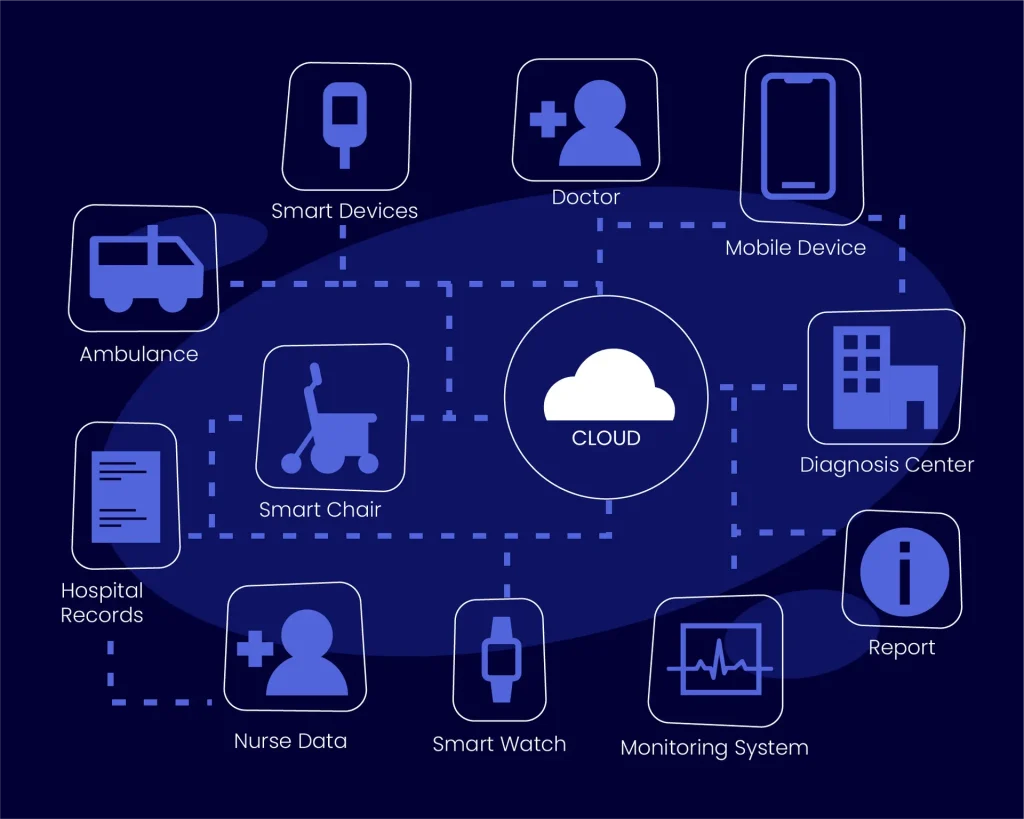
Predictive Maintenance in Healthcare Infrastructure
Predictive maintenance in healthcare moves away from the old approach of fixing equipment on a set schedule or only after something breaks. Instead, it uses sensor data and ongoing analysis to spot early signs of potential failure, allowing teams to address issues before they interrupt patient care.
Continuous Condition Monitoring
Specialized IoT sensors are attached to different items of the hospital infrastructure. It may include everything from large imaging systems to HVAC equipment and backup power units. These sensors track performance indicators continuously and can detect even the slightest hiccups in their operations.
For instance, with imaging systems that rely on superconductive magnets, such as MRI machines, built-in pressure sensors continuously monitor cryogen levels. When the system detects pressure patterns that suggest a potential decline, it sends an early warning to the engineering team. This gives them time to step in and fix the issue before it escalates into a major equipment failure.
The overall objective of this strategy is to use real-time data analytics to predict equipment malfunctioning, etc. By making service decisions based on actual usage patterns and signs of wear, organizations can improve overall system reliability and plan budgets more effectively, directing maintenance resources where they are needed.
Automating Supply Chain with Smart Inventory Management
Intelligent automation helps reduce the heavy manual workload and frequent errors that come with traditional inventory counting. By tracking supplies in real time, smart inventory systems make sure that the necessary equipment or items are available. For clinics, this means no overstocking of expensive equipment
To support this, many facilities are introducing smart storage units for fast-moving medical items. These cabinets combine weight sensors, tag readers, and similar technologies to monitor stock levels continuously and adjust counts automatically.
The operations function under a digital replenishment protocol. This means that once the supply level in a container drops below a preset threshold, the system registers the state change. This action automatically triggers a replenishment request, which is routed directly to the facility’s Enterprise Resource Planning (ERP) system. This process helps maintain optimal inventory levels by automating routine administrative aspects of ordering and supply chain oversight. 
Remote Patient Monitoring (RPM) and Data Integration
The integration of remote patient monitoring technology improves clinical oversight efficiency by allowing automated, continuous physiological monitoring of patients situated in general wards.
Early Warning System Automation
Wearable biosensors monitor vital signs such as heart rate variability and respiratory rate. The collected data is analyzed by AI and machine learning models to calculate an Early Warning Score (EWS). If the patient’s vitals are disturbing, the system alerts the response team, who then pay more attention to the patient care.
Data from connected medical devices is also used by advanced analytics to generate detailed insights and support clinical decision-making. When integrating this real-time patient data with the Electronic Health Record (EHR), compliance with regulations like HIPAA guarantees that the information is shared securely and remains interoperable with existing hospital systems.
Conclusion
IoT technologies are changing how hospitals operate by streamlining daily workflows, keeping track of equipment, and supporting patient care. Systems like real-time location tracking, predictive maintenance, and smart inventory help reduce routine administrative tasks and make sure important resources are always on hand. Remote patient monitoring and early warning tools give staff continuous insight into patient health without constant manual checks. By using real-time data and analytics, hospitals can prevent equipment problems, make smarter decisions, and manage resources more efficiently. Overall, IoT makes hospitals more responsive, organized, and focused on patient needs.