



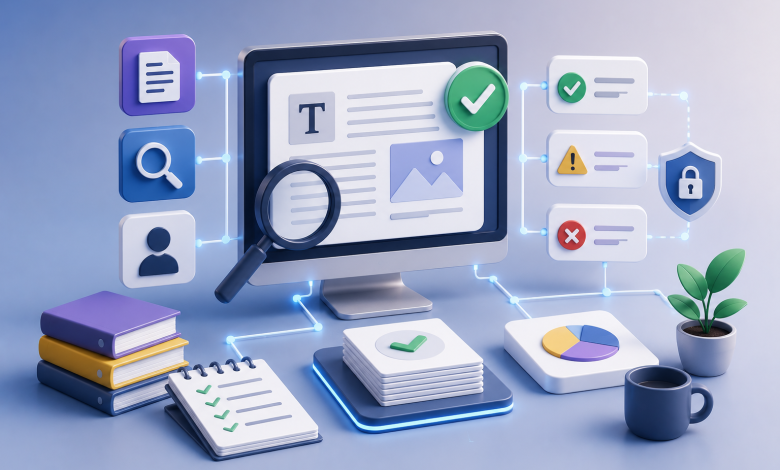
A well-structured content verification workflow keeps track of the quality of the content and maintains consistency. It keeps the team members aligned and connected to the whole process of content strategy, from ideation to publication.
To get the best result, this whole review process of each piece of writing involves deciding what elements to verify and who will review them.
However, content verification can become overwhelming at times when there are piles of written pieces to publish under pressure.
So, a perfect plan and a checklist for reviewing the content and deploying the right person for each phase, who knows the work best, throughout the whole workflow, make the content verification process much easier and more impactful.
This article discusses how a content team can plan an actionable and effective content verification workflow.

What To Verify?
Almost half of the worries of checking the content will be gone if the content team can decide which aspects and elements need to be reviewed.
To verify the quality of the content and make it ready for publication, a content team must check the following elements.
Plagiarism And AI
Any content, whether it is a blog, an article, or a simple tagline, requires novelty and originality. For that, the writing needs to be plagiarism-free and checked for AI-written text.
Plagiarism or AI-written parts always lower the standard of content. So, the first thing you must check is plagiarism and automation.
For that, you can use a reliable plagiarism checker and an AI content detector that delivers accurate results.
Statistics, Data, And Quotes
The second most important thing to check in content is to verify that the statistics, information, and data are provided.
For that, the writers and editors should always double-check if the sources from which the data is taken are credible. Also, they must remember to verify that the statistics and the numbers are accurately written.
After verifying the data, the content team needs to add the sources or links of the references inside the documents.
When it comes to providing quotations, the reviewers must ensure that they insert a traceable reference that directly links to the original speaker or main documents. They must also verify the claims or opinions against the sources, if there are any.
Proper sourcing, adding references, and using accurate data not only elevate the standard but also make the writer and the article trustworthy and reliable.
Quality Check
Here comes the most technical but essential part of the content verification flow. Content quality checks are never truly finished. There is always another pass to make. The more an editor goes through this process, the more it improves.
However, the following criteria are the four basic ones that need to be ensured and checked.
Readability: The primary measure of good writing is its clarity and readability. While drafting, the writer should keep some white space to give the audience a breathing space to make it a comfortable read.
To make the content easy to read, they should use simple language with an engaging flow, avoiding complex jargon, sentence structures, and terminologies.
SEO: In online content for business and marketing purposes, SEO optimization is a key criterion to check. Whether the content will rank on the first page and be visible in AI overviews or not is directly connected to SEO optimization.
However, the writer must not overuse the keywords or include them out of context. Otherwise, the content will seem shallow and lose its natural flow. So, reviewers should check if they are inserted wisely and strategically.
Relevance: Without relevance to the core topic and alignment with the brand voice, content will not make any sense to the readers.
If there are any redundant texts in a writing that do not engage the target audience, they must be removed or edited.
Correctness: The underlying message may be conveyed in the content. It might also be relevant enough to the core subject. Grammatical and structural clarity should also be there; otherwise, readers may find mistakes, which will lessen the content’s gravity.
Content Verification Workflow Steps
The process of content verification becomes impactful when the tasks are divided into multiple steps among different team members with specialized skills.
These steps make sure that the write-ups go through a thorough review, which will detect even the tiniest flaws, shortcomings, and repetitive parts.
Self-Review
The creative writers should start by making a structure on their own, and following it as a foundation, they can write the first draft on their own.
After finishing the first draft, the writer should read the whole article to look for grammatical mistakes and topical clarity.
As the writers go through their own writing, they will understand if the writing serves its purpose and delivers the core objective. During this time, the writer may also want to add some new points and perspectives to the article. Or they may edit out some of them.
Therefore, most of the errors will be filtered out in this step, and the content will improve.
Editorial Review
In this part, a reviewer who did not contribute during the first draft writing should be involved. The reviewer will verify the content from an objective perspective to get a fresh and unbiased outcome.
During editorial review, the editor catches factual errors and fixes them using trustworthy sources before anything gets published.
They must also verify the overall clarity and quality of the content and fine-tune the whole blog to make it ready for approval.
Finally, they reread the headings, meta titles, and meta descriptions to make them catchy and impactful.
Final Check From Publisher
Finally, the publishers read the whole content and see if the demands and requirements are met before publishing. If there are further changes, they send them back to the editors. If they find it fit for publishing, they approve and publish it.
Update After Publishing
However, the content verification does not end after publishing. Each piece of content needs to be audited regularly.
So, if the content becomes outdated or the information and perspectives change with the market evolution, it needs to be updated.
Final Thought
Content verification is as important as writing the content. It might seem complicated and unorganized at times.
But with robust teamwork, a systematic workflow, and a chain of command, the content review process will seem easier even with strict deadlines.
When every member of the content team executes their role with genuine commitment and stays aligned on the purpose behind each piece, the results speak for themselves.