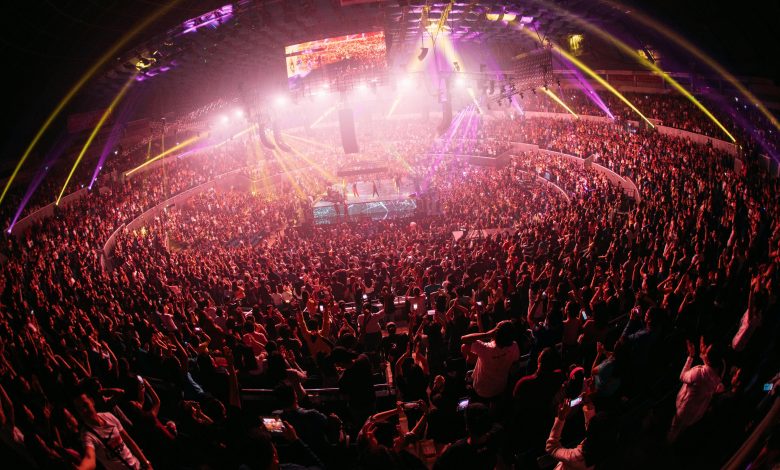
An AI-powered camera system can detect a speaker change and cut to the right angle in 20 milliseconds. That’s roughly 10 times faster than a human operator can react, according to Virtual Video Director, whose neural network-based switching platform has been deployed across broadcast and live event environments for six years. It’s a small detail that says something much bigger about where AI in event production is heading.
The audio visual production services market sits at $44.81 billion in 2025 and is on track to reach $66.58 billion by 2030, according to The Business Research Company. A significant share of that growth ties directly to artificial intelligence working its way into cameras, speakers, lighting rigs and control rooms. For professional audio visual services providers, AI is already part of the daily workflow; it’s in the mixing console, the maintenance schedule and the camera tracking software. And the rate of adoption is picking up. Agorify’s 2025 industry data shows 70% of event technology companies plan to develop AI features within the next 12 months, while 69% of event platforms already include them.
So what does this look like in practice, and why should anyone who plans, produces or attends live events care? Three areas stand out: what audiences see, what they hear and what happens behind the scenes to keep it all running.
When Cameras and Lights Have a Mind of Their Own
The visual side of live production has always been the most labour-intensive. Camera operators, lighting designers and video engineers work in real time with very little margin for error. AI is changing the maths on that.
Intelligent camera systems now track speakers automatically, frame shots based on movement and composition rules and switch angles dynamically during presentations. Virtual Video Director’s platform, for instance, uses on-device neural network voice detection across up to 128 audio channels, supporting integration with ATEM, vMix, Tricaster and OBS systems. There’s no cloud round-trip and no perceptible delay.
Beyond cameras, AI-driven control platforms are learning to read the room. According to AV Productions UK, systems like Q-Sys and L-ISA can recognise voices, detect ambient noise and fine-tune sound and lighting simultaneously. Lighting systems learn presentation sequences and adjust brightness as speakers move across the stage, maintaining cinematic consistency without a lighting operator manually riding the faders. At Prolight + Sound 2025 in Frankfurt, one of the industry’s largest trade events, organisers highlighted how machine learning algorithms now optimise both the placement of light sources and their adaptation throughout an event, creating a tailored atmosphere in real time.
Here’s where AI in event production gets particularly useful across live visuals:
- Automated speaker tracking and shot framing without a dedicated camera operator
- Dynamic camera switching triggered by voice detection, stage movement or slide changes
- Adaptive lighting that responds to presenter movement, camera exposure and ambient conditions
- Generative AI tools that accelerate stage design visualisation and layout concepting
The important thing to notice is that production crews aren’t shrinking. They’re shifting. Camera operators become creative supervisors, reviewing AI-selected shots and overriding them when a more interesting angle presents itself. Lighting designers spend more time on storytelling and less on troubleshooting flicker rates. The technology handles the repetitive mechanics and the humans handle the artistry. That’s a better division of labour for everyone involved and it makes high-quality production accessible to smaller events that previously couldn’t afford a full technical crew.
Sound That Listens Back
If the visual side of AI in event production gets the most attention, the audio side might be where it delivers the most value. Sound is notoriously difficult to get right in live settings. Every venue has different acoustics. Every audience absorbs sound differently. Humidity, crowd density and background noise all change throughout the day.
AI-powered sound systems are now addressing all of this simultaneously. At major festivals including Coachella, AI-assisted systems dynamically adjust sound levels in real-time, analysing incoming audio signals and fine-tuning EQ, compression and spatial balance on the fly, according to Echotone Music’s 2025 reporting. The result is consistent, high-quality sound for audiences whether they’re front row or hundreds of metres from the stage.
Digital mixers from brands like Yamaha and Waves Audio now use algorithms that optimise signal paths and enhance clarity across complex multi-stage setups. Auto-mixing tools like Roex’s Automix handle basic mixing decisions for smaller venues or volunteer-run events, while engineers retain final control over the creative choices that shape the audience’s experience. For touring productions, AI analyses venue-specific data (including humidity, room dimensions and crowd absorption patterns) to preset equalisation settings, ensuring consistent sound night after night across entirely different spaces.
Then there’s the accessibility angle, which deserves more attention than it typically receives. AI speech recognition in 2025 achieves 95 to 98% accuracy in clean audio conditions, per V7 Labs. Word error rates in noisy environments have dropped from 45% to 12% since 2019, a 73% reduction according to VoiceToNotes.ai’s benchmarking data. That level of reliability makes real-time AI captioning genuinely viable at scale. It serves attendees with hearing difficulties, of course, but it also opens events to multilingual audiences worldwide through live translation, expanding reach without adding production complexity. For event organisers, this also simplifies compliance with tightening accessibility regulations across both the US and Europe.
And when real-time captioning works at that accuracy, it changes who your event audience can actually be.
The Crew You Don’t See
The most consequential AI applications in live events might be the ones audiences never notice. Behind the curtain, AI is tackling the operational risks and logistical headaches that have plagued production teams for decades.
Predictive maintenance is a good example. AI monitoring tools now analyse data from lighting fixtures, amplifiers, displays and other critical equipment, tracking temperature fluctuations, signal degradation, power irregularities and usage patterns in real time. According to AV Productions UK, these systems can predict a projector failure days before an event. A technician swaps out the unit during setup and the audience never knows there was almost a problem. For large-scale productions where a single equipment failure during a keynote can derail an entire programme, that kind of foresight changes the risk profile entirely.
The efficiency gains are measurable. AV Productions UK reports that AI-driven control platforms have reduced AV setup preparation time from approximately eight hours to around two hours. Agorify’s data indicates AI-driven automation cuts staffing costs by 20 to 30% for event agencies. These aren’t theoretical projections; they’re operational realities for companies already using these tools daily.
Forrester’s Events Survey, based on data from over 250 event managers, found that 68% of organisations use (or plan to use) AI for data analysis. On top of that, 39% of event marketers use AI for content creation. The gap between interest and implementation is closing, even if Forrester’s researchers observed that many organisations remain in learning mode. The direction, though, is clear.
If AI can predict a projector failure three days before a keynote, manage sound for 50,000 people and switch cameras faster than you can blink, what does the production team of 2030 actually look like?
The Stage is Already Set
AI in event production has moved past the experimental phase. It’s in the cameras, the speakers, the lighting rigs and the maintenance logs. The $44.81 billion AV production services market is absorbing these tools because they deliver practical results: faster setups, fewer failures, better sound, sharper visuals.
The gap between early adopters and the rest of the industry is narrowing quickly. With 70% of event technology companies actively building AI features and 69% of platforms already including them, AI-assisted production is on course to become standard practice rather than a competitive advantage. Forrester’s survey data points to a market where the appetite for AI far exceeds current deployment, which typically means rapid acceleration is coming. The organisations that figure out implementation first will set the benchmark; the rest will be adapting to it.
For anyone involved in live events (planners, producers, AV providers), the practical question has shifted from whether to adopt AI to which applications deliver the most value for your specific production needs. Whether it’s a corporate conference for 200 people or a festival stage in front of 50,000, the tools are available, proven and getting more accessible by the month. The entry point certainly doesn’t have to be a full AI overhaul; even a single AI-powered mixing tool (or an automated camera switcher) can meaningfully improve what your audience experiences.
For those interested in how AI is streamlining workflows beyond live events, The AI Journal’s guide to automating tasks with AI offers a useful look at how these tools are being applied across content and design processes.
The next time you’re at a conference and everything runs flawlessly, will you wonder how much of that precision was human and how much was something else entirely?