
Here’s a number that should give anyone about to greenlight an AI project some pause. MIT’s 2025 research on enterprise AI development company found that roughly 95% of generative AI pilots delivered no measurable impact on the bottom line. Not that they failed in a technical sense. Most of them worked fine in the demo. They simply never turned into anything the business could point to. IDC framed the same problem from another angle that stuck with me. For every thirty-three AI proofs of concept a company launched, only four reached production.
I’ve spent enough time on both sides of that gap to say something that sounds obvious the moment you hear it and gets ignored constantly. The pilot working was never the hard part. A model that gives sharp answers on a clean dataset in a notebook has proven almost nothing about whether it will survive contact with your actual business. The distance between that demo and a system people trust in production is where AI projects quietly live or die, and closing it is a completely different job than building the demo was.
That job is mostly not about the model at all. It’s about the data feeding it and the systems it has to survive inside once real users arrive. It’s the unglamorous engineering that turns a clever prototype into something dependable, and, if I’m honest, the discipline to kill the pilots that were never going to pay off. That combination is what a good AI development company is actually for.
The Demo Was Never the Hard Part
A pilot is built to impress. It runs on curated data and follows a happy path, in front of a friendly audience that wants it to work. Every one of those conditions disappears in production.
Real data is messier than pilot data, and it goes stale. Real users do things you never scripted. Edge cases that never came up in the demo show up on day two. And eventually a finance team asks the question the demo never had to answer, which is what the thing actually earned. The widely quoted failure statistics aren’t really a story about AI being overhyped. They’re a story about the enormous gap between “it works in a demo” and “it works,” and about how many teams treat crossing that gap as a formality rather than the main event.
I saw this up close with a document-processing model that dazzled everyone in the demo. On the dozen sample files it had been tuned against, it was nearly perfect. Then it met the real intake queue, full of scanned faxes and rotated pages and forms people had filled out in ways no one had anticipated, and its accuracy fell off a cliff. The model hadn’t changed at all. The world it was suddenly asked to work in had.
Why Pilots Stall, and It’s Almost Never the Model
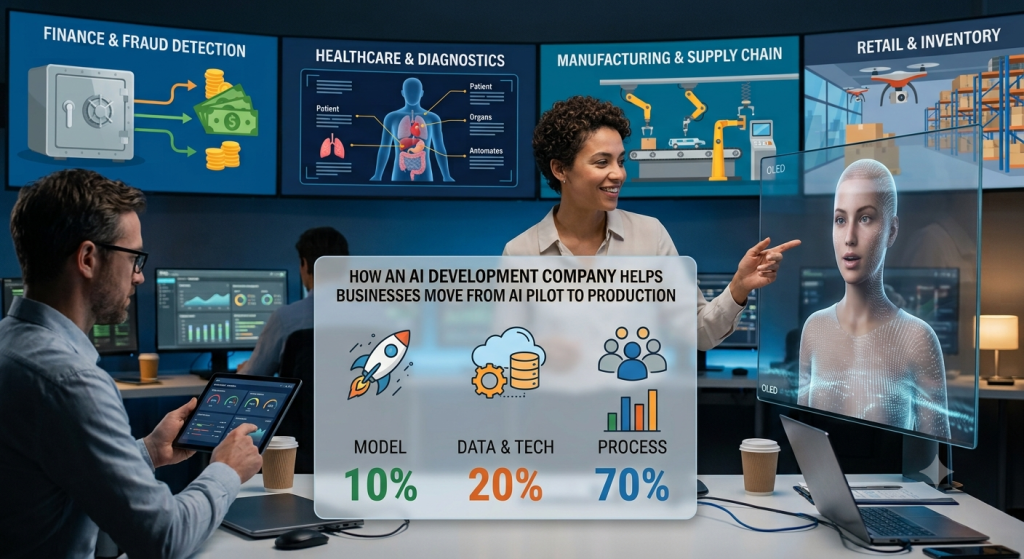
If you want a single number that reframes the whole problem, BCG’s is the one I’d pick. In their analysis of where AI value actually comes from, they put only about 10% of the effort on the algorithm itself. Another 20% is the surrounding technology and data. A full 70% is people and process. The model everyone obsesses over is the smallest slice of the three.
That matches what actually goes wrong. Gartner, projecting that at least 30% of generative AI projects would be abandoned after the proof-of-concept stage, named the reasons plainly, and the theme was mundane. Shaky data. Cost that got out of hand. Risk controls nobody had built, and a business case no one could quite state. Notice what isn’t anywhere on that list. The model is not smart enough.
Walk through how a pilot really dies and the pattern repeats. The data that looked clean in the demo turns out to be fragmented and stale the moment it’s pulling from live systems. The model has to bolt onto software built years before anyone imagined it. Evaluation? Usually nobody set any up, so quality drifts and no one notices until a customer does. There’s no guardrail and no honest “I’m not sure,” so an occasional confident mistake chips away at trust fast. Then the cost that was nothing across a hundred test queries turns alarming across a million, and the people who were meant to use the thing never changed how they work in the first place. None of that is a model problem. Every bit of it is engineering and organization.
What an AI Development Company Actually Does Differently
This is where a specialized partner earns its fee, and it isn’t by having a cleverer model. It’s by treating AI as a production system rather than a science project.
In practice, that starts with data pipelines that keep the model fed with fresh, correct information instead of a frozen snapshot from six months ago. The output then has to land inside the real workflow, where the work already happens, not in a separate tool nobody remembers to open. Someone has to build a way to measure quality continuously, so a regression gets caught before your customers catch it, with monitoring and guardrails and a person kept in the loop wherever the stakes justify one. Cost has to be tamed before it scales from trivial to frightening. And none of it counts unless the change-management work happens too, so the system is genuinely used rather than admired for a week and quietly dropped.
There’s a data point here that businesses tend to find uncomfortable. MIT’s same 2025 research found that AI deployments built with specialized partners reached scale roughly twice as often as ones built entirely in-house. That isn’t a knock on internal teams, who are often excellent. It reflects that production AI is a distinct discipline, and the teams who do it every week have already made the expensive mistakes on someone else’s project. In our AI/ML development work at BiztechCS, the deployments that make it to production are almost never the ones with the most impressive model. They’re the ones where the boring scaffolding around the model was taken seriously from the start.
Read also: How to Choose the Best AI/ML Development Company for Your Business Needs?
The Honest Part: Some Pilots Should Die
Now the caveat, because the “95% failure” headline gets misread as a tragedy when a lot of it is just good hygiene. Not every pilot deserves production. Some were solving a problem that didn’t matter, and the right outcome for those is a quiet, early death.
The discipline isn’t rescuing every proof of concept. It’s telling the difference between the ones worth industrializing and the ones worth stopping, and then going deep on the survivors. BCG’s data backs this up in a way I find genuinely clarifying. The companies getting the most out of AI pursue only about half as many opportunities as their peers, and they successfully scale more than twice as many. They run fewer pilots and finish more of them. A partner willing to tell you which pilot to kill is worth considerably more than one who cheerfully ships all of them and lets you discover the dead ends yourself.
The uncomfortable version of this is that a serious partner will occasionally argue you out of the very project you called them for. That isn’t them turning down work. It’s them noticing that the pilot in front of them solves a problem your business doesn’t really have, and having the nerve to say so before you’ve spent a year and a budget finding out the hard way.
What to Ask Before You Hire One
Because the whole thing depends on the partner, be concrete when you evaluate one. Ask how they get a model to production, not how accurate their model is on a benchmark. The benchmark is table stakes and it tells you almost nothing about whether the system will hold up.
Push on what their monitoring looks like once it’s live, and what happens when the model is confidently wrong at two in the morning. Find out how they keep evaluating quality after launch, not just before it. Most of all, get them to explain how they’ll measure business impact, because if the answer isn’t tied to something a finance team would recognize, you’re already back in the 95%. A partner who only wants to discuss model architecture is selling you a demo. The right AI development company would rather dig into your data and your real workflow and how you’ll know the thing is working, because that is what a system, as opposed to a science project, is actually made of.
The pilot-to-production gap isn’t a mystery, and it isn’t really about artificial intelligence at all. It’s about the discipline to build the boring parts properly and the honesty to stop the pilots that won’t pay. At BiztechCS we’ve watched that play out across enough AI/ML development projects to believe the businesses that win aren’t the ones running the most experiments. They’re the ones who industrialize the few that work and have the sense to walk away from the rest.