The video production landscape is experiencing a seismic shift. What once required a full crew, expensive equipment, and weeks of post-production can now be accomplished by a single creator with a laptop and the right AI tools. But this isn’t just about speed—it’s about fundamentally rethinking how we approach visual storytelling.
I’ve been creating video content for the past seven years, and the changes I’ve witnessed in the last two alone have been more dramatic than everything that came before. Let me walk you through what’s actually happening in the industry right now.
The Current State: Where Traditional Meets Algorithmic
Traditional video production workflows haven’t changed much in decades. You script, storyboard, shoot, edit, color grade, add sound, and render. Each stage requires specialized skills and software—Adobe Premiere for editing, DaVinci Resolve for color, After Effects for motion graphics. A professional editor might spend 40 hours on a 5-minute video.
Meanwhile, AI-powered video tools have evolved from novelty experiments to legitimate production assets. According to a 2024 report by Grand View Research, the global AI in media and entertainment market is projected to reach $99.48 billion by 2030, growing at a compound annual growth rate of 26.9%. This isn’t hype—it’s measurable adoption.
But here’s what’s interesting: the best creators aren’t abandoning traditional tools. They’re hybridizing. A friend of mine who runs a YouTube channel with 800K subscribers now uses AI for initial rough cuts and B-roll generation, but still does final color grading and sound mixing manually. His production time dropped from 12 hours per video to 6, while his quality actually improved because he could spend more time on the creative decisions that matter.
The traditional video production software market—dominated by Adobe, Blackmagic, and Avid—is responding by integrating AI features into existing platforms. Adobe’s Sensei AI now powers auto-reframe, content-aware fill, and speech-to-text features in Premiere Pro. But standalone AI tools are moving faster, iterating weekly instead of annually.
The Pressure Points: What’s Breaking in Video Production
The video production market is facing three critical challenges that are forcing change:
The Volume Problem: Businesses now need 10x more video content than they did five years ago. Social media algorithms favor video, and platforms like TikTok, Instagram Reels, and YouTube Shorts demand constant output. A marketing team that used to produce one video per month now needs three per week. Traditional workflows can’t scale to meet this demand without proportionally scaling budgets and teams.
The Skills Gap: Professional video editing requires months of training. Color grading is practically an art form. Motion graphics demand both technical and design skills. According to LinkedIn’s 2024 Jobs Report, video editor positions have a 35% longer time-to-fill than the average creative role because qualified candidates are scarce. Small businesses and solo creators simply can’t access this expertise.
The Cost Barrier: A single professional video can cost anywhere from $3,000 to $50,000 depending on complexity. Stock footage subscriptions run $200-500 monthly. Professional editing software subscriptions add another $50-100 per month. For startups, small businesses, and independent creators, these costs are prohibitive. They’re forced to choose between quality and quantity, and usually sacrifice both.
I’ve seen this firsthand. A local restaurant owner I know wanted to create weekly promotional videos but couldn’t justify hiring a videographer at $500 per video. She tried doing it herself with iMovie but spent so much time learning the software that she gave up after three attempts. This is the reality for millions of small businesses.
Integrating AI Into Your Video Workflow: A Practical Approach
The key to successfully using AI in video production isn’t replacing your entire workflow—it’s identifying specific bottlenecks and applying the right tools strategically.
Stage 1: Concept and Scripting
AI writing tools like ChatGPT or Claude can help generate initial script ideas, though they need heavy human editing. I use them for brainstorming alternative angles or expanding on concepts, not for final scripts. The real value is in breaking through creative blocks, not in generating finished content.
Stage 2: Visual Planning
Tools like Runway ML and Pika Labs can generate visual references and storyboard concepts from text descriptions. Instead of spending hours searching stock photo sites or sketching rough ideas, you can generate dozens of visual concepts in minutes. A filmmaker I interviewed used this approach to pitch a commercial concept to a client—the AI-generated mood boards helped secure the project, which was then shot traditionally.
Stage 3: Asset Creation
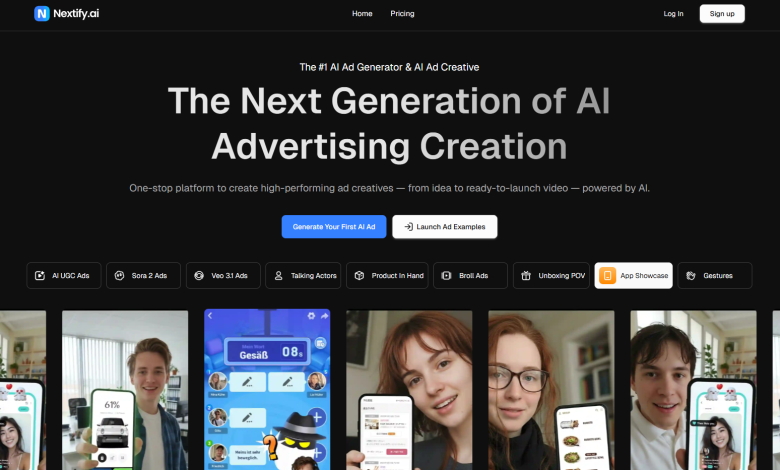
This is where AI shines brightest. Need B-roll of a specific scene you don’t have footage for? Tools like Synthesia can generate video from text, though the results still look somewhat artificial. For advertising content specifically, platforms like Nextify.ai function as an AI ad video generator, allowing marketers to create promotional videos from product descriptions and images without filming anything. A case study from an e-commerce brand showed they reduced ad production time from 3 days to 2 hours using a AI Ad Video Generator, though they noted the content worked better for social media ads than for premium brand campaigns.
Stage 4: Editing and Assembly
AI-powered editing tools like Descript treat video like a text document—you can edit footage by editing the transcript. Delete a sentence, and the corresponding video disappears. This is genuinely revolutionary for interview-heavy content. A podcast producer I know cut his editing time by 60% using this method.
Adobe’s Auto Reframe uses AI to intelligently crop horizontal video for vertical formats, tracking subjects and keeping them centered. What used to take 30 minutes of manual keyframing now happens in 30 seconds.
Stage 5: Enhancement and Finishing
AI color grading tools can analyze your footage and apply professional-looking color corrections automatically. Tools like Topaz Video AI can upscale footage, remove noise, and even interpolate frames to convert 24fps footage to 60fps. The results aren’t perfect, but they’re often good enough, especially for social media content.
What to Watch Out For: The AI Video Production Reality Check
Despite the hype, AI video tools have significant limitations you need to understand before restructuring your workflow.
The Uncanny Valley Problem: AI-generated human faces and movements still look slightly off. Your audience will notice, even if they can’t articulate why. This is fine for abstract B-roll or product shots, but problematic for anything requiring emotional connection.
Consistency Issues: AI tools struggle with consistency across multiple shots. If you’re generating a series of scenes, characters might look slightly different in each one. Lighting and style can shift unpredictably. This makes AI-generated content difficult to use for anything requiring visual continuity.
Copyright Ambiguity: The legal status of AI-generated content is still evolving. Some AI tools were trained on copyrighted material without permission, creating potential legal risks. Always check the licensing terms of any AI tool you use commercially. Some platforms explicitly state their output is royalty-free; others are vague.
The “Good Enough” Trap: AI makes it easy to produce mediocre content quickly. The danger is that you’ll stop pushing for excellence because “good enough” is so accessible. I’ve seen creators’ quality decline after adopting AI tools because they stopped critically evaluating their work.
Over-Reliance Risk: If you build your entire workflow around a specific AI tool, you’re vulnerable to that platform changing its pricing, features, or shutting down entirely. Several AI video tools I used in 2023 no longer exist. Always maintain the ability to produce content without AI if necessary.
The Road Ahead: What’s Coming in AI Video Production
Based on current development trajectories and conversations with people building these tools, here’s what I expect to see in the next 2-3 years:
Real-Time Collaboration Between Human and AI: Instead of AI generating complete videos, we’ll see tools that function more like intelligent assistants—suggesting edits, offering alternatives, and automating tedious tasks while keeping humans in creative control. Think of it like autocomplete for video editing.
Personalization at Scale: AI will enable mass customization of video content. Imagine creating one master video that automatically adapts its messaging, visuals, and pacing based on who’s watching it. Marketing teams are already experimenting with this for ad campaigns.
Democratization Without Degradation: As AI tools improve, the quality gap between professional and AI-assisted amateur content will narrow. This doesn’t mean professionals become obsolete—it means the baseline quality rises, and professionals differentiate through creativity and strategic thinking rather than technical execution.
Hybrid Workflows Become Standard: The future isn’t “AI vs. Traditional”—it’s integrated workflows where AI handles specific tasks within a broader creative process. Professional editors will use AI for rough cuts and routine tasks, freeing them to focus on storytelling and emotional impact.
The Bottom Line: Tools Change, Storytelling Doesn’t
AI is genuinely transforming video production workflows, but it’s not replacing the fundamental skill that matters most: knowing what story to tell and how to tell it effectively.
The creators and businesses seeing the best results from AI video tools aren’t the ones trying to automate everything—they’re the ones strategically applying AI to specific bottlenecks while maintaining creative control over the elements that define their unique voice.
If you’re producing video content in 2026, you can’t ignore AI tools. But you also can’t rely on them exclusively. The sweet spot is somewhere in between: using AI to handle the tedious, time-consuming tasks that don’t require human creativity, while reserving your energy and attention for the decisions that actually matter.
The technology will keep improving. The workflows will keep evolving. But the core question remains the same: What are you trying to say, and who are you trying to reach? Answer that first, then choose your tools accordingly.