The art of helping people carry their pregnancy, labor and their post-during pregnancy has greatly shifted several folds with the development of education and technology. Artificial intelligence is also being applied in the learning process of modern doulas training, as well as artificial experience to future doulas. The AI simulation will provide interactive experience in which the trainee is able to train and practice on emotional support, communication and decision making that will be applicable in various childbirth situations. The strategy helps to fill in the gap between theory and practice to make students more prepared and assured to face the real world.
The Evolution of Doula Education
Conventional doula education has been based on workshops, mentorship, and live demonstrations as a way of educating the learners about the complexities of birth support. Although these techniques are a good experience, they usually rely on the access to the live births or role-play sessions that might not be varied enough to ensure that the range of experiences that students gain is completed. As the need to hire a well-trained doula continues to grow adapting to the more and more intricate childbirth setting, educators have been forced to explore digital tools to enhance the availability and quality of learning.
The use of AI simulation has not only provided a new dimension to doula education due to the virtual component but also provided the learners with a chance to experience real birth scenarios. Rather than using observation only, students will be able to communicate with artificial patients powered by AI to share their emotions, describe their sensations, and respond in response to the doula. This type of experiential learning has ensured that training is more consistent, flexible as well as inclusive allowing exposure to situations that may not be experienced in all other traditional forms of training.
Realistic Scenario-Based Learning
Simulations of AI doula training are meant to recreate as many possible birthing scenarios as possible, including some smooth births and more complicated emotional or physical issues. These simulated situations enable the learners to be in interactive situations where they have to use empathy, communication and problem solving in real time. The tone, the selected words and body language can be reacted to by the virtual birthing client which will enable the trainees to perfect their interpersonal skills and learn how to change their approach depending on the emotional state of the client.
This simulation enables the trainees to gain effective critical thinking and emotional intelligence, which are the two essential elements of successful doula care. Students are not taught to stick to the answers, but to think on their feet and react suitably to various changes. The capacity to have varied scenarios also makes the graduates ready to deal with the unpredictability of the actual births which enhance their confidence and professional preparation.
Integration with Educational Platforms
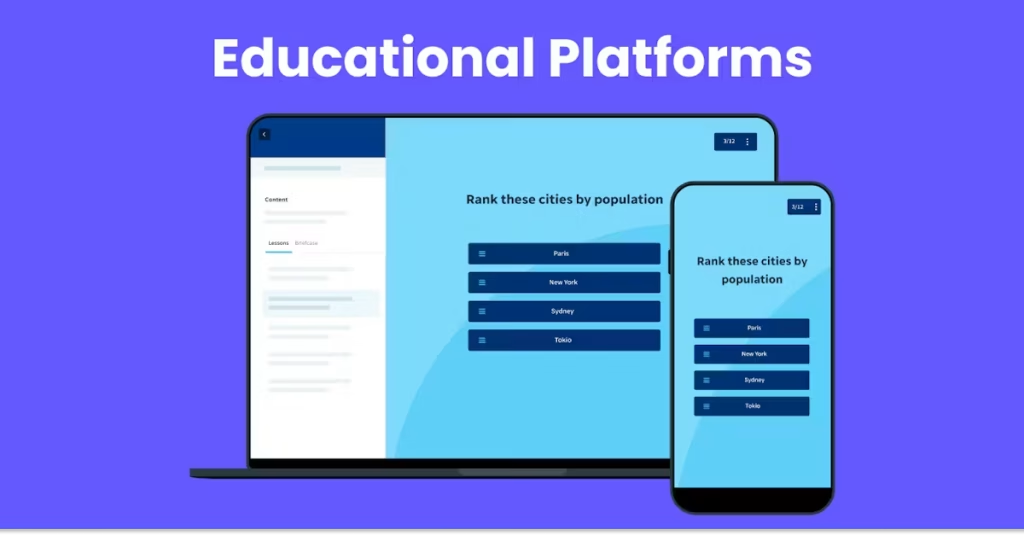
The simulation software of AI is being incorporated directly into the curriculum of any modern doula school. These usually go together with online learning platforms which monitor progress, assess performance and provide real-time feedback. This would enable students to go through their interactions, know where they can improve and repeat situations to reinforce their weak areas. The technology also allows the instructors to track progress and tailor upcoming lessons to the requirements of every learner.
Implementation of AI simulation within a systematic training module provides an equilibrium of self-education and mentoring. Students will be able to train according to their own schedules, participate in numerous sessions and discuss their experience in group workshops later. The hybridity of this approach enhances the learning environment and assists in the mediation of digital practice and human connection that is at the core of the doula profession.
Ethical and Emotional Preparedness
Emotional preparedness is one of the most valuable things about AI-based doula training. Birth may be demanding, unpredictable and emotionally volatile. The simulations allow students the security to investigate how they may react to profoundly emotional or stressful situations. Guided reflection and repetition will equip them with emotional stamina and compassionate care to take care of clients.
The AI systems are further designed to replicate ethical dilemmas that might occur in the real-life context. As an example, trainees can be placed in virtual situations where they are required to maneuver on a personal spectrum, family issues, or communication issues with medical practitioners. Simulation practice of such moments will guarantee that doulas will acquire the professionalism and sensitivity to manage such situations of complexity within interpersonal interactions in the real world.
Accessibility and Global Reach
Another reason why AI simulation is relevant is to open up doula education to individuals who might not be able to participate in face-to-face programs. Virtual training tools allow online doula schools to access learners anywhere in the world without being restricted by location or schedule. This will not only increase the opportunities of learners but also will help to create a more diverse community of doulas, which will make the profession richer, both in terms of cultural perspectives and approaches.
Simulation-based training is flexible and cost-effective to students who juggle between work, family, or economic limitations. It saves the time of traveling and gives learners the opportunity to study the content at their pace without affecting the quality of the education. Consequently, this increases the number of people who can become certified and join the profession in order to fill the rising demands of the trained birth support professionals.
The Future of Doula Simulation Technology
Artificial intelligence in training doula is a developing field, and new technologies are being introduced to enhance the simulation and other interactive features all the time. The developers are developing voice recognition and emotion analysis and even simulated worlds to enhance the immersion. Due to the maturation of technology, future doulas will be required in simulated holographic clients, attend collaborative virtual births with other care providers, and in this way, they will be forced to enrich their teamwork and communication competencies.
Finally, the introduction of AI simulation is defining a new world of doula education where computer technology helps humanity and does not overtake it. Innovation coupled with compassion can make a modern doula training grant potential future birth professionals the confidence, sensitivity, and flexibility that they need to deliver exceptional care. Such a humanistic approach to learning and technological advancement means that the future generation of doulas will be better equipped than before to help families go through one of the most significant events in their lives.