



Buying furniture online has always required a leap of imagination.
A shopper may love a product photo and still hesitate. Will the TV stand feel too wide for the living room? Will the finish read warm or flat under different lighting? Will a dresser leave enough clearance for the drawers to open? Will a nightstand sit at the right height beside the bed? Will a shoe cabinet actually solve the entryway clutter, or just add another bulky object to the hallway?
That hesitation is why furniture ecommerce behaves differently from most online categories. Shoppers are not simply buying an object. They are buying scale, proportion, storage function, room compatibility, and, above all, confidence that the piece will work once it is in the room.
AI room visualization is starting to change that experience. By combining room images, structured product data, layout intelligence, visual recommendations, and increasingly capable rendering tools, furniture shopping is shifting from static to interactive. Rather than asking customers to imagine how a piece might look at home, AI-powered tools can help them preview, compare, and plan before they commit. But the real story is not prettier rooms. The deeper value of AI furniture shopping is helping customers make better decisions — and that depends on something far less glamorous than generative imagery.
Why Furniture Is One of the Hardest Categories to Buy Online
Furniture is among the most complex ecommerce categories precisely because it has to work in real, physical space.
A customer buying a lamp, a cushion, or a small decor item can focus mostly on style and price. A customer buying a TV stand, dresser, bed, sofa, or storage cabinet has to reason about a much larger set of variables — most of which a product photo cannot answer on its own:
- Will it fit the wall, and leave the room feeling open rather than crowded?
- Will the color work with the furniture already in the room?
- Will the storage capacity actually match daily needs?
- Will the doors, drawers, or shelves be practical in use?
- Will it arrive in a manageable way, and is assembly worth the effort?
- And if it does not work — how painful is the return?
Each of those open questions adds friction, and friction is the single biggest barrier in online furniture conversion. A TV stand is the textbook example. A shopper may love the design and still stall on whether it is wide enough for a 65-inch screen, shallow enough for a small apartment, and capable of hiding the cables, router, remotes, and game console. That decision is not really about appearance. It is about how the product will behave inside a specific room — and behavior is exactly what a flat product image leaves to the imagination.
AI room visualization is compelling because it attacks that gap directly: it helps shoppers see furniture in context instead of in isolation.
What AI Room Visualization Actually Means
AI room visualization is not a single technology. It is a stack of capabilities that together move a shopper from browsing products to planning a room.
In furniture ecommerce, that stack might include uploading a room photo, generating layout concepts, previewing a product in a space, comparing finishes or materials, recommending complementary items, or assembling shoppable room scenes. At its most useful, the experience connects three things that rarely meet on a traditional product page: the shopper’s real space, the product’s actual data, and the room outcome the shopper is trying to achieve.
| Technology | What It Does in Furniture Shopping | Where It Helps Most |
|---|---|---|
| AI image generation | Creates room concepts and style variations | Inspiration and discovery |
| Computer vision | Interprets room photos and visual context | Room analysis and layout |
| AR placement | Previews a product in a physical room | Scale and spatial confidence |
| 3D models | Shows product form from multiple angles | Shape, proportion, details |
| Recommendation systems | Suggests products by style, size, behavior | Product discovery |
| Structured product data | Gives AI accurate size and function facts | Fit, filtering, and trust |
No single layer carries the experience. Generative inspiration is genuinely useful, but furniture shoppers also need accurate dimensions, honest product photography, clear storage details, and practical buying guidance. The division of labor is simple to state and hard to execute: a beautiful visualization can inspire a purchase, but reliable product data is what makes that purchase feel safe.
From Static Product Pages to Room-Based Shopping
Traditional ecommerce pages are built around the item — a title, a gallery, a price, a dimensions table, reviews, and an add-to-cart button. That structure still matters. But furniture buyers increasingly need a room-based experience layered on top of the product-based one.
A white-background image lets a customer see the product clearly. Lifestyle photography conveys mood and styling. Yet neither fully answers the most personal question a furniture shopper has: how will this piece work in my room? AI room visualization is the first tool set that begins to close that gap at scale.
Instead of evaluating a TV stand alone on a product page, a shopper can start to picture it beneath a wall-mounted screen, beside a particular sofa, near a window, inside a narrow apartment. Instead of guessing whether a warm wood tone will clash with an existing rug, they can simulate the combination. That reframes the entire shopping mindset. The old question was “Do I like this product?” The new question becomes “Can I see this product working in my home?” — and the second question is a far stronger buying signal than the first.
A Confidence Engine, Not Just an Inspiration Tool
AI visualization is often filed under “inspiration.” That description is true but incomplete. In furniture ecommerce, AI’s more important role is confidence-building.
Furniture carries friction because shoppers are afraid of being wrong — wrong size, wrong color, wrong proportion, wrong return ordeal. Room visualization reduces that fear by supplying context before the commitment. Mapped against the specific uncertainties that stall a furniture purchase, the shift looks like this:
| Shopper Uncertainty | Traditional Response | AI-Enhanced Response |
|---|---|---|
| “Will it fit?” | Dimensions listed on the page | Shown in room context with scale cues |
| “Will it match?” | Lifestyle images and swatches | Style comparison in a room-like setting |
| “Will it feel too bulky?” | Photos from several angles | Layout preview with surrounding furniture |
| “What should I pair it with?” | Related-products carousel | Room-based recommendations |
| “Is this the right category?” | Search filters | Problem-based suggestions (“hide cables”) |
| “Can I trust the look?” | Reviews and product photos | Real images, data, and previews combined |
The pattern across every row is the same: the most useful AI shopping tools do not merely make rooms prettier. They make product decisions clearer. That distinction is the whole argument of this piece, and it is the one most easily lost in the excitement over generative imagery.
How AI Helps Shoppers Understand Size and Scale
Scale is the hardest part of buying furniture online, and the place AI can add the most value — provided one condition holds.
A TV stand can look sleek in a studio photo and feel undersized beneath a large television. A dresser can look compact until the buyer realizes the drawers need clearance to open. A nightstand can look right in isolation and sit too low beside a tall bed. A shoe cabinet can appear slim and still block the walkway if the depth is wrong. Visualization can surface all of these problems earlier in the journey, when they are cheap to fix rather than expensive to return.
This matters most for larger items such as TV stands with storage, where a shopper has to judge not only how the piece looks, but its width relative to the screen, its depth relative to the walkway, its cable access, and its ability to organize the media equipment behind a clean front. For a category like that, the relevant data a visualization tool needs is unusually rich:
- Overall width, depth, and height
- Internal storage layout and shelf adjustability
- Door or drawer clearance
- Cable access and ventilation
- Visual proportion relative to the screen
- Whether the piece works with a wall-mounted TV
And this is where the condition becomes unavoidable. AI can support the decision, but it cannot invent the underlying facts. A render that places a confidently wrong dimension into a room does not reduce uncertainty — it manufactures a new, more dangerous kind. The best experiences pair visualization with accurate size charts, real dimensions, and room-planning guidance. Visualization should illustrate the data, never substitute for it.
The Hidden Dependency: AI Is Only as Good as the Product Data Behind It
AI room visualization can generate convincing images. But if the product data beneath those images is incomplete or inaccurate, the output does not just underperform — it actively misleads. This is the part of the AI-shopping conversation that brands most consistently underestimate.
A visualization system needs far more than a product name. It needs structured information about size, color, material, function, storage, style, and use case — clean, complete, and machine-readable. The quality of that data sets a hard ceiling on the quality of the experience.
| Product Data Field | Why It Matters for AI Shopping |
|---|---|
| Width | Determines wall fit and visual balance |
| Depth | Affects walkway clearance and room flow |
| Height | Impacts proportion and usability |
| Material / finish | Helps match interior style accurately |
| Color family | Supports reliable visual recommendations |
| Storage type | Connects products to functional needs |
| Drawer / door count | Clarifies organization capacity |
| Cable management | Critical for media furniture |
| Assembly details | Reduces purchase hesitation |
| Lifestyle / customer photos | Provides real-world context and trust |
This is why the brands likely to benefit from AI shopping are, quietly, the ones investing in data infrastructure rather than novelty. Online furniture retailers such as Sicotas that maintain clear product dimensions, room-based imagery, and organized, function-led category structures are positioning themselves for an era in which shoppers expect digital tools to compare products on their behalf. A reliable AI-guided experience cannot be built on weak product information — the visualization layer is only ever as trustworthy as the catalog underneath it.
AI Room Visualization and Style Confidence
Furniture is emotional as much as functional. Shoppers want a room to feel calm, warm, modern, organized, or simply theirs. AI can help them explore those feelings before buying, which is a meaningful shift in how the category is sold.
A customer might compare how a TV stand reads in a warm minimalist living room versus a darker, more modern apartment. Another might test whether rattan texture makes an entryway feel softer. Someone furnishing a bedroom might check whether matching nightstands and a dresser produce a genuinely more coordinated look. AI makes those comparisons fast and low-stakes.
It also changes how discovery begins. Instead of starting from a category like “TV stands,” a shopper may start from a goal — “make my living room feel less cluttered,” “hide the cables under my TV,” “create a calmer bedroom,” “organize a small entryway.” That is a move from category-led discovery to problem-led discovery, and it has real consequences for how brands should structure their catalogs. The winners will be the brands that tag, describe, and present products by how people actually use them, not just by what they are called.
AI, AR, and 3D: Related, but Not Interchangeable
AI visualization is often lumped together with AR and 3D modeling, but the three solve different problems, and conflating them leads to muddled product strategy.
AI is strongest at interpreting room style, generating concepts, suggesting combinations, and personalizing recommendations. AR excels at dropping a product into the shopper’s actual environment through a device camera. 3D models let users inspect form, shape, and angles up close. Each has a distinct strength, and each has a real limitation:
| Tool | Strength | Limitation |
|---|---|---|
| AI visualization | Fast room concepts and style exploration | Not always dimensionally exact |
| AR placement | Products seen in the actual room | Needs good 3D models and device support |
| 3D product views | Shows shape, angles, and detail | Expensive to produce at scale |
| Product configurators | Test finishes, sizes, and variants | Only work with structured options |
| Recommendation engines | Surface relevant products | Need strong tagging and clean data |
The mature furniture experience will layer several of these together. A shopper might upload a room photo, receive AI layout suggestions, place a product in AR, rotate a 3D model, compare dimensions against their space, and then shop a complete room look — all in one session. The brands that make that multi-step journey feel like a single, simple flow will hold a durable advantage, because the friction they remove is friction every competitor still carries.
How AI Can Improve Product Discovery
Search behavior is shifting in a way that rewards AI. Customers frequently do not know — or do not use — the industry term for what they need.
A shopper may never search “media console.” They may search “how to hide a router and cables in a small living room.” Another may never search “shoe cabinet,” but will type “how to stop shoes piling up by the front door.” AI can translate those real-world problems into the right product categories, which is unusually powerful in furniture, where customers so often start from a pain point rather than a product name.
| Customer Problem | Category AI Might Suggest |
|---|---|
| “My TV area looks messy.” | TV stand with closed storage |
| “My shoes pile up by the door.” | Shoe cabinet |
| “My bedroom has no storage.” | Dresser |
| “My bedside table is cluttered.” | Nightstand with drawers |
| “My apartment feels crowded.” | Small-space storage furniture |
| “I want a warmer living room.” | Wood-toned or rattan-accent furniture |
This is where AI-powered discovery becomes genuinely more human: it maps everyday language onto product function. For brands, the implication is concrete — product and category pages need to describe not only what an item is, but which problem it solves. The catalog has to speak the customer’s language, not only the merchandiser’s.
What AI Still Cannot Replace
For all its promise, AI can inspire, recommend, and visualize — but it cannot stand in for every part of the furniture decision. Being clear-eyed about the limits is what separates a credible AI strategy from a hype cycle.
AI cannot fully replace accurate measurements, real product photography, material close-ups, verified customer reviews, delivery details, return policies, honest assembly expectations, the unpredictability of real-world lighting, or human judgment about how a piece will actually be lived with day to day. A generated room can look beautiful and still leave the most important questions unanswered. The customer still needs to know the true dimensions, the real finish, the storage layout, the assembly reality, and how the piece will function in an ordinary week.
The point is not that simulation is untrustworthy. The point is the direction of the relationship: the future of AI furniture shopping should not replace trust with simulation. It should use simulation to support trust. That ordering is the difference between a tool that helps shoppers and one that eventually burns them.
Privacy and Trust in AI-Powered Furniture Shopping
AI room visualization frequently asks shoppers to upload images of their homes — which introduces a category of trust challenge that traditional ecommerce never had to manage.
A room photo can reveal personal belongings, family details, a floor plan, window placements, valuables, and more. Customers will reasonably want to know how those images are handled. Brands and technology providers should be explicit about:
- Whether uploaded images are stored, and for how long
- Whether images are used to train models
- Whether users can delete their images and outputs
- Whether a given visual is AI-generated or a real photograph
- Whether stated product dimensions are exact or approximate
Privacy clarity is becoming part of the shopping experience itself, not a footnote buried in a policy page. A tool that asks users to show their homes has to demonstrate, visibly, that it respects their data. In AI-powered ecommerce, trust is no longer only about product quality — it is also about data behavior, and shoppers are learning to judge both.
How AI Can Reduce Purchase Hesitation
The objective of visualization is not a fantasy room. It is the practical movement of a shopper from hesitation to clarity. A strong AI experience helps answer the decision-stage questions that otherwise stall a purchase:
| Customer Concern | How AI Visualization Can Help |
|---|---|
| Will it fit? | Shows approximate scale in context |
| Will it match my room? | Compares finishes, colors, and styles |
| Will it feel too crowded? | Tests placement and layout options |
| What should I buy with it? | Suggests complementary pieces |
| Is this the right category? | Connects room problems with product types |
| Can I imagine living with it? | Creates an emotional preview |
When a shopper clicks after seeing a product in context, that click is qualitatively different from idle browsing — they are closer to imagining ownership. But the responsible framing matters. AI can help reduce hesitation; it should never be sold as a guarantee of fit, color, or final outcome. Overpromising on visualization is the fastest way to convert a confidence tool into a returns problem.
A Framework: The Five Layers of AI-Ready Furniture Ecommerce
A brand preparing for AI-powered shopping can think about readiness in five layers, ordered deliberately from foundation to flourish:
| Layer | What It Means | Why It Matters |
|---|---|---|
| Product truth | Accurate dimensions, materials, finishes, storage | Prevents misleading visuals |
| Room context | Lifestyle images, room examples, layout guidance | Helps shoppers imagine real use |
| Functional tagging | Products tagged by problem, room, size, storage | Powers relevant recommendations |
| Trust signals | Reviews, customer photos, returns, assembly clarity | Supports purchase confidence |
| Shoppable inspiration | Room scenes, bundles, complete-the-look paths | Connects visuals with conversion |
Most brands instinctively start at the fifth layer — the beautiful, shoppable inspiration. The more durable strategy starts at the first. Without product truth, every layer above it becomes fragile, because a stunning shoppable scene built on a wrong dimension is not an asset. It is a liability waiting for a return label.
The Future: From Product Pages to AI-Guided Room Planning
The trajectory points away from isolated product pages and toward guided room planning. A future shopper may begin not with a product search but with a room problem — “I need my living room to feel less cluttered” — and let the experience work backward to specific products.
From that single sentence, an AI-powered flow could plausibly:
- Ask for a room photo or basic dimensions.
- Identify the available wall space.
- Ask about goals — storage, warmth, cable management.
- Recommend product categories.
- Show several layout options.
- Compare product sizes against the room.
- Suggest a complete room look.
- Link directly to the underlying product pages.
- Provide styling, assembly, and care guidance after purchase.
The shift is structural. The old ecommerce funnel ran: product search, product page, decision. The emerging funnel runs: room problem, AI visualization, product recommendation, shoppable room, purchase. Furniture ecommerce becomes less about showing more products and more about helping shoppers make better room decisions — a reorientation from inventory display to decision support.
What Furniture Brands Should Do Now
No brand needs to wait for a perfect AI platform to start preparing. Most of the highest-leverage steps are already within reach today, and most of them are unglamorous data and content work rather than cutting-edge tooling:
| Brand Action | Why It Matters |
|---|---|
| Clean, consistent product data | Helps AI tools make better recommendations |
| Room-based imagery | Helps shoppers imagine real use |
| Clear size and measurement guides | Reduces sizing uncertainty |
| Real customer photos | Builds real-world trust |
| Style and function tags | Improves problem-led discovery |
| Shoppable room scenes | Connects inspiration with purchase |
| Privacy clarity for AI tools | Builds confidence in uploads and data |
The brands that gain the most from AI will not necessarily be the earliest adopters of the flashiest tools. They will be the ones that make their product information easiest for both humans and machines to understand — because in an AI-mediated catalog, legibility to the model is becoming as important as legibility to the shopper.
Final Takeaway: AI Makes Furniture Shopping More Visual, but Data Builds Trust
AI room visualization is changing online furniture shopping by making it more visual, more interactive, and more personal. It helps shoppers move past static product photos and picture how a piece might actually work in their own homes — and that is a real, durable improvement to a category that has always demanded imagination.
But AI visuals alone are not enough, and pretending otherwise sets up both shoppers and brands to be disappointed. The most successful furniture ecommerce experiences will pair inspiration with accurate product data, real-world imagery, clear dimensions, privacy transparency, and practical buying guidance. AI can help customers dream, compare, and explore. Data is what lets them trust what they see.
In the end, the furniture brands that win the AI era will be the ones that make their products easier to imagine and easier to believe — in that order, and never one without the other.
Image Prompts (Recraft AI)
Image 1 — Hero (16:9)
Type B · Conceptual / Editorial-tech · Tool: Recraft · Aspect: 16:9 · Placement: Directly under H1, before opening paragraph
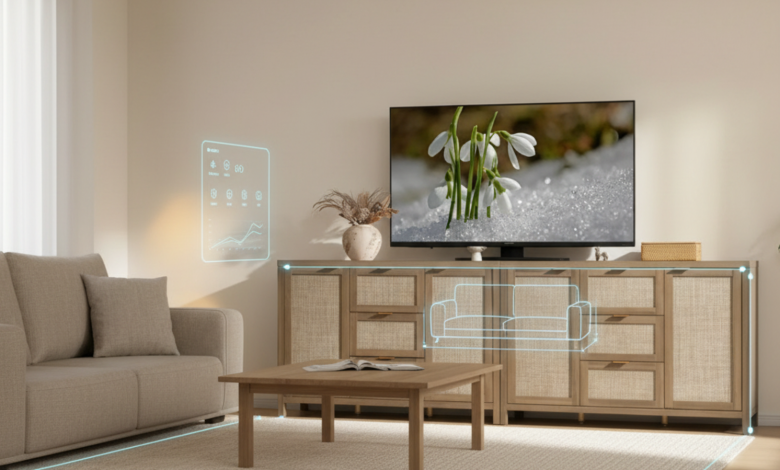
Conceptual editorial photograph illustrating AI-assisted furniture shopping, soft natural daylight, clean and modern, suitable for a technology-publication header. The scene shows a real small living room from a slightly elevated angle: a low, clean-lined wooden TV stand beneath a wall-mounted screen, a compact linen sofa, a light-wood coffee table, and a textured rug. Subtly overlaid across part of the room is a translucent, elegant digital interface effect — faint geometric measurement lines, soft glowing dimension markers along the TV stand width and depth, and a couple of minimal floating UI cards suggesting product data and a room-fit preview — rendered tastefully and restrained, not busy or sci-fi. The blend communicates “real room plus digital intelligence.” Calm neutral palette of warm whites, oat, light oak, and soft cool-blue accents for the digital overlay elements. Magazine-quality, sophisticated, no people, no readable text, no brand logos, no cluttered HUD.
Avoid: brand logos, readable text or numbers, busy sci-fi HUD effects, harsh neon, cyberpunk styling, glitch effects, robotic or humanoid figures, stock-photo cliches, cluttered interface elements, anything that looks gimmicky rather than refined.
Image 2 — Feature (4:3)
Type B · Conceptual / Editorial-tech · Tool: Recraft · Aspect: 4:3 · Placement: Inside H2 “How AI Helps Shoppers Understand Size and Scale,” directly above the H2 “The Hidden Dependency.”
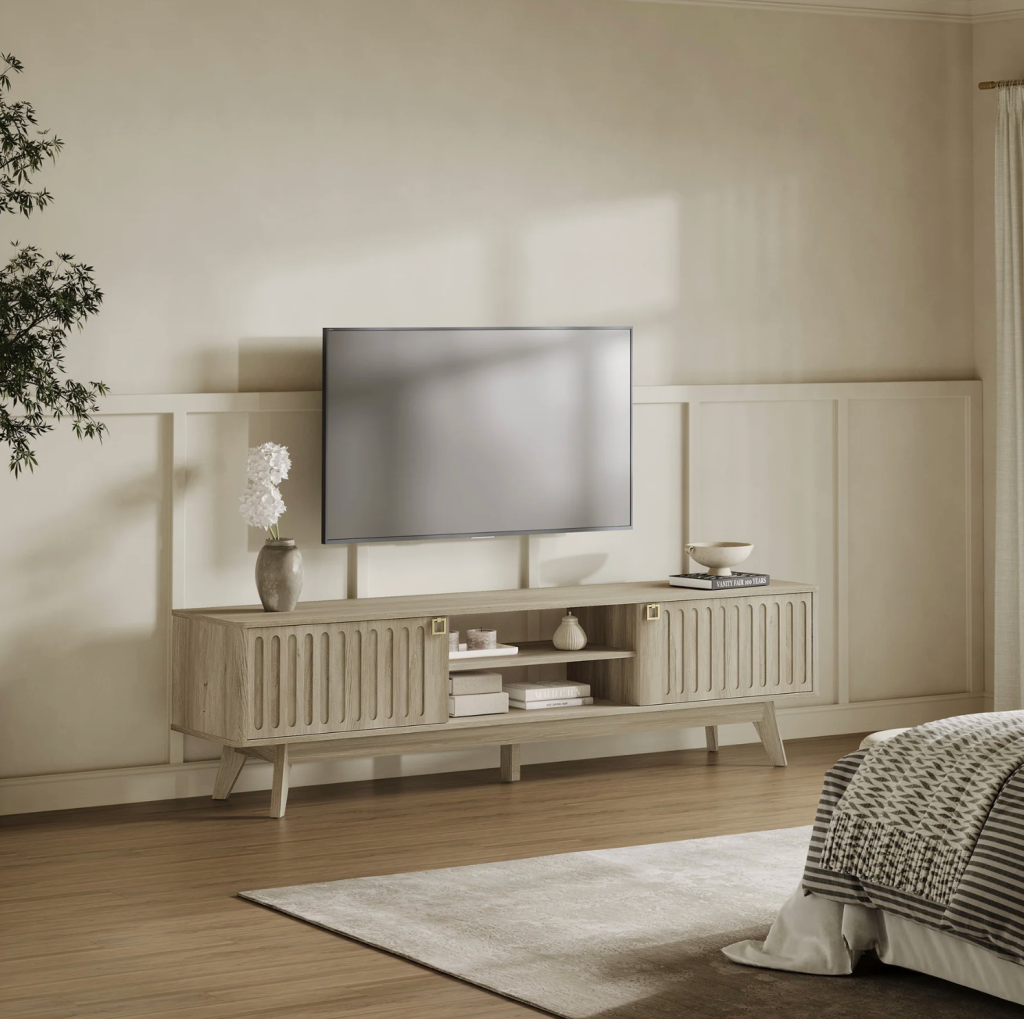
Conceptual close-up editorial photograph showing the relationship between a furniture product and its underlying data, soft natural daylight. The frame focuses on a low, clean-lined wooden TV stand against a neutral wall, with a subtle, elegant translucent overlay of measurement guides — slim glowing lines marking width, depth, and height, plus a couple of minimal floating data points indicating dimensions and storage, rendered tastefully and restrained. The effect should read as “accurate product data made visible,” emphasizing precision and trust rather than spectacle. Warm wood grain clearly visible beneath the digital overlay. Calm neutral palette of warm whites, oat, and light oak with restrained soft-blue accents for the overlay lines. Magazine-quality, refined, no people, no readable text or numbers, no brand logos.
Avoid: brand logos, readable text or numbers, busy sci-fi HUD, neon, cyberpunk or glitch styling, robotic figures, cluttered interface graphics, gimmicky effects, harsh artificial lighting.