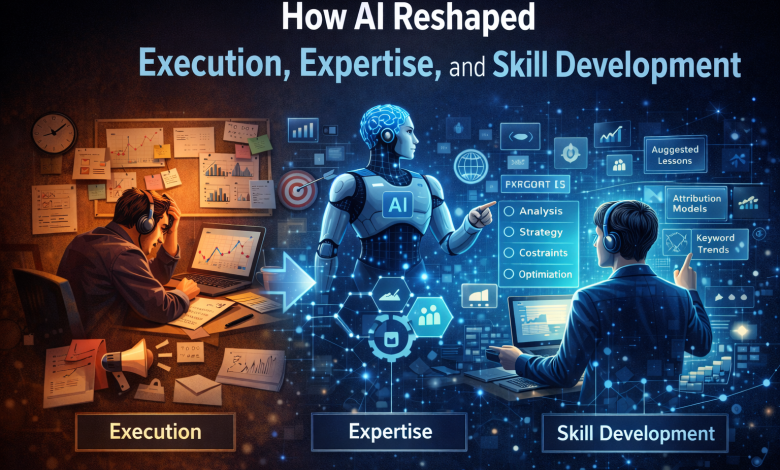
By 2026, artificial intelligence stopped being a “tool” and became an active decision-maker across industries. What started as automation for repetitive tasks evolved into systems that plan, predict, execute, and optimize in real time. Nowhere was this shift more visible than in how businesses executed growth strategies, how professionals built expertise, and how skills were learned, applied, and monetized.
This transformation was not limited to technology companies. Marketing teams, service providers, and educators all felt the change. Execution became faster but more complex. Expertise shifted from doing manual work to supervising intelligent systems. Skill development moved away from static learning toward continuous, AI-assisted upskilling.
In this new environment, success depended on one thing: how well humans and AI worked together. Those who adapted gained an unfair advantage. Those who didn’t were quickly outpaced.
AI Redefined Execution — From Manual Work to Intelligent Systems
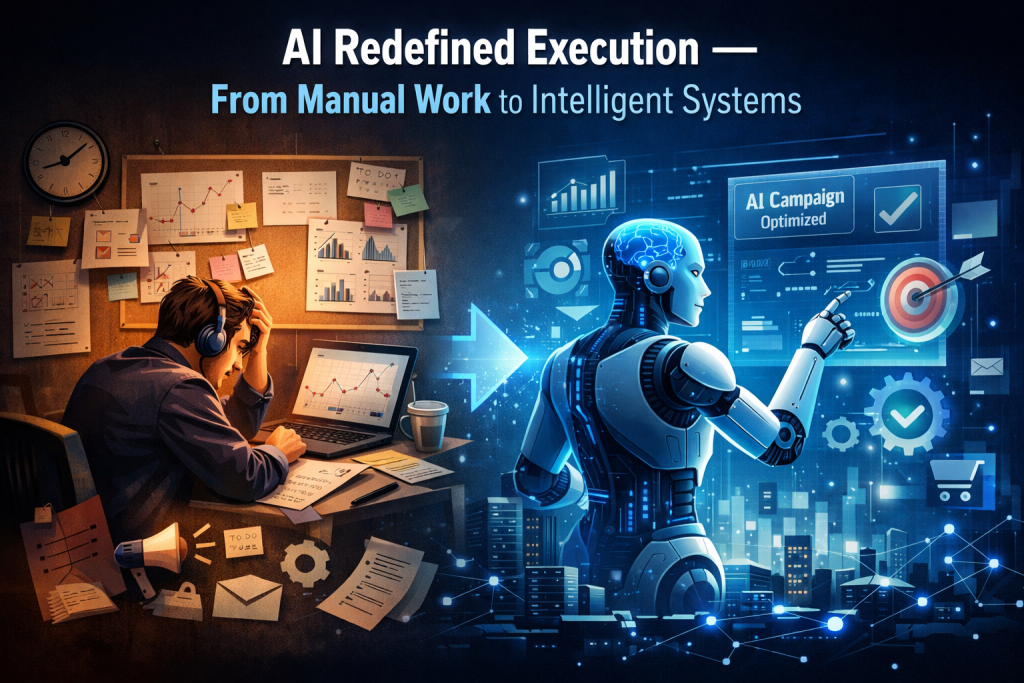
Execution in 2026 looks nothing like it did just a few years ago. AI systems no longer wait for step-by-step instructions. They analyze large volumes of data, identify patterns, spot opportunities, and recommend—or directly execute—actions autonomously. What once took teams weeks of planning, testing, and iteration now happens in hours, sometimes even minutes.
In digital growth functions, AI now manages campaign planning, audience segmentation, creative testing, and performance optimization at the same time. Instead of launching a single campaign and waiting for results, businesses run hundreds of micro-experiments powered by machine learning models that adapt in real time. Execution has become continuous, predictive, and deeply data-driven.
This shift has fundamentally changed how digital marketing agencies operate. Agencies are no longer valued for manual execution alone. Their real strength lies in strategic oversight, AI system configuration, and insight interpretation. A digital marketing agency like Tattvam Media, for example, focuses less on running isolated campaigns and more on building scalable, AI-enabled growth systems that deliver consistent results with leaner teams.
At the same time, AI has raised expectations across the board. Faster execution means faster feedback loops. Poor strategies fail more quickly. Weak assumptions are exposed instantly. AI does not remove accountability—it amplifies it. In 2026, execution rewards clarity of thinking, not just speed of action.
Expertise in the Age of AI — From Doing to Directing
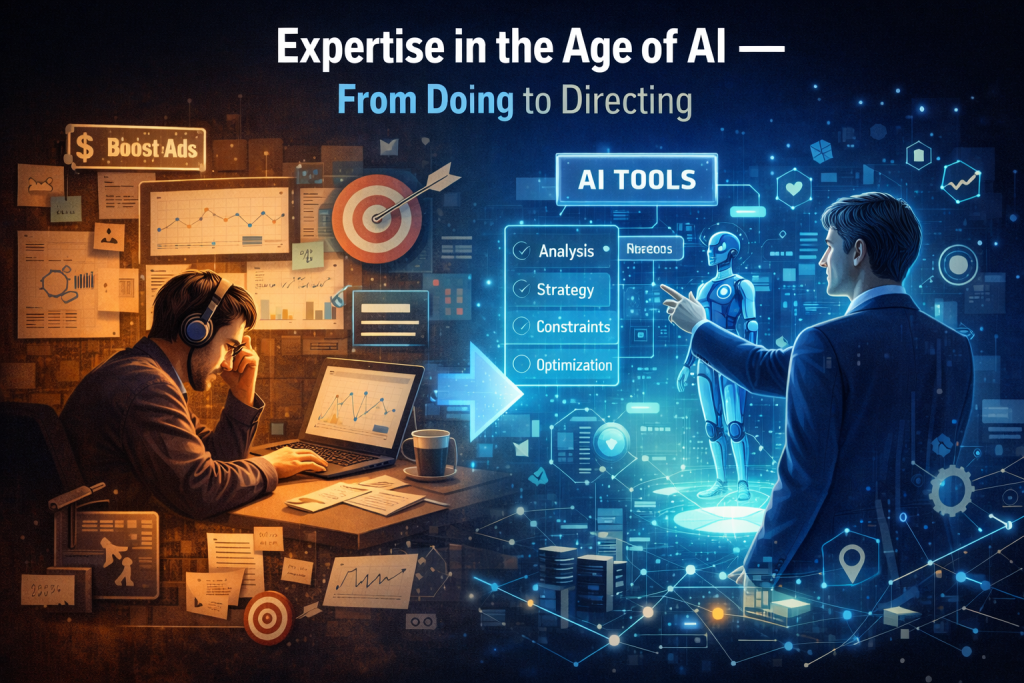
Expertise has undergone a quiet but powerful transformation. In the pre-AI era, expertise was defined by how well someone could perform tasks manually. In 2026, expertise is defined by how effectively someone can guide intelligent systems toward the right outcomes.
Professionals are no longer judged by how many tools they know. They are judged by how well they understand systems, data signals, and decision logic. An expert marketer no longer just runs ads or writes content. They design frameworks, set constraints for AI tools, interpret performance patterns, and make strategic decisions that machines cannot take on their own.
This evolution has also reshaped learning paths. Traditional experience-based growth has been replaced by accelerated learning cycles. Professionals now build expertise faster by working alongside AI—reviewing outputs, correcting errors, refining prompts, and optimizing workflows. The feedback loop is shorter, more practical, and deeply connected to real-world execution.
As a result, demand for structured, future-ready education has increased. A digital marketing course by Academy of Digital Marketing, for instance, focuses less on surface-level platform mechanics and more on AI-driven strategy, automation logic, and decision-making. Courses that teach professionals how to think with AI, rather than simply use tools, create expertise that remains relevant as platforms evolve.
Expertise today is not about competing with AI.
It is about orchestrating it effectively.
Skill Development Shifted From Static Learning to Continuous Adaptation
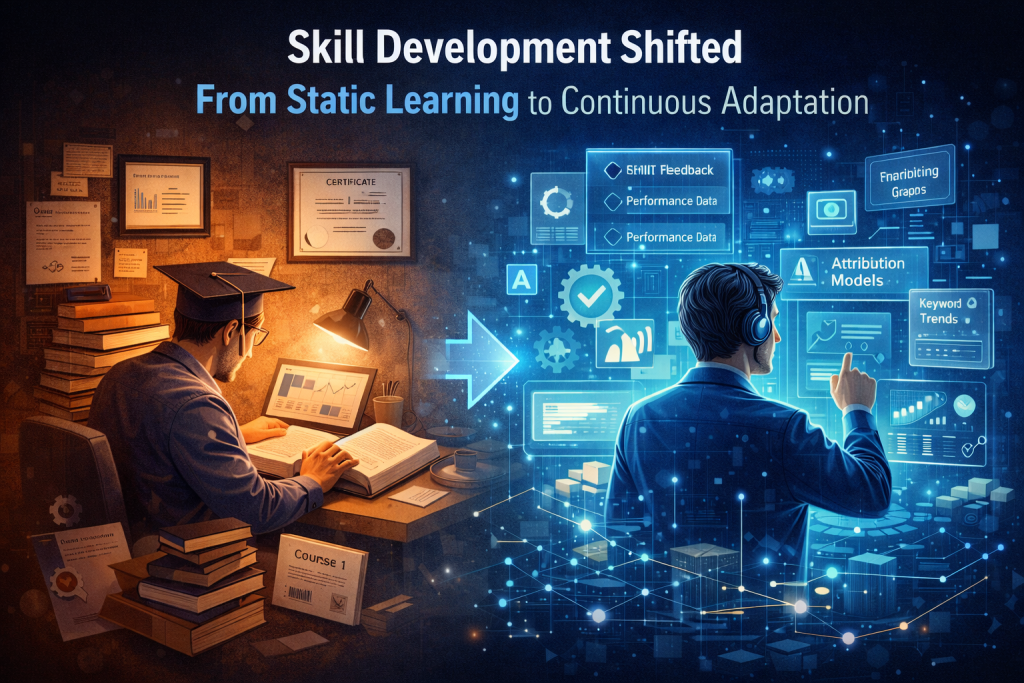
By 2026, skill development stopped being event-based and became continuous by default. Learning was no longer tied to degrees, certifications, or one-time courses. Instead, professionals upgraded skills in real time, alongside their work, guided by AI-powered systems that identified gaps instantly.
AI-driven learning platforms analyze performance data, project outcomes, and behavioural patterns to recommend what an individual needs to learn next. Professionals no longer guess which skills are “in demand.” Demand is visible, measurable, and personalized.
For many, this change has reshaped how digital marketing courses are consumed. Instead of long, generic modules, learning is broken into focused, outcome-driven segments. A professional running paid campaigns may receive AI-suggested lessons on attribution modelling or creative fatigue, while someone focused on content may be guided toward search intent mapping or AI-assisted content optimization.
This model has significantly shortened the gap between learning and earning. Skills are applied immediately. Feedback is instant. Progress is measurable. Those who commit to continuous learning stay relevant. Those who rely on outdated knowledge fall behind quickly.
In 2026, skill development is not about knowing more.
It is about adapting faster.
The Convergence of Agencies, Education, and AI
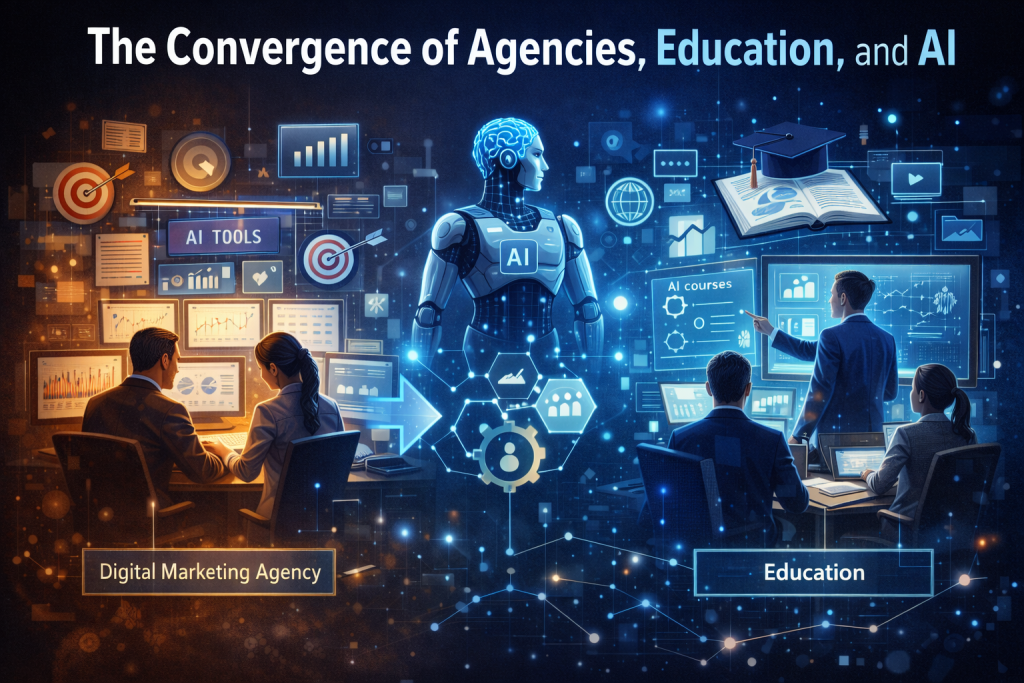
One of the most significant changes in 2026 is how boundaries between execution, education, and expertise have blurred. Digital marketing agencies are no longer just service providers. Many now act as training ecosystems, offering structured learning paths to clients, internal teams, and aspiring professionals.
This convergence exists because AI has standardized execution but amplified the importance of strategic thinking. Businesses don’t just want results; they want understanding. Professionals don’t just want jobs; they want future-proof skills.
As a result, agencies that invest in education—through mentorship, workshops, and AI-led learning frameworks—build stronger teams and longer client relationships. At the same time, educational platforms that integrate real-world agency workflows create talent that is immediately deployable.
AI sits at the centre of this ecosystem. It connects theory with practice, data with insight, and learning with execution. The winners in this new model are not those who choose between agency work or education, but those who blend both intelligently.
What This Means for Professionals and Businesses Going Forward
The reshaping of execution, expertise, and skill development is not a temporary phase. It is the new operating system for work.
For professionals, this means careers are no longer linear. Growth depends on curiosity, adaptability, and the ability to work with AI systems effectively. Titles matter less. Impact matters more.
For businesses, especially those investing in digital growth, success depends on choosing the right partners and building internal intelligence. Whether working with a digital marketing agency or investing in upskilling teams through modern courses, the focus must be on systems, not shortcuts.
AI does not remove the need for human judgment. It raises the bar for it.
Conclusion
By 2026, AI did not simplify work—it clarified it.
Execution is no longer about effort. It is about systems.
Expertise is no longer about knowing tools. It is about making decisions.
Skill development is no longer optional. It is continuous.
AI accelerated everything, but it also exposed gaps faster. Weak strategies fail sooner. Outdated skills lose relevance more quickly. At the same time, those who understand how to work with AI move ahead at a pace that was impossible just a few years ago.
For businesses, growth now depends on intelligent execution—often powered by AI-driven digital marketing agencies that combine automation with human judgment. For professionals, career stability comes from mastering AI-assisted workflows and committing to structured, future-ready learning through modern digital marketing courses.
The advantage in 2026 is not access to AI. Everyone has that.
The advantage is how well you think, adapt, and execute with it.
AI didn’t replace human value.
It demanded a higher version of it.
FAQs
- How has AI changed execution in digital marketing?
AI has transformed execution from manual, campaign-based work into continuous optimization. Tasks like audience targeting, creative testing, and performance analysis are now automated, allowing teams and digital marketing agencies to focus on strategy, planning, and decision-making rather than repetitive execution.
- Does AI reduce the need for human expertise?
No. AI reduces manual effort but increases the need for strategic expertise. Professionals are now required to interpret AI outputs, guide systems, and make high-level decisions that machines cannot handle independently.
- What skills are most important in an AI-driven marketing environment?
Critical skills include data interpretation, AI tool orchestration, strategic thinking, prompt engineering, and understanding automation workflows. Soft skills like problem-solving and adaptability are equally important.
- How are digital marketing courses evolving because of AI?
Modern digital marketing courses focus less on platform tutorials and more on AI-led strategy, automation frameworks, real-time optimization, and decision-making. Learning is modular, practical, and aligned with real-world execution.
- Are digital marketing agencies still relevant in 2026?
Yes, but their role has evolved. Agencies are valued for strategic oversight, AI system configuration, performance interpretation, and scalable execution—not just for running campaigns manually.
- How does AI support continuous skill development?
AI analyzes performance data and identifies skill gaps in real time. It then recommends personalized learning paths, allowing professionals to upskill while working instead of pausing their careers to learn.
- Can beginners still enter digital marketing in the AI era?
Yes. AI lowers entry barriers by handling technical complexity. However, beginners must focus on learning strategy, systems thinking, and real-world application through structured courses and guided practice.
- What is the biggest mistake professionals make with AI?
Relying on AI without understanding the logic behind it. Treating AI as a shortcut instead of a system to be guided often leads to poor results and skill stagnation.
- How should businesses adapt to AI-driven execution?
Businesses should invest in AI-enabled workflows, partner with forward-thinking digital marketing agencies, and continuously train internal teams to work alongside AI systems.
- Is AI a threat or an advantage for careers?
AI is an advantage for those who adapt. Careers grow faster when professionals learn to collaborate with AI, update skills continuously, and focus on strategic value rather than manual tasks.