

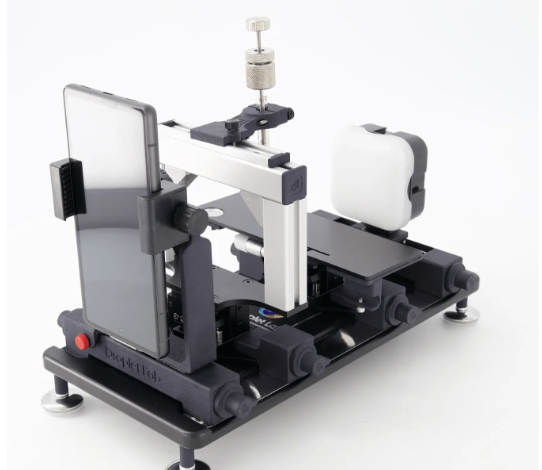
In a materials science lab at a Fortune 500 leader in the adhesive label and packaging industry, a senior research associate recently handed off a $5,000 smartphone-based instrument to a colleague with minimal training. Within hours, the new user was running surface tension measurements independently—the kind of analysis that traditionally required weeks of specialized training on $20,000 benchtop equipment.
The instrument in question doesn’t look like much: a compact optical module that clips onto a smartphone, paired with a syringe for dispensing tiny droplets onto test surfaces. But inside that unassuming package runs an AI model trained on more than 20,000 real-world images of water droplets, automating measurements that have frustrated scientists for decades.
Welcome to the quiet revolution happening in surface science, where a small employee-owned Canadian company is using machine learning to democratize one of materials research’s most finicky measurement techniques.
The company behind this transformation is Droplet Lab, a youth-driven startup that has quietly survived for a decade by turning expensive benchtop instruments into portable, AI-powered tools. Their flagship product, the Dropometer, is now used by researchers at Ivy League universities and Fortune 500 companies across five continents; proving that sometimes the most disruptive technology comes not from Silicon Valley, but from a small team solving unglamorous problems that matter.
The Problem With Droplets
If you’ve never thought about how liquids interact with surfaces, you’re not alone. But this obscure corner of physics underpins a staggering range of products: the coatings that keep your windshield clear in rain, the adhesives holding your smartphone together, the packaging that keeps food fresh, even the biofilms that form on medical implants.
Understanding these interactions requires measuring something called contact angle;
essentially how a droplet sits on a surface. A high contact angle means the liquid beads up (think water on a freshly waxed car); a low contact angle means it spreads out (water on bare metal). The difference of a few degrees can make or break a product.
The traditional way to measure this involves expensive goniometers; bulky benchtop instruments with high-resolution cameras, precision stages, and software that costs more than the hardware. A researcher places a droplet, captures an image, then manually fits a mathematical curve to the droplet’s profile. It’s tedious, subjective, and maddeningly inconsistent. Two operators measuring the same droplet can get different results. The same operator can get different results on different days.
“The measurement itself isn’t hard,” explains Gurdeep Saini, who leads AI development at Droplet Lab and holds a Master’s in Applied Science from York University. “The hard part is reducing human variability.”
Teaching AI to See Droplets
That’s where machine learning comes in. Over the past several months , Droplet Lab built a custom AI model trained on more than 20,000 images of actual droplets in real experimental conditions; not pristine textbook examples, but the messy reality of industrial labs and manufacturing floors.
“We needed the AI to handle what researchers actually encounter,” Saini says. “Surface roughness, contamination, lighting variations, different materials, different liquids. The theoretical models work great in simulations, but real droplets don’t read the textbooks.”
The system captures an image of a droplet through the smartphone camera, then the AI instantly analyzes the profile using the Young-Laplace equation; a mathematical relationship that describes how surface tension shapes liquid interfaces. Within seconds, it spits out contact angle and surface free energy (calculated using the contact angle and method of choice among 3) measurements . No manual curve-fitting. No operator bias. Just automated precision that matches instruments costing four times as much.
The company’s underlying measurement approach has been independently vetted: in peer‑reviewed papers in Review of Scientific Instruments and Colloids and Surfaces A, Droplet Lab validated its original smartphone-based system in a semi‑automatic workflow, where the user provides an initial baseline estimate that the algorithm then refines. Those studies benchmarked performance against the industry-standard KRÜSS DSA100, a $25,000+ benchtop instrument and found close agreement. The machine‑learning model is a newer add-on that builds on this validated core, automating the remaining initialization step to make measurements fully automatic.
From Classroom Frustration to Global Labs
The origin story starts in a university classroom, where Dr. Alidad Amirfazli was teaching surface science and watching students struggle with complex, expensive equipment. “How do you teach hands-on science,” he wondered, “when only one student at a time can actually touch the instrument?”
That frustration sparked Droplet Lab. For years, it served primarily academic customers; professors who wanted their students to actually run experiments rather than watch demonstrations. But in July 2022, something shifted. A group of former employees, led by current CEO Abhimanyu Bhandankar, bought out the company and pivoted toward industrial applications.
Today, Droplet Lab’s instruments are used by researchers at Ivy League universities and Fortune 500 companies across five continents. Their clients have cited the technology in over 40 peer-reviewed papers. The applications span an impressive range: designing antibacterial coatings for dental crowns, optimizing biodegradable packaging films for raspberries, formulating stable emulsions for biotech applications.
At the University of South Florida, the chemistry department deployed 33 of Droplet Lab’s educational units; about $30,000 worth of equipment; transforming their undergraduate labs. Instead of students crowding around a single demonstration, now everyone gets hands-on experience with real surface science experiments.
“The willingness of Droplet Lab to create something specifically for academia was fantastic,” says Dr. John Figueroa, Assistant Director of Teaching Labs at USF. Faculty report higher student engagement, better data literacy, and more confidence in experimental work.
Portability Changes Everything
But the real strategic insight wasn’t just making the instruments cheaper. It was making them portable.
Traditional goniometers are benchtop fixtures; heavy, fragile, requiring controlled lab conditions. Droplet Lab’s smartphone-based system weighs less than 2.5 kilograms and fits in an airline carry-on. That means field scientists can run surface measurements on factory floors, construction sites, or remote research locations.
A corporate quality engineer at a global leader in polymer extrusion and catheter design puts it bluntly: “We completed our Gage R&R study on the unit we have, and it performed very well.”
For manufacturing QA teams, that’s high praise; reproducibility and reliability in production environments, not just pristine research labs.
The portability factor compounds with the AI automation. You don’t need a surface science PhD to run reliable measurements; you just need someone who can follow basic protocols. The AI handles the expertise.
The Democratization Play
There’s a broader pattern here that extends beyond surface science. As AI models prove capable of matching human expertise in specialized measurement tasks, the economics of scientific instrumentation fundamentally shift. Capabilities that required six-figure budgets and specialized personnel suddenly become accessible to smaller companies, field researchers, and educational institutions.
Bhandankar frames it ambitiously: “Make surface science as accessible as a thermometer, something any lab, factory, or classroom can use confidently.”
The company is building what they call a Surface Science Hub: an open knowledge base with practical guides, industry standards, and real measurement datasets. More unusually, they published an impartial buyer’s guide spanning the entire goniometer market. From premium systems to low-cost and even free tools like ImageJ; so buyers can choose what fits their use case.
For a small company competing against established players like KRÜSS and Biolin Scientific, it’s a counterintuitive strategy. But it aligns with the AI thesis: if machine learning truly eliminates expertise barriers, then democratizing knowledge accelerates adoption. The technology becomes the education.
What’s Next
Droplet Lab is now expanding its machine-learning capabilities to perform fully automated surface-tension measurements , environmental control chambers for temperature and humidity, and a higher-specification, desktop-based platform designed for increased throughput in industrial and R&D workflows.
The goal is moving from simple measurements to intelligent insights; flagging process drift, suggesting optimal treatment parameters, linking surface data to product performance.
The company remains employee-owned, a small team grinding away in Canada while serving a global customer base. It’s the kind of quiet, technically focused startup that doesn’t make splashy headlines but slowly rewires entire industries from the inside.
Ten years after starting in a university classroom, Droplet Lab is proving that you don’t need massive funding rounds or Silicon Valley hype to build transformative technology. Sometimes you just need a really good AI model, 20,000 droplet images, and a willingness to solve an unglamorous problem that matters to thousands of researchers and manufacturers worldwide.
As more cheap, portable, AI-powered scientific instruments enter the market, the gates around advanced research capabilities continue to fall. What requires a dedicated lab today might run on a smartphone tomorrow. And the technologies we think of as specialized and expensive might become as routine as checking the temperature.
The droplets, it turns out, were just the beginning.