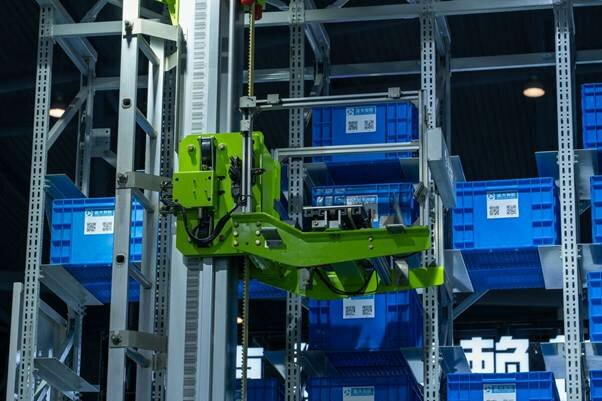
Robotic palletizers are showing up more and more in warehouses today. Before, stacking boxes on pallets was slow and pretty tiring work. They had to lift everything by hand and ensure that the load was carefully placed so it wouldn’t tip over later on.
Now a lot of that work is done by machines that can just keep going without stopping. They move faster, don’t get tired, and usually make fewer mistakes. Because of that, warehouses can handle more goods at once and things just run a bit smoother overall.
The growth of internet commerce further accelerates these changes. Customers want their deliveries faster, accurate inventory information and as few delays as possible. To meet such expectations, increasing numbers of companies are investing in AI technologies that allow robots to make decisions independently and adapt to situations in real time.
Why Are Warehouses Rapidly Switching to Automation?
In recent years, many companies have been faced with a shortage of labor, but also with rising costs of doing business. Jobs such as lifting heavy boxes, moving goods and stacking products on pallets are often strenuous and increase the risk of occupational injuries.
Automation helps companies to face up to these challenges more easily. Robots can do the repetitive, physically demanding work and employees can do the work that requires experience, supervision and decision-making.
The other advantage of machines is that they can work for nearly all the time. People get tired and need to rest, but not machines. They just keep on working. That is why work in the warehouse is quicker and deliveries are less likely to be late.
How Do AI Robots Work in Modern Warehouses?
Older industrial robots mostly just followed fixed instructions. They did exactly what they were programmed to do, nothing more. Today’s systems are a bit smarter. They use things like artificial intelligence, machine learning, and cameras to understand what’s happening around them and react to it in real time.
So, robots do not just execute commands anymore, they can ‘understand’ the environment in which they work. They recognize the different types of packaging, they see the available space and adapt their working method to the situation.
For example, if boxes of different sizes arrive on the conveyor belt, the AI system can calculate the best arrangement on the pallet to keep the load stable and safe for transport. Manual adjustments are eliminated, and the whole process becomes more efficient.
Many systems also include 3D cameras which enable robots to distinguish between products of different shapes, sizes and weights, which makes work even more precise.
A New Era of Palletization
For years, palletizing has been considered one of the most demanding jobs in warehouses. Manual stacking of goods requires concentration, physical strength and a lot of time, especially when dealing with large quantities of products.
Fortunately, today’s robotic palletizers make this process much easier. Using robotic arms, sensors and AI software, they automatically pick up products and place them on pallets in the most efficient way.
Their great advantage is flexibility. They can work with different types of goods without major programming changes, which makes them ideal for companies that process a large number of different products on a daily basis.
In addition, such systems contribute to greater safety in the workplace. The need to lift heavy loads is reduced, and thus the number of injuries caused by physical strain on employees.
Artificial Intelligence and Computer Vision Are Changing the Game
One of the biggest innovations in recent years is the combination of artificial intelligence and computer vision. Cameras and sensors allow robots to analyze products in real time and recognize even improperly placed packages.
This technology is particularly visible in large warehouses, where every day thousands of different products are processed. Instead of the operator having to manually adjust the system for each new type of goods, AI independently recognizes product characteristics and modifies the work process.
The result is fewer errors, less damage in transit and better use of warehouse space. The longer the system operates, the more accurate it becomes as a result of the data it continuously collects and analyzes.
Human-Robot Collaboration
When talking about automation, the question is often asked whether robots will replace humans. However, practice shows that technology is mostly used to support employees, not to replace them.
Collaborative robots, also known as cobots, are particularly interesting. They are designed to work safely alongside humans. Thanks to built-in sensors, they can register the presence of workers and automatically slow down or stop work if there is a possibility of a collision.
This way you get the best of both worlds. The robots take care of the repetitive, physically demanding work, and humans take care of the supervision, problem solving and process management.
That’s why many warehouses are opening new positions related to automation management, data analysis, and advanced systems maintenance.
What Awaits Us in the Future?
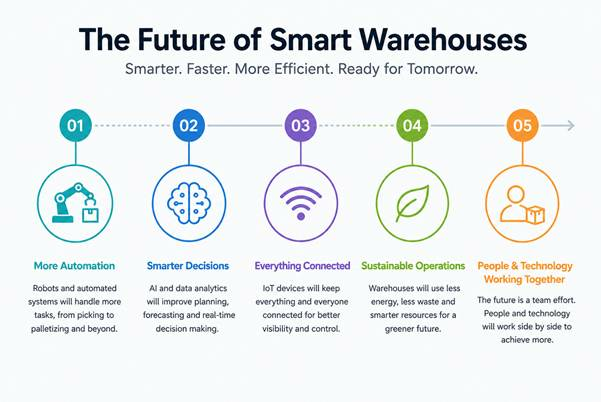
All indications are that investment in AI and robotics will continue to grow. The new generation of robots already uses advanced algorithms that allow them to independently plan tasks, optimize movement through the warehouse and collaborate even more efficiently with people.
Experts believe that by the end of the decade, a large number of new warehouses will be designed around automated systems. Artificial intelligence will play an increasingly important role in inventory management, delivery planning and warehouse organization.
For companies that want to stay competitive, automation is no longer the plan for the future. It is becoming an integral part of everyday business and one of the key success factors in the modern supply chain.