Introduction
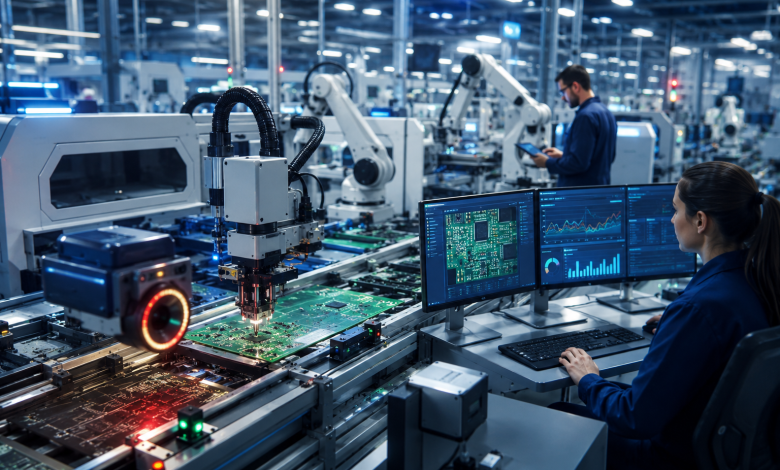
Artificial intelligence (AI) is reshaping the electronics manufacturing industry by enabling smarter decision-making, greater production accuracy, and more efficient factory operations. Rather than replacing traditional manufacturing processes, AI enhances them by analyzing large volumes of production data, identifying patterns, and supporting real-time decisions that improve quality and operational performance. Across Europe, manufacturers are increasingly integrating AI into their production environments to remain competitive in a rapidly evolving market.
Poland has emerged as one of Europe’s most dynamic electronics manufacturing hubs, supported by a skilled engineering workforce, modern industrial infrastructure, and strategic access to regional supply chains. As smart factory technologies continue to evolve, many manufacturers are adopting AI-driven solutions to strengthen productivity, improve quality assurance, and respond more effectively to changing customer demands. This article explores how AI is transforming electronics assembly in Poland’s smart factories, the technologies driving this shift, and the practical benefits these innovations bring to modern electronics production.
Poland’s Electronics Manufacturing Industry Is Embracing AI
Poland has experienced significant growth in electronics manufacturing over the past decade, becoming an important production destination for companies serving automotive, industrial, telecommunications, medical, and consumer electronics markets. Its central location within Europe, combined with a highly skilled technical workforce and expanding industrial investment, has strengthened the country’s role in regional manufacturing networks.
The transition toward Industry 4.0 has accelerated digital transformation across Polish manufacturing facilities. Today, many factories are investing in connected equipment, real-time production monitoring, and intelligent automation to improve operational efficiency. As Industry 5.0 principles gain momentum, manufacturers are placing greater emphasis on combining advanced technologies with human expertise to create more flexible, sustainable, and resilient production environments.
Nearshoring trends have also encouraged European businesses to diversify supply chains closer to key markets, making Poland an increasingly attractive manufacturing location. AI plays an important role in this transformation by helping factories optimize production planning, improve product quality, and make data-driven decisions that support long-term competitiveness.
Understanding AI in Electronics Assembly
Artificial intelligence in electronics assembly refers to computer systems capable of analyzing manufacturing data, recognizing patterns, and supporting operational decisions that traditionally relied on manual observation or fixed automation rules. Unlike conventional automation, which follows pre-programmed instructions, AI continuously learns from production data and adapts to changing manufacturing conditions.
Several technologies contribute to AI-powered manufacturing. Machine learning algorithms analyze historical and real-time production information to identify opportunities for process improvement. Machine vision systems use advanced cameras and image recognition software to inspect components, solder joints, and completed assemblies with exceptional speed and consistency. Industrial Internet of Things (IIoT) devices collect data from machines, sensors, and production equipment, creating a connected manufacturing environment where information flows continuously across the factory.
Importantly, AI complements rather than replaces skilled engineers and production teams. Human expertise remains essential for interpreting complex manufacturing requirements, validating AI-generated recommendations, and managing continuous improvement initiatives that ensure reliable and high-quality production.
How AI Is Transforming Electronics Assembly in Poland’s Smart Factories
AI-Powered Quality Inspection
Quality inspection is one of the most valuable applications of AI in electronics manufacturing. Traditional manual inspection can be time-consuming and may produce inconsistent results, particularly when inspecting thousands of complex circuit boards every day. AI-powered Automated Optical Inspection (AOI) systems combine high-resolution cameras with machine vision algorithms to identify defects quickly and accurately.
These systems can detect solder bridges, insufficient solder, missing components, incorrect component orientation, and other manufacturing defects in real time. For example, during an SMT production run, an AI-assisted inspection system can compare every solder joint against predefined quality parameters. If an abnormality is detected, the affected board is automatically flagged for further inspection before progressing to the next manufacturing stage. This proactive approach reduces defects, minimizes rework, and improves overall production consistency.
Predictive Maintenance for Continuous Production
AI is also transforming equipment maintenance by shifting manufacturers from reactive repairs to predictive maintenance strategies. Instead of servicing machinery only after a failure occurs or following fixed maintenance schedules, AI analyzes sensor data collected from production equipment to identify early warning signs of wear or performance changes.
Continuous monitoring of vibration, temperature, operating speed, and power consumption allows manufacturers to detect potential issues before they develop into costly failures. Maintenance teams can then schedule repairs during planned production windows, reducing unexpected downtime and improving equipment reliability. This approach helps electronics manufacturers maintain stable production schedules, extend machine lifespan, and improve overall factory efficiency.
AI Technologies Used in Electronics Assembly
| AI Technology | Primary Function | Practical Manufacturing Example |
| Machine Vision | Detects production defects | Automated PCB solder joint inspection |
| Machine Learning | Optimizes production workflows | Intelligent production scheduling |
| Predictive Analytics | Predicts equipment failures | Preventive machine maintenance |
| Industrial IoT | Collects real-time operational data | Monitoring SMT production lines |
| Robotics & Cobots | Automates repetitive assembly tasks | Component placement and packaging |
| Digital Twins | Simulates manufacturing processes | Testing workflow improvements before implementation |
How AI Is Transforming Electronics Assembly in Poland’s Smart Factories (Continued)
Smarter Production Planning and Supply Chain Optimization
Beyond quality inspection and equipment maintenance, AI is transforming how electronics manufacturers plan production and manage supply chains. Traditional planning methods often rely on historical data and manual scheduling, making it difficult to respond quickly to changing customer demands or supply chain disruptions. AI-powered planning systems analyze real-time production data, inventory levels, supplier performance, and demand forecasts to support faster and more informed decision-making.
Machine learning algorithms can automatically adjust production schedules based on equipment availability, workforce capacity, and material supply. This helps manufacturers reduce bottlenecks, improve machine utilization, and deliver products more efficiently. AI can also forecast demand by analyzing historical sales patterns, seasonal fluctuations, and market trends, allowing companies to optimize inventory while minimizing excess stock and shortages.
Another important advantage is intelligent resource allocation. AI identifies the most efficient way to assign machines, operators, and materials across production lines, helping factories maintain consistent productivity even when production requirements change. These capabilities make electronics manufacturing more agile, resilient, and responsive to customer expectations.
AI in PCB Assembly and Box Build Manufacturing
Artificial intelligence is increasingly integrated throughout SMT production, PCB assembly, and final product integration. During surface-mount technology (SMT) processes, AI helps optimize component placement accuracy, monitors solder paste quality, and identifies production anomalies before they affect finished products. Combined with machine vision, AI contributes to greater consistency across high-volume manufacturing operations.
Manufacturers specializing in PCB assembly Poland are also using AI to improve traceability throughout production. Every stage of assembly—from component placement and soldering to inspection and testing—can generate valuable operational data. AI analyzes this information to identify recurring process variations, enabling continuous improvement and reducing the likelihood of defects.
In box build manufacturing, AI supports more efficient product assembly by monitoring workflow efficiency, verifying component installation, and assisting with functional testing. Intelligent inspection systems help ensure that complete electronic assemblies meet quality requirements before packaging and shipment. Rather than replacing skilled technicians, AI provides additional insights that help teams make better decisions, improve production consistency, and maintain high manufacturing standards.
Benefits and Challenges of AI Adoption
The adoption of AI delivers significant advantages for electronics manufacturers seeking higher productivity and better operational performance. Real-time data analysis allows production teams to identify process improvements more quickly, while automated inspection systems reduce human error and improve product consistency. Predictive maintenance minimizes unexpected equipment failures, helping manufacturers maintain reliable production schedules and reduce maintenance costs.
AI also enhances traceability by collecting production data throughout the manufacturing process. This improves quality control, supports regulatory compliance, and enables faster root-cause analysis if issues arise. These benefits are helping manufacturers specializing in electronics assembly Poland improve production efficiency, enhance product reliability, and strengthen their competitiveness across the European market.
Despite these advantages, successful AI implementation requires careful planning and long-term investment. Manufacturers should consider several important factors before deploying AI technologies:
- Initial investment in hardware, software, and infrastructure
- Workforce training and digital skills development
- Integration with existing production equipment
- Cybersecurity and data protection requirements
- Maintaining high-quality production data for accurate AI analysis
Addressing these challenges strategically helps organizations maximize the long-term value of AI while minimizing operational risks.
The Future of AI in Poland’s Smart Factories
The next generation of smart factories will continue integrating AI with advanced digital technologies to create even more connected and intelligent manufacturing environments. Edge AI will allow production equipment to process information locally for faster decision-making, while digital twins will enable manufacturers to simulate production scenarios before implementing operational changes. Collaborative robots, supported by AI, will increasingly work alongside skilled employees to improve efficiency without replacing human expertise.
As Industry 5.0 continues to evolve, manufacturers will focus on balancing automation with human creativity, sustainability, and resilience. Poland’s electronics sector is well positioned to benefit from these developments through continued investment in digital innovation, engineering talent, and advanced manufacturing capabilities.
Conclusion
Artificial intelligence is transforming electronics manufacturing by improving quality control, production efficiency, equipment reliability, and operational decision-making. Rather than replacing skilled professionals, AI serves as a powerful tool that enhances human expertise and enables smarter, data-driven manufacturing processes.
As more manufacturers invest in digital transformation, the future of Electronics assembly in Poland will likely be shaped by intelligent automation, connected production systems, and continuous innovation. Companies such as tstronic demonstrate how modern manufacturing organizations can embrace advanced technologies while maintaining high standards of quality and precision.
Businesses exploring electronics manufacturing partnerships should look beyond automation alone and evaluate technical expertise, manufacturing capabilities, quality assurance processes, and a commitment to continuous improvement.
Frequently Asked Questions
What is AI in electronics assembly?
AI in electronics assembly refers to the use of machine learning, computer vision, and data analytics to improve production quality, automate inspections, optimize manufacturing processes, and support better operational decisions.
Why is Poland becoming a leader in smart electronics manufacturing?
Poland offers a skilled engineering workforce, strong industrial infrastructure, strategic access to European markets, and increasing investment in Industry 4.0 technologies, making it an attractive location for advanced electronics manufacturing.
How does AI improve PCB assembly quality?
AI-powered inspection systems detect soldering defects, missing components, alignment issues, and production inconsistencies in real time, helping manufacturers improve first-pass quality and reduce rework.
Can AI replace human workers in electronics manufacturing?
No. AI is designed to support human expertise by automating repetitive tasks, analyzing production data, and providing recommendations, while skilled professionals continue to oversee production, quality, and engineering decisions.
What AI technologies are commonly used in smart factories?
Common technologies include machine vision, machine learning, predictive analytics, Industrial IoT, collaborative robots (cobots), and digital twins.
What are the biggest challenges of implementing AI in electronics manufacturing?
Key challenges include implementation costs, workforce training, legacy system integration, cybersecurity, and maintaining high-quality production data.
How does AI support sustainable electronics manufacturing?
AI helps reduce material waste, optimize energy consumption, improve equipment efficiency, and increase production accuracy, contributing to more sustainable manufacturing operations.