


B2B SaaS competition has intensified to the point where traditional competitive intelligence processes can no longer keep up. Pricing shifts occur overnight. New AI-driven features appear weekly.
Competitors experiment with packaging, messaging, and positioning at a pace that far exceeds the typical quarterly CI review cycle. Sales teams feel these changes first during live conversations. By the time a slide deck is updated, the market has already moved.
This acceleration is pushing organizations to rethink their entire competitive intelligence function. AI is transforming CI from a documentation-heavy process into a real-time revenue driver.
Instead of producing reports that become outdated within weeks, competitive insights now flow directly into sales motions, giving reps the information they need at the moment they need it.
For product marketing managers, Sales Ops, RevOps, and sales leaders, this shift represents a major opportunity to create a more aligned, data-driven, and competitive go-to-market motion.
The Limitations of Traditional Competitive Intelligence
Traditional CI has always been valuable, but it has been limited by slow cycles, manual processes, and limited distribution.
Most CI tools were built for collecting and organizing information, not for influencing outcomes. They help teams assemble folders, wikis, and battlecards, but they do little to ensure that insights reach sellers at the right time.
Product marketers spend hours monitoring competitor activities manually, whether scanning pricing pages, reading release notes, checking review platforms, or monitoring social feeds.
Although PMMs produce polished competitive decks, these materials often underperform in the field. Reps may not access them in time, forget where they are stored, or rely on outdated versions.
Disseminating CI across large organizations is difficult, which leads to inconsistent messaging and stale information. When sales teams operate with different versions of competitive truth, the GTM motion becomes fragmented.
The consequences of stale CI are measurable. Gartner’s research shows that 80 percent of tech buyers report some form of post-purchase regret. Many of these issues stem from conflicting or outdated information inside the buying committee, which underscores how critical aligned intelligence is in competitive deals.
When CI is delivered too late, sales teams spend more time navigating objections, clarifying outdated claims, and addressing confusion that could have been prevented.
How AI Has Transformed the Foundation of CI
Artificial intelligence has fundamentally changed the economics of competitive intelligence. Tasks that once required hours of manual effort are now automated, continuous, and far more accurate.
AI-driven monitoring tools now track competitor websites, pricing pages, job boards, release notes, documentation, review platforms, and social channels at all times.
Automated change detection surfaces even small updates that would have gone unnoticed in traditional audits. Natural language processing summarizes updates and applies the appropriate tags so PMMs can see what matters without sifting through noise.
These improvements significantly reduce the amount of manual research required. Instead of spending hours gathering information, PMMs can focus on strategic interpretation. AI-powered CI platforms now function like sentinels that watch the competitive landscape continuously, sending only relevant updates to marketing and sales teams.
The broader adoption of AI across B2B organizations reinforces this trend. A recent report shows that 67 percent of companies already use AI or machine learning to drive growth, and 90 percent view AI as critical to their long-term strategy.
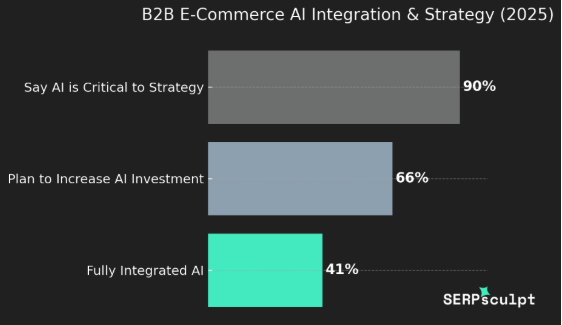
Image: B2B E-Commerce AI Integration & Strategy (2025) showing data: 90% say AI is critical to strategy, 66% plan to increase AI investment, and 41% have fully integrated AI | Source: serpsculpt.com
Competitive intelligence now updates in real time, giving organizations a continuously refreshed understanding of competitor moves. Instead of being locked in quarterly cycles, CI evolves as the market evolves.
Moving from Research to Revenue
The most significant impact of AI-powered CI is that it now directly influences revenue. Insights no longer sit in documents waiting to be discovered. They enter the sales motion exactly when needed.
AI can analyze live sales conversations through call intelligence tools and instantly surface differentiation points or competitive context. If a buyer mentions a competitor’s new pricing tier, AI can highlight recent changes, alert the rep to messaging gaps, or pull up relevant objection-handling guidance. This type of real-time assistance removes friction from sales cycles and keeps deals on track.
This shift yields real results. According to Bain and Company, early AI deployments in sales have produced 30 percent or greater improvements in win rates.
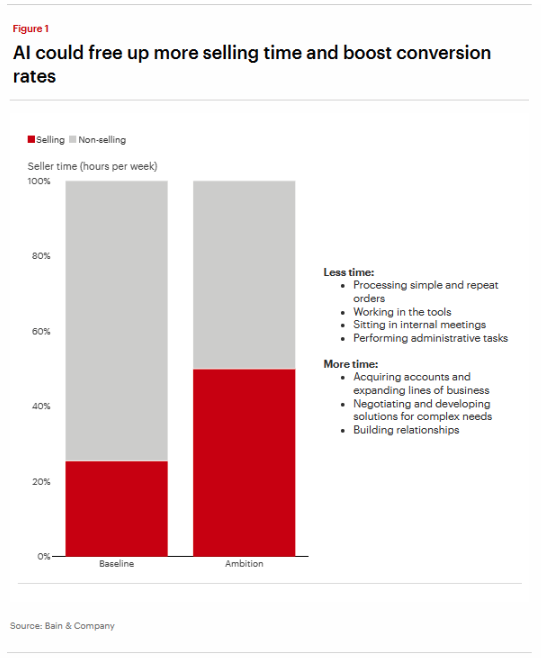
Image: Bar chart comparing baseline and future seller time, showing AI increasing selling time from about 20% to nearly 50% while reducing non-selling work | Source: bain.com
When sellers can address competitive questions instantly, negotiations accelerate. Instead of interrupting momentum to ask a PMM for guidance or search through folders, reps respond confidently in the moment. Faster answers reduce objections and strengthen buyer trust.
Competitive insights also flow automatically into systems sellers use daily, including Slack, CRM platforms, call intelligence tools, and sales enablement systems. As a result, CI becomes part of the daily revenue engine rather than a standalone function.
AI and Semantic Search: A Knowledge Base That Empowers Sales
Artificial intelligence has also transformed how knowledge is stored, retrieved, and used inside organizations. Traditional knowledge bases rely on folder navigation, tagging, and manual upkeep. Semantic search replaces this rigid structure with natural, intuitive access.
A rep can simply type a question such as “How do we beat Competitor A on integration capabilities” and instantly receive the most relevant insights from across documents, battlecards, notes, wikis, and competitive updates. AI interprets intent rather than relying on exact keywords.
Semantic search democratizes competitive intelligence. Instead of relying on a small group of PMMs or CI managers, every rep can access timely guidance independently. Battlecards, once static and manually refreshed, become dynamic. When AI detects a competitor update, it updates the relevant sections automatically. Reps see the latest information without waiting for periodic revisions.
This creates a self-serve, always-available competitive intelligence layer that empowers sales teams to operate more effectively. It also reduces the load on PMMs, who no longer need to manually update assets every time a competitor moves.
How AI Elevates and Expands the PMM Role
Far from replacing PMMs, AI strengthens their strategic influence. With automated research handling manual work, PMMs gain more time and bandwidth to focus on positioning, messaging, market analysis, and competitive strategy.
PMMs stop chasing updates and start interpreting patterns. They can identify strategic shifts earlier, guide product teams on emerging trends, and advise leadership on potential threats or category opportunities.
Product marketing research reinforces this shift. HubSpot’s competitive analysis kit highlights how PMMs increasingly use CI to shape differentiation strategies.
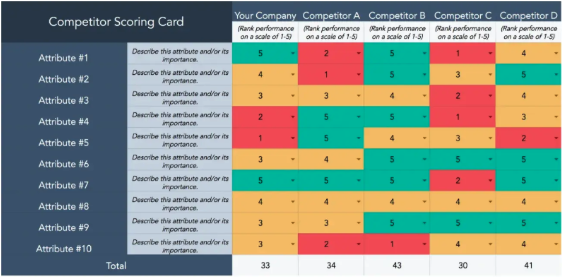
Image: HubSpot’s Competitor Scoring Card template | Source: hubspot.com
Always-on CI enables PMMs to bring more credibility, accuracy, and strategic direction to cross-functional discussions. They become advisors who help sales, product, and leadership make timely, data-driven decisions.
What This Means for Sales Ops, RevOps, and Sales Leaders
Sales Ops and RevOps leaders gain more predictable, insight-driven pipelines. They can embed competitive intelligence into deal reviews, forecasting, and rep coaching. Real-time signals help identify patterns related to deal velocity, competitor mentions, and objection trends.
For sales leaders, always-on CI increases deal readiness. Reps are better equipped to handle objections and articulate differentiation. Teams stay aligned with the current competitive landscape rather than relying on outdated materials.
Win rates rise. Deal cycles shorten. Confidence increases across the organization.
The Future of CI: Real-Time, Predictive, and Revenue-Centric
The shift from static competitive research to always-on intelligence is reshaping how B2B SaaS organizations compete.
AI has reduced the cost and effort of collecting and organizing data, enabling PMMs to focus on high-leverage strategy rather than manual work. Competitive insights now reach sales teams in real time, directly improving their ability to win.
The next evolution of CI will be predictive. AI models will identify emerging competitor trends before they surface publicly. CI will expand to ecosystem intelligence that maps how partners, technologies, and regulations influence market advantage.
Organizations that embrace this shift will operate with greater speed, alignment, and competitiveness. Instead of reacting to market changes, they will anticipate them.
About the Authors
Takahiro Morinaga and Gagandeep Tomar, creators of Steve AI, focus on real-time competitive intelligence for B2B SaaS. They combine business strategy with machine learning to help GTM teams anticipate competitive moves earlier and win more deals.
Reference List:
Gartner. (2024, November 20). Tech buying regrets? The ideal customer profile fixes it. https://www.gartner.com/en/articles/tech-buying-regrets
SerpSculpt. (2025, August 16). How many B2B companies are using AI to drive growth in 2025. https://serpsculpt.com/how-many-b2b-companies-are-using-ai-to-drive-growth/
Bain & Company. (2025, September 23). AI Is Transforming Productivity, but Sales Remains a New Frontier. https://www.bain.com/insights/ai-transforming-productivity-sales-remains-new-frontier-technology-report-2025/
HubSpot. (2025, April 11). Competitive analysis kit. https://blog.hubspot.com/marketing/competitive-analysis-kit