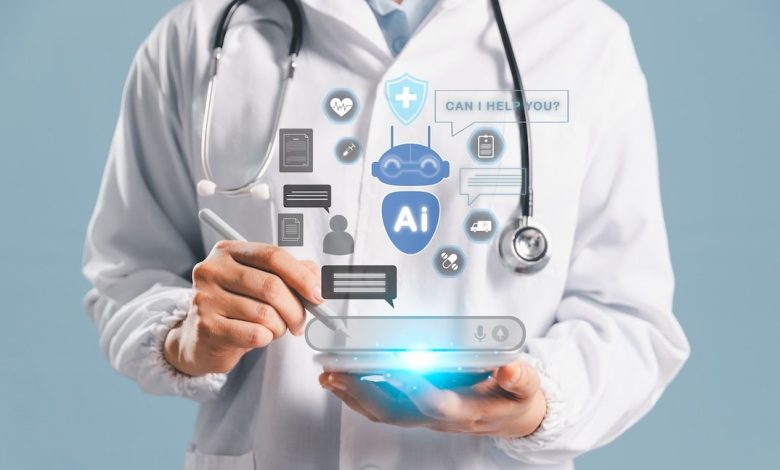
The healthcare industry is undergoing one of its most significant technological transformations in history. At the center of this shift lies the powerful convergence of artificial intelligence and electronic health records, a combination that is redefining how clinicians access information, make decisions, and deliver care.
As hospitals and practices look to modernize their infrastructure, understanding how AI weaves itself into EHR systems has become essential for administrators, developers, and care teams alike.
The Foundation: What AI Brings to EHR Systems
Initially, electronic health records (EHRs) were intended to excel in one particular function which was storing patient information electronically. They replaced paper charts, centralized information, and ideally facilitated better care coordination. However, with time it was realized that merely digitizing records was insufficient. The EHR systems grew bulky, challenging to use, and well-known for adding to doctor burnout.
In 2022 there was a study posted in the Journal of the American Medical Association which stated that physicians spent almost 2 hours on administrative EHR duties for every hour devoted to actual patient care. This disparity required a more intelligent answer.
The Market Is Responding Rapidly
The numbers paint an interesting picture. The global AI in healthcare market was worth of almost $20. 9 billion in 2024 and may reach over $148 billion by 2030, and it is expected to grow at a compound annual growth rate of roughly 38. 5%, Grand View Research reports. A significant portion of that growth is coming about from EHR-enhancing AI, including predictive analytics platforms and automated documentation tools.
Healthcare organizations are investing greatly. A survey conducted by the American Hospital Association indicates that over 75% of hospitals have adopted some type of AI tool integrated into their electronic health record. On the other hand, there are over 700 FDA-approved AI algorithms intended for medical applications up to the end of 2023, most of which can be used directly in the current EHR settings.
The numbers here are indicative not only of excitement but also of real-world adoption pressure. The strict regulatory demands, the shift towards value-based care and the sheer amount of data being generated about patients every day is forcing the facilities to look out for intelligent methods of managing and taking action on clinical data.
Core Areas Where AI Integrates with EHRs
Clinical Documentation and Ambient Listening
One of the immediate applications with an impact is ambient clinical intelligence, AI that listens to conversations between patients and doctors and automatically writes out structured clinical notes within the EHR. Companies such as Nuance (which is now part of Microsoft) and Suki have made tools that have greatly reduced the documentation burden that physicians have been suffering from for ages. Studies indicate that such tools can cut down on the documentation time by 50% or even higher, giving medical professionals more time they can use for interacting directly with their patients.
The AI does not simply transcribe; it also understands the meaning and organizes data in the correct sections of the electronic health record and flags out for the doctor’s review anything that may require attention. This is very advanced natural language processing that is taking place in real-time while providing medical care.
Predictive Analytics and Early Warning Systems
The integration of artificial intelligence within electronic health records (EHR) allows for real-time monitoring of vital signs, lab results, medication history, and even socioeconomic factors of a patient simultaneously to generate risk scores that warn healthcare professionals if their patient’s condition may worsen.
Systems designed for sepsis early detection are exemplary. With an extensive library of thousands of patient records, AI within EHRs learns those initial signs of sepsis, which can be seen hours ahead of traditional clinical criteria for diagnosing it.
Other such models are also being rolled out for monitoring hospital readmissions of patients with chronic diseases, as well as tracking patient adherence to prescribed medications. Intermountain Health Care provides evidence that predictive tools powered by AI integrated in their EHR system have contributed to minimizing some adverse occurrences by double-digit percentages.
Clinical Decision Support
The clinical decision support systems (CDSS) powered by artificial intelligence are way more than the usual drug interaction alerts that were used in early electronic health record (EHR) systems. Present-day CDSS tools make use of machine learning so as to give out personalized advice that is supported by scientific findings to the particular patient profile. These tools can present related clinical guidelines, indicate diagnostic tests through symptoms, recommend treatment pathways that follow evidence, and also indicate possible errors in diagnosis.
There needs to be an effective partnership with a good EHR integration company for these AI tools to operate correctly with a hospital’s current technology set. These specialized companies make sure that the AI engines whether they were created internally or from third party vendors, integrate well with data structure of the EHR system. Without the integration layer, even with an advanced AI model, it is useless in actual healthcare setting.
Radiology and Imaging Analysis
AI integration into EHRs is not limited to text-based records. Imaging AI has become one of the fastest-growing segments, with algorithms that can analyze X-rays, CT scans, MRIs, and pathology slides and push their findings directly into the patient’s EHR record. A radiologist’s workflow that once involved manual review and separate documentation can now be augmented by AI tools that pre-read scans, highlight areas of concern, and automatically populate preliminary reports in the EHR.
Revenue Cycle and Coding Automation
On the administrative side, AI is streamlining medical coding and billing processes by reading clinical notes and automatically assigning the correct ICD and CPT codes. This reduces claim denials, speeds up reimbursement cycles, and reduces the manual burden on coding teams. The financial ROI here is substantial, incorrect coding costs the U.S. healthcare system an estimated $36 billion annually, and AI-assisted coding has shown accuracy improvements of 20–30% in multiple health system pilots.
Interoperability: The Ongoing Challenge
The persistent obstacles in AI-EHR integration are interoperability issues. Because healthcare information is scattered in different systems, formats, and facilities, it is known for being fragmented across various places. The HL7 FHIR (Fast Healthcare Interoperability Resources) standard is among the ways through which the existing differences are bridged with a view of creating one common language for exchanging healthcare information. The effectiveness of AI systems heavily relies on the wealth of information about patients that is spread over time and the richness of this data; but fragmented records always undermine it.
This is exactly why the role of an experienced EHR integration company has become very critical now. These companies specialize in developing links between AI platforms, established EHR systems, third-party applications, and data storage facilities. Their job makes sure that the AI models get the neat, full, and properly formatted data needed for reliable performance.
Ethical Considerations and Clinician Trust
No discussion of AI in EHR systems is complete without addressing the human dimension. Clinician trust remains a significant factor in adoption. Physicians are understandably cautious about black-box algorithms influencing their clinical decisions, particularly when the stakes are life and death. Transparency in how AI models are trained, validated, and updated is essential to building that trust.
There are also important questions around algorithmic bias. If AI models are trained on datasets that underrepresent certain demographic groups, their recommendations may be less reliable for those populations, a concern that intersects directly with health equity goals. Responsible AI in EHR deployment requires ongoing model monitoring, bias auditing, and inclusive dataset curation.
Looking Ahead
The integration of AI into electronic health records is not a future possibility; it is a present reality accelerating at a remarkable speed. From reducing the documentation burden on physicians to enabling earlier intervention for at-risk patients, the benefits are tangible and growing. The organizations that invest thoughtfully in AI-EHR integration today, with attention to interoperability, ethics, and clinician adoption, will be best positioned to deliver smarter, faster, and more equitable care in the years ahead. The technology is ready. The question now is whether healthcare systems can build the infrastructure, the partnerships, and the culture to fully embrace it.