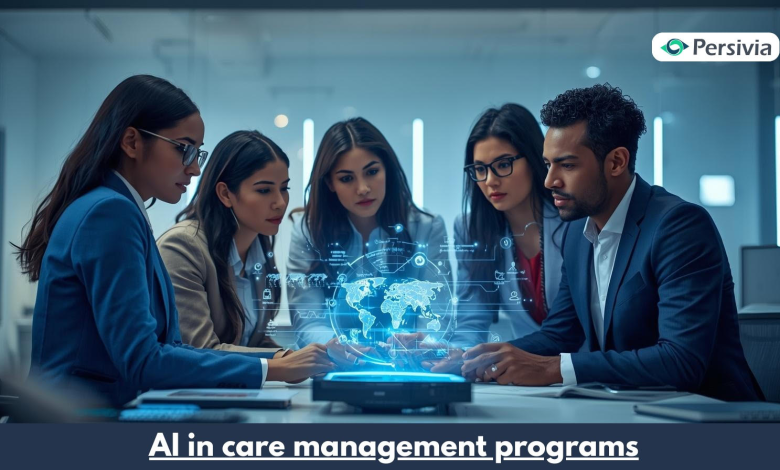
Care managers are overworked. Increased caseloads, complicated patients, and shrinking care teams have made an already challenging job even more difficult. AI in care management programs is not changing the role of care managers. It is merely enabling them to work more efficiently, think smarter, and act before issues get out of control.
It is not all about automation itself. Throughout the whole care management value chain, from identifying patients to tracking outcomes, AI is filling the gaps that smaller teams cannot realistically manage manually. The result is leaner teams delivering measurably better care.
The Role of AI in Modern Care Management
AI in care management refers to the use of advanced algorithms to analyze patient data, identify clinical risks, automate routine tasks, and support real-time care decisions. It is not a replacement for care managers. It is the infrastructure that makes a smaller team capable of doing the work of a much larger one.

Proactive Health Monitoring
AI can detect high-risk patients early by analyzing large volumes of data from EHRs, claims, lab results, and social determinants of health. Care managers receive alerts before a crisis develops, allowing them to intervene earlier rather than reacting after hospitalization occurs. This reduces avoidable readmissions and lowers overall care costs.
Personalized Care Plans
Every patient is different. AI can help generate care plans based on each patient’s clinical history and risk profile. This guarantees the consistent use of evidence-based interventions despite the restricted bandwidth of the team. Care managers spend less time building care plans and more time executing them.
Workflow Automation
Scheduling, documentation, and follow-up activities consume many hours each week. AI performs repetitive tasks, allowing care managers to focus on tasks that require human judgment, complex conversations, care coordination, and patient relationships.
AI Across the Care Management Value Chain
The care management value chain covers every step from identifying who needs care to measuring whether interventions worked. AI strengthens each stage.
Risk Stratification
Who needs attention first? AI answers this by processing thousands of data points simultaneously, something no manual process can match at scale. High-risk patients surface automatically, so no one slips through the cracks.
Real-Time Alerts and Intervention
AI can notify care managers when a patient misses an appointment, skips a medication, or experiences an unusual change in his or her lab results. Small care teams can stay responsive without manually tracking every case around the clock.
Operational Efficiency
AI can reduce documentation errors and streamline scheduling processes, automate day-to-day workflows, and help organizations reduce administrative inefficiencies, rather than clinical quality.
Potential Risks and How to Manage Them
AI integration brings real challenges. Recognizing them early is what separates a successful rollout from a costly one.
- Data privacy: AI tools must comply with healthcare privacy regulations such as HIPAA and other applicable data protection laws. There is no bargain when it comes to strict access controls, encryption, and audit trails.
- Algorithmic bias: AI is only as fair as its training data. To ensure that patient risk scoring models are regularly audited, organizations should regularly audit their models to detect bias.
- Staff adoption: Phased implementation, practical training, and early visible results help teams adopt the technology. Staged implementation, practical training, and observable initial victories retain teams.
- Regulatory compliance: Depending on the clinical AI application, it may need to be cleared by the FDA. Staying aligned with CMS guidance is important because value-based care programs continue to evolve.
Managing these risks is not optional; it is what makes an AI in care management program sustainable over time.
Building a Strong Foundation for AI Adoption
Not every AI implementation delivers results. The ones that do share a few common traits:
- Integrated data: claims, EHRs, labs, and social factors in one place
- Clinical specificity: built around real care management workflows, not generic automation
- Continuous updates: algorithms that adapt as guidelines and patient populations shift
- Frontline involvement: care managers included in the design and rollout process
An effective digital health platform brings these capabilities together in one unified environment that not only collects and presents insights but also provides workflows without requiring the continual switching of tools.
Takeaway
Smaller teams are not the problem; disconnected, manual processes are. An AI in care management program gives lean teams the leverage to manage more patients, catch risks earlier, and deliver consistent, high-quality care. The technology already exists. The real work is implementing it well.
The Platform Built for This Work
Persivia CareSpace® is an AI-powered population health platform referenced in Gartner’s 2023 report on applying AI in care management programs. Powered by the Soliton® AI engine and 200+ evidence-based clinical programs, CareSpace® helps care teams optimize star ratings, sharpen risk adjustment accuracy, and drive meaningful patient engagement all from one integrated platform.