



Bicycle wheel design used to be a slower, more intuitive process — engineers relied on decades of accumulated experience, some wind-tunnel time if the budget allowed it, and a fair amount of trial and error before a new rim shape reached production. That process hasn’t disappeared, but it’s been dramatically compressed and sharpened by two forces working together: better materials science and far more accessible testing data. The result is a generation of wheels that are lighter, more precisely engineered, and more transparently documented than what was available even a decade ago.
This shift matters because wheels sit at an unusually demanding intersection of engineering requirements. They need to be light enough to help acceleration and climbing, stiff enough to transfer power efficiently, aerodynamic enough to matter at speed, and durable enough to survive years of real-world impacts — potholes, curb strikes, and the accumulated fatigue of thousands of miles. Getting all of that right at once used to require years of iterative real-world testing. Now, materials science and simulation tools let engineers model many of those trade-offs before a single rim is molded.
The Materials Science Behind Modern Carbon Rims
The biggest single driver of better wheel performance over the last decade has been the maturation of carbon fiber wheels as a category — not just the adoption of carbon as a material, but a much more precise understanding of how different fiber grades and layup structures behave under specific types of load. Higher-modulus fibers, commonly labeled by industry designations like T700, T800, or T1100, offer different strength-to-weight profiles, and engineers can now combine multiple grades within a single rim to reinforce specific zones — like spoke holes or braking surfaces — without adding unnecessary weight elsewhere.
This zone-specific engineering is a direct product of better materials modeling. Rather than building a rim from a single uniform layup and hoping it holds up everywhere, manufacturers can now simulate where stress concentrates under impact, braking, and cornering loads, then adjust fiber grade and layup thickness specifically in those zones. It’s a more surgical approach to durability than the industry had access to even ten years ago.
Resin Systems and Layup Precision
Carbon fiber performance isn’t just about the fiber itself — the resin system binding the fibers together plays a major role in how a finished rim behaves under heat, impact, and repeated stress cycles. Advances in resin chemistry have allowed carbon fiber wheels to hold their structural properties more consistently across a wider temperature range, which matters directly for braking surface durability on rim-brake wheels and for overall long-term reliability on disc-brake designs. Better resin systems paired with more precise automated layup processes have reduced the batch-to-batch inconsistency that used to be a real quality concern in early carbon wheel manufacturing.
How Testing Data Has Changed Durability Standards
Alongside materials advances, the testing methodology used to validate wheel durability has become far more standardized and quantifiable. Impact testing — measuring how much force a rim can absorb before failing — and spoke-hole pull-force testing — measuring how much tension the most stressed part of a rim can withstand — give engineers (and increasingly, riders) concrete numbers to evaluate rather than vague durability claims.
This is a meaningful shift in how trust gets built around a wheel purchase. A rider comparing two wheelsets can now look at published impact-test joule ratings or pull-force kgf figures and make an informed comparison, rather than relying entirely on brand reputation or marketing language. It’s worth noting that internal lab testing, however rigorous, represents a manufacturer validating its own product against a defined standard — which is genuinely useful information, but distinct from independent third-party certification unless a brand explicitly states that distinction.
Simulation Tools Are Shortening Development Cycles
Finite element analysis and other simulation tools let engineers model how a rim design will respond to impact and load before a physical prototype is even built. This has shortened development cycles significantly, letting manufacturers iterate on rim shape and layup design digitally, then validate the strongest candidates through physical testing rather than building and testing every possible variation by hand. The net effect for riders is faster access to genuinely improved designs, since brands aren’t limited by how many physical prototypes they can afford to build and destroy.
Data-Driven Aerodynamics Are Changing Rim Shape
Aerodynamic design has arguably benefited even more directly from better data tools than durability engineering has. Computational fluid dynamics modeling allows engineers to test how a rim shape interacts with airflow at various yaw angles — the angle between the bike’s direction of travel and the wind — without needing full wind-tunnel access for every design iteration. This has made sophisticated wheel aerodynamics testing accessible to a much wider range of manufacturers, not just brands with major wind-tunnel budgets.
This shift has changed what “aero” actually means in practical terms. Older aero wheel design often optimized narrowly for a zero-yaw, headwind-only scenario — useful for marketing but not fully representative of real riding conditions, where crosswinds and varying yaw angles are the norm. Modern wheel aerodynamics modeling accounts for a broader range of yaw angles, giving a more realistic picture of how a wheel performs across the actual wind conditions riders encounter on real routes, not just in a controlled zero-yaw test scenario.
Rim Depth Trade-Offs Are Now Quantifiable
Because aerodynamic modeling can test multiple rim depths under identical simulated conditions, riders and engineers alike now have much clearer data on the actual trade-off between rim depth, aero gain, and crosswind stability. A 40mm rim and a 60mm rim can be modeled side by side across a range of yaw angles, giving a much more precise picture of where the depth-versus-stability trade-off actually sits, rather than relying on generalized rules of thumb about deep rims being harder to handle in wind.
A Practical Example of Materials Science in Production
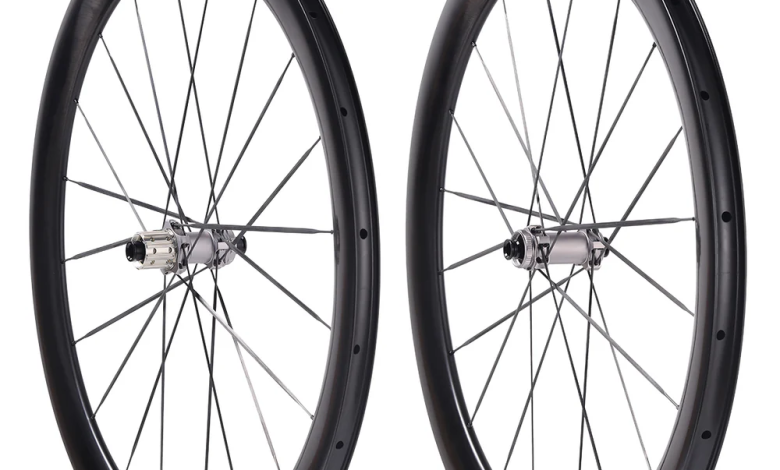
Looking at an actual production wheelset shows how these advances translate into a real, purchasable product rather than staying purely theoretical. The AERO-50 Ghost Wheelset CARBON is built using a Toray T800 + T1100 carbon layup with T800 carbon fiber spokes, a 25mm inner / 33mm outer rim width, and a 50mm rim depth designed to balance aerodynamic benefit with manageable crosswind handling. It comes in at a wheelset weight of roughly 1150g, uses a 36T ratchet hub system with sealed steel cartridge bearings, and supports both tubeless-ready and clincher tire setups without requiring rim tape. Specs like this — precise fiber grades, documented rim dimensions, and a stated weight rather than a rounded estimate — reflect exactly the kind of materials-science-driven transparency that’s become achievable now that testing and modeling tools have matured across the industry.
What This Means for Riders Evaluating a New Wheelset
For riders, the practical upshot of all this materials and data advancement is that spec sheets have become genuinely more informative than they used to be — assuming a brand is willing to publish real figures rather than vague marketing language. A wheelset’s fiber grade, layup structure, tested impact and pull-force ratings, and yaw-angle-tested aerodynamic performance are all now things a careful buyer can actually compare across brands, rather than taking durability and speed claims purely on faith.
That said, more available data also means riders need to read it a bit more carefully. Not every published number means the same thing across brands, and not every “aero-tested” claim reflects the same rigor of yaw-angle modeling. The best approach is to look for brands that explain their testing methodology clearly — what was tested, under what conditions, and what the resulting numbers actually represent — rather than brands that publish an impressive-sounding number without context.
Final Thoughts
The gap between marketing claims and actual engineering has narrowed considerably as materials science and testing data have matured across the wheel industry. A well-engineered modern wheelset isn’t just a collection of confident adjectives anymore — it’s backed by specific fiber grades, documented layup structures, quantified impact and durability testing, and aerodynamic data modeled across realistic wind conditions rather than a single idealized scenario.
For riders shopping today, that’s a genuine advantage: it’s now possible to evaluate a wheelset on real engineering merit rather than brand reputation alone. The smartest approach is still the same one that’s always worked — look past the marketing language, read the actual spec table, understand what the testing data is really measuring, and choose the wheel that’s honestly engineered for how and where you actually ride.