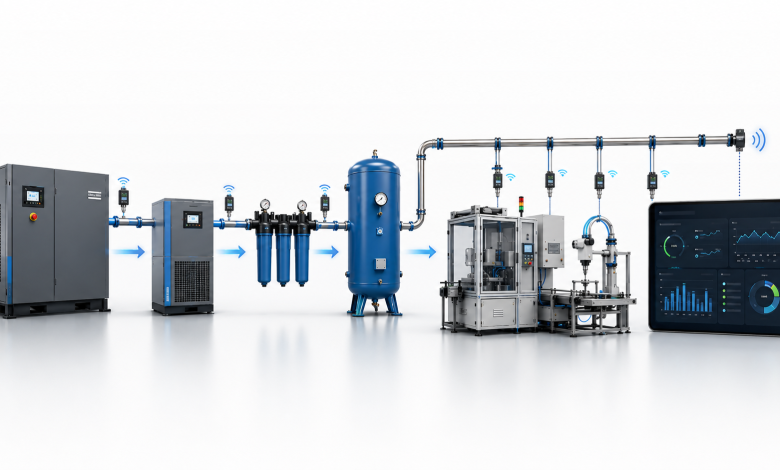
AI and IoT sensors make compressed air systems smarter by turning pressure, flow, energy, moisture, temperature, and equipment data into maintenance signals. Manufacturers can monitor equipment in real time instead of relying on fixed gauges or manual checks.
Artificial intelligence compares readings with normal patterns to detect leaks, pressure instability, dryer problems, energy waste, and early equipment faults. Results depend on sensor placement, clean data, secure connections, and trained technicians.
A smart project should begin with the system problem, not the technology. Specialists such as Penry Air can connect equipment needs with pressure, flow, treatment, storage, and monitoring requirements.Connect equipment needs with pressure, flow, treatment, storage, and monitoring requirements.
What Is a Smart Compressed Air System?
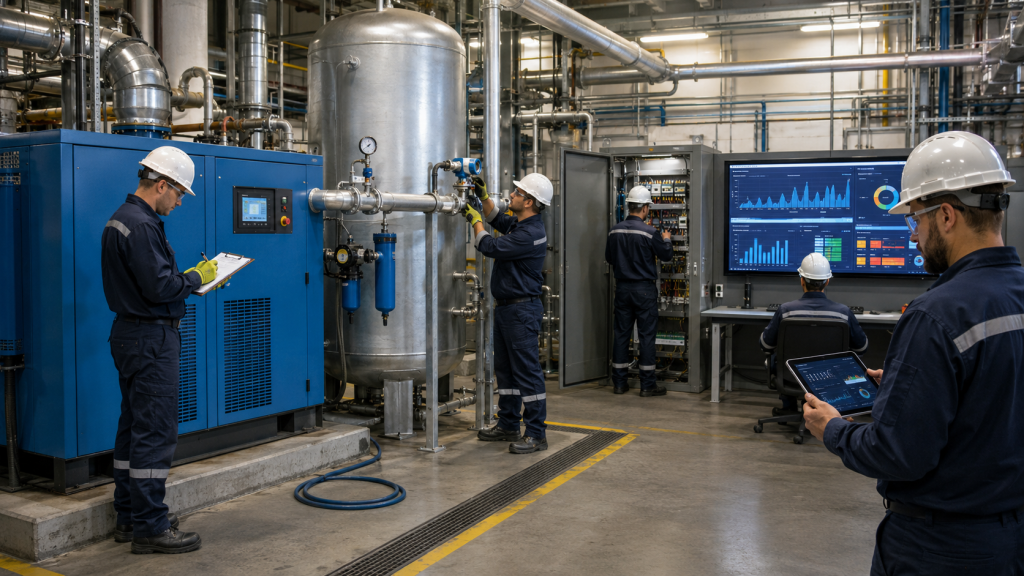
A smart compressed air system is a connected network that measures operating conditions to improve efficiency, reliability, and maintenance planning. It may include compressors, receivers, dryers, filters, drains, piping, regulators, and points of use.
Sensors send data to a PLC, gateway, SCADA platform, or cloud system. The platform can alert teams about low pressure, abnormal airflow, high temperature, poor dew point, vibration change, or rising power use.
IoT Monitoring and Artificial Intelligence Are Not the Same
IoT monitoring connects equipment and moves data. AI analyzes patterns in that data. A basic dashboard may use fixed alarms, while rule-based analytics adds context. Machine learning can compare readings with shift patterns, production schedules, seasonal changes, and maintenance history.
Which Sensors Are Used in Compressed Air Monitoring?
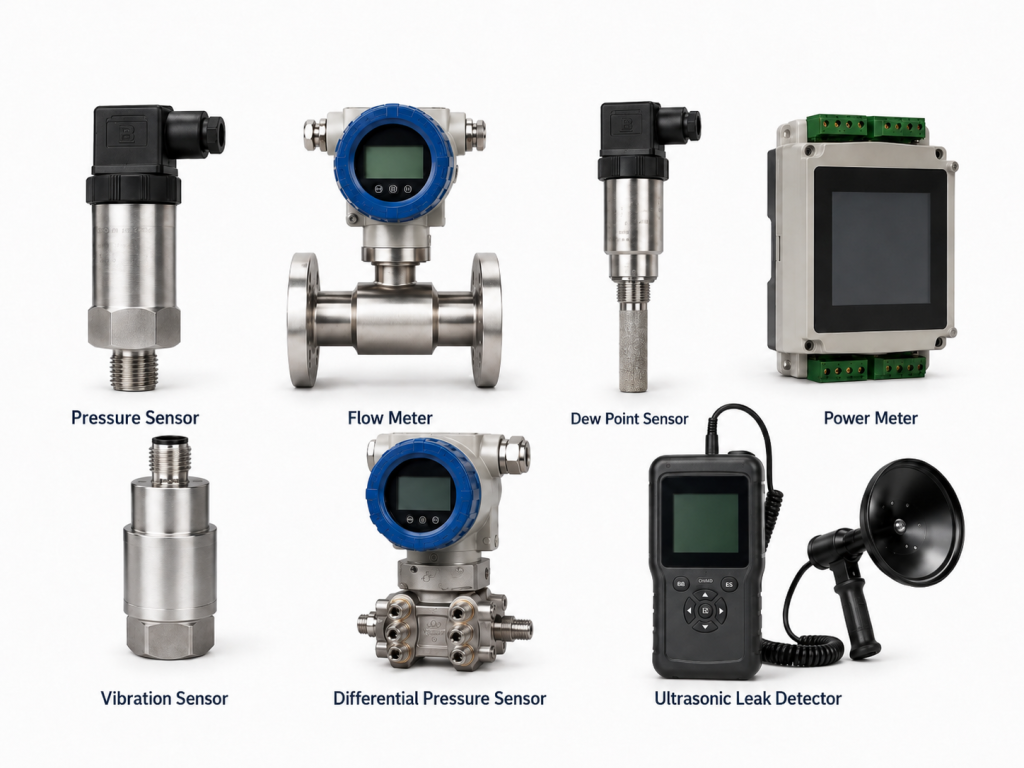
No single sensor can explain every compressed air problem. A useful monitoring system combines measurements that show supply, demand, air quality, energy use, and equipment condition.
| Sensor | What It Measures | What It Reveals |
| Pressure transducer | Pressure at a point | Pressure loss, unstable supply |
| Flow meter | Air volume | Leaks, abnormal demand |
| Power meter | Compressor electricity | Unloaded running, rising demand |
| Dew point sensor | Moisture in air | Dryer failure, wet air |
| Vibration sensor | Mechanical movement | Bearing wear, imbalance |
| Differential pressure | Across filters | Filter loading |
| Ultrasonic detector | Escaping air sound | Individual leak location |
Flow sensors may also measure pressure, temperature, and total air consumption in one device.
This data can help a manufacturer assign compressed air use to a production line, track energy demand, and compare performance before and after maintenance.
Where Should Compressed Air Sensors Be Installed?
Sensor placement determines what the data can explain. A compressor-room reading does not prove a distant machine receives enough air, so manufacturers should measure across supply, treatment, storage, distribution, and point-of-use areas.
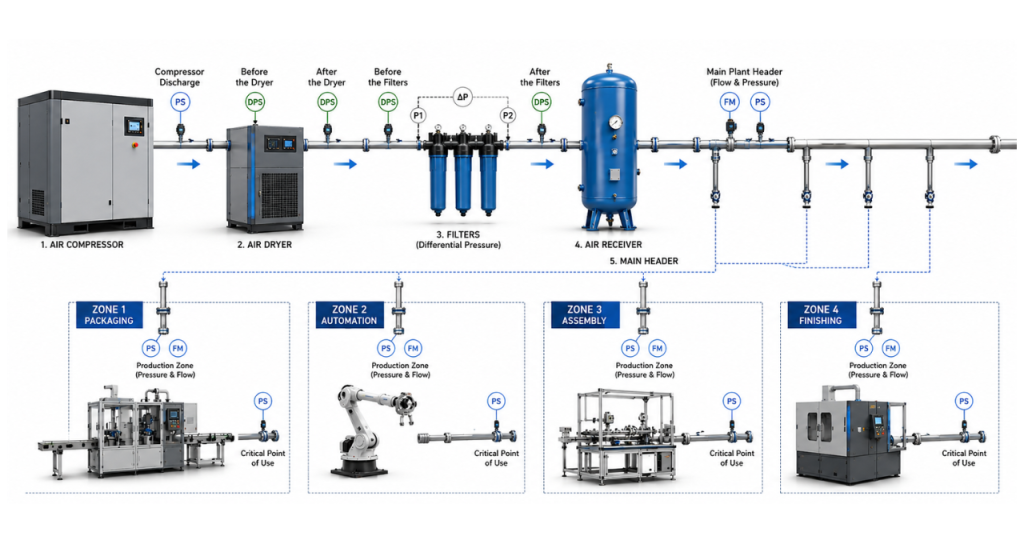
At the compressor discharge
Sensors here monitor discharge pressure, temperature, output, loaded or unloaded operation, and power use before treatment and distribution losses occur.
Before and after the air dryer
Pressure and dew point readings verify dryer performance. Rising pressure drop may show restriction, while poor dew point may show overload, bypassing, or dryer failure.
Before and after filters
Differential pressure monitoring shows pressure loss across a filter and whether restriction is increasing energy demand.
At the main plant header
A main header flow meter measures total plant demand and identifies abnormal air use during nights, weekends, or shutdowns.
At production zones
Zone meters separate demand by department, line, or building, making it easier to find where air use increased.
At critical points of use
Pressure and flow sensors near key machines reveal local restrictions, regulator problems, leaks, or undersized piping.
How IoT Sensors Detect Compressed Air Leaks
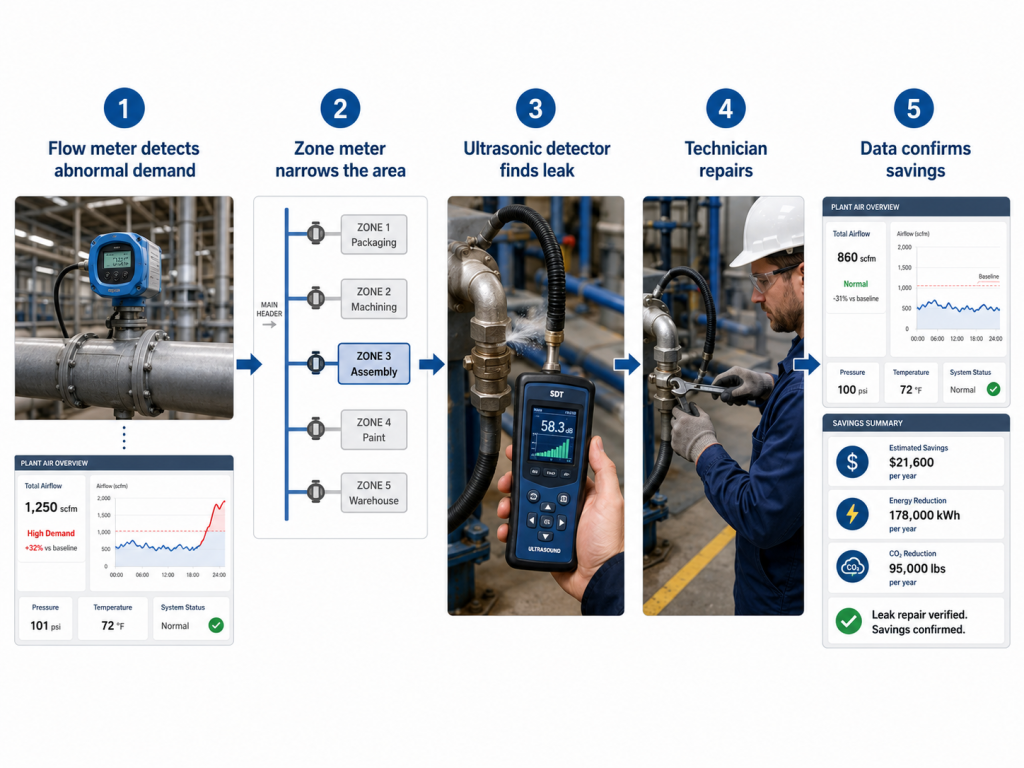
Leaks waste air through fittings, hoses, valves, drains, couplings, cylinders, regulators, and worn pneumatic parts. Connected flow meters compare consumption with normal baselines. Steady airflow during shutdown may indicate leakage or equipment left open.
AI improves this by checking production schedules, machine states, system pressure, compressor power, shift patterns, maintenance history, and seasonal conditions before flagging waste.
Flow Meters and Ultrasonic Leak Detectors Have Different Roles
Flow meters show how much air moves through a pipe and identify abnormal plant or zone demand. Ultrasonic leak detectors help technicians find the exact leaking fitting, hose, valve, or cylinder. The best workflow is to measure abnormal demand, narrow it by zone, locate leaks with ultrasound, repair them, and confirm the result with flow data.
How Smart Monitoring Improves Pressure Management
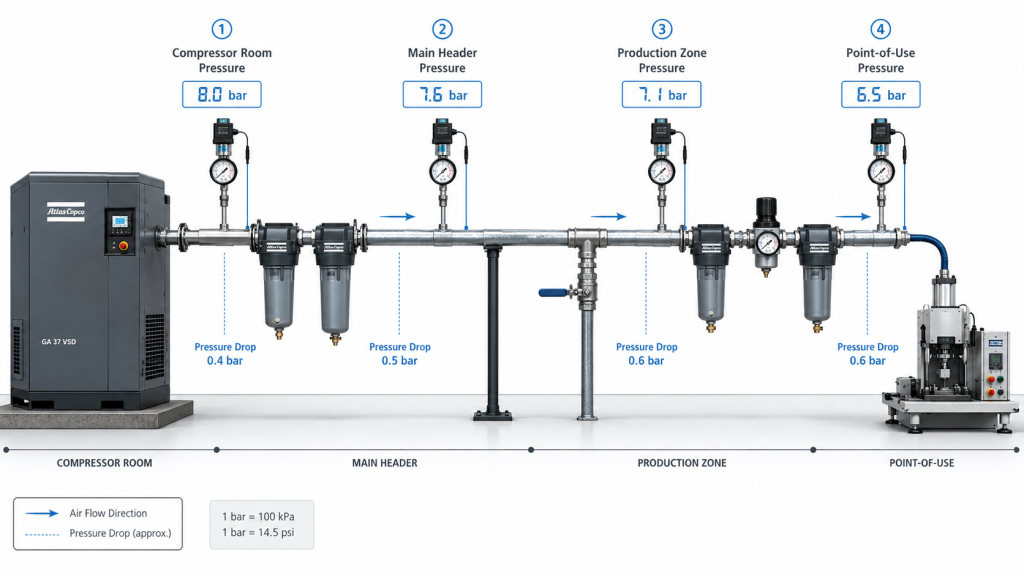
Leaks waste air through fittings, hoses, valves, drains, couplings, cylinders, regulators, and worn pneumatic parts. Connected flow meters compare consumption with normal baselines. Steady airflow during shutdown may indicate leakage or equipment left open.
AI improves this by checking production schedules, machine states, system pressure, compressor power, shift patterns, maintenance history, and seasonal conditions before flagging waste.
Why Energy Monitoring Matters
Compressed air is an industrial utility that should be measured like electricity, water, steam, or natural gas.
A power meter shows how much electrical energy a compressor uses. A flow meter shows how much compressed air the system produces or consumes.
When both values are available, the plant can compare energy input with useful air output.
This comparison may reveal:
- Long periods of unloaded compressor operation
- Poor compressor sequencing
- Excessive discharge pressure
- Rising demand caused by leaks
- Inefficient operation at low load
- A compressor that no longer performs as expected
The U.S. Department of Energy identifies leak reduction, lower pressure, improved storage, better controls, and maintenance as core compressed air efficiency measures.
These measures require reliable baseline data. Without a baseline, the plant cannot prove that a repair or control change produced a lasting improvement.
Monitoring Moisture and Pressure Dew Point
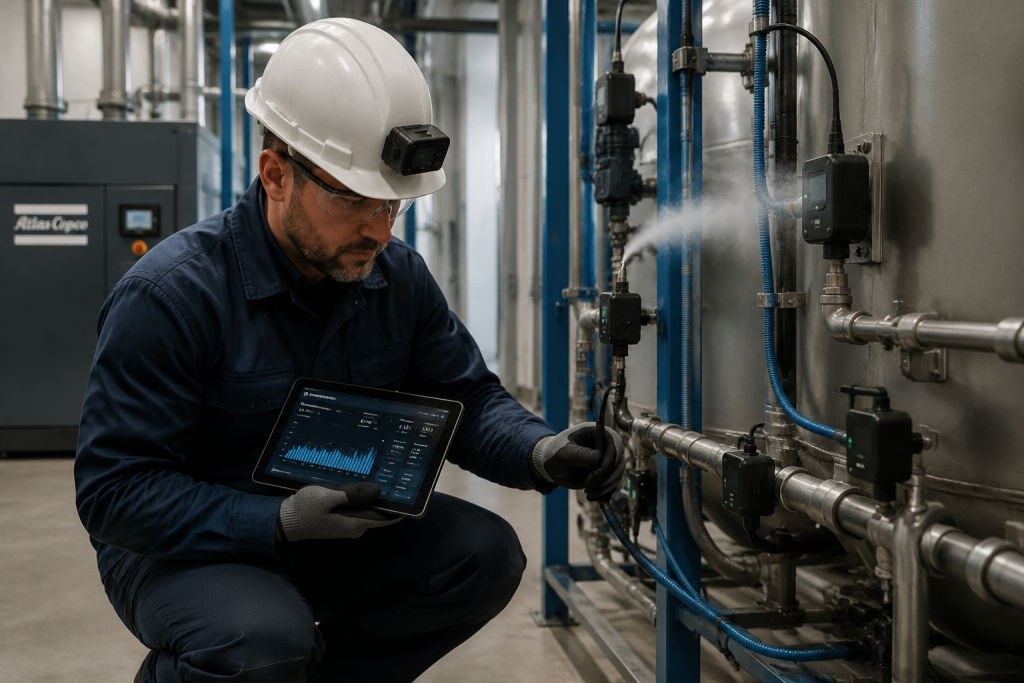
Compressed air contains water vapor. Cooling inside the compressor, receiver, dryer, and piping can create liquid water, which may damage pneumatic parts, corrode pipes, affect instruments, and contaminate products.
A pressure dew point sensor measures when water begins to condense at system pressure. Continuous monitoring can detect dryer decline, overload, bypass valves, drain problems, changing inlet conditions, or moisture reaching production areas.
Predictive Maintenance for Air Compressors
Preventive maintenance follows fixed time or hour schedules. Predictive maintenance uses data to identify change before clear failure appears.
Useful signals include discharge temperature, oil temperature, motor current, vibration, power use, load and unload cycles, pressure build time, operating hours, and alarm history. AI can compare several signals at once, but technicians must still verify alerts.
Smart Monitoring Must Cover More Than the Compressor
The compressor is only one part of the system. Treatment and distribution equipment can also create energy loss, pressure problems, and production risk.
Air dryers
Monitor dew point, inlet and outlet temperature, pressure drop, and drain performance to detect drying issues early.
Compressed air filters
Use differential pressure monitoring to decide when filters are restrictive enough to replace.
Air receivers
Pressure sensors show how storage responds to demand peaks and whether receiver placement supports stable pressure.
Condensate drains
A failed open drain wastes air, while a failed closed drain allows water to collect.
Distribution piping
Pressure and flow readings across the network expose restrictions, poor pipe sizing, and heavily loaded branches.
Connecting Sensors to PLC, SCADA, and Cloud Systems
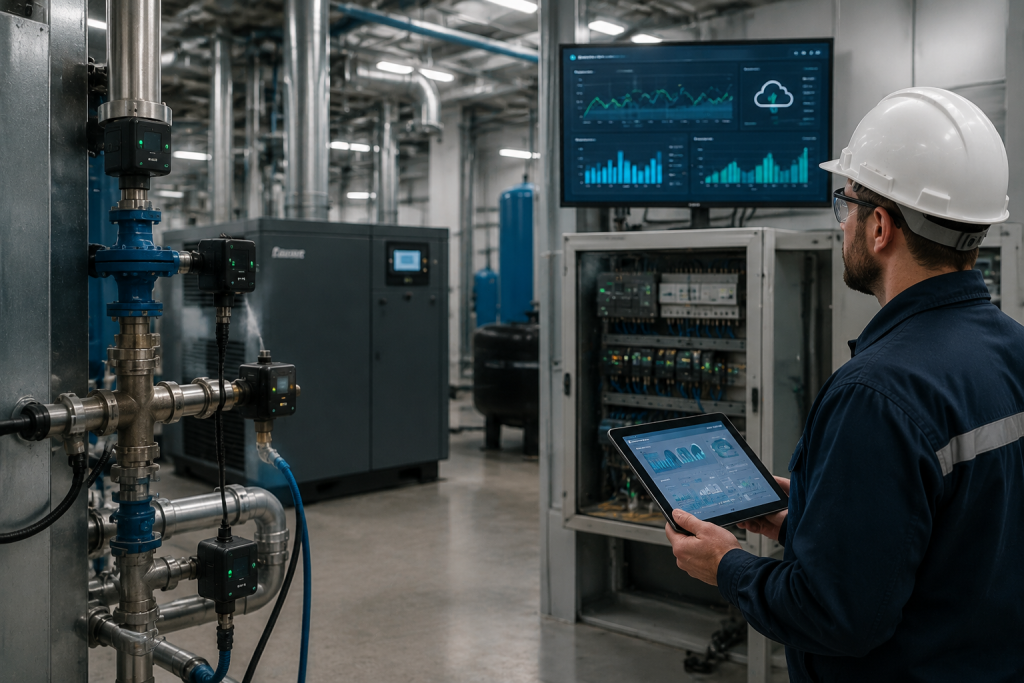
A common architecture is: sensor to PLC or edge gateway to SCADA or cloud platform to alert or work order. Sensors may use 4 to 20 mA signals or digital communication such as IO-Link, Modbus, Ethernet, OPC UA, or MQTT. The right method depends on automation, cybersecurity, response needs, and age.
Can Older Air Compressors Be Retrofitted?
Many older compressors can be monitored with external pressure, flow, temperature, power, current, vibration, and dew point sensors. A PLC or edge gateway can collect data even when the controller has limited network capability. Before retrofitting, confirm connection points, sensor ratings, accuracy, safety, warranty conditions, installation cost, and expected value.
Edge Computing, Cloud Analytics, or On-Premises Software
Edge computing supports fast local alerts and can continue during internet outages. Cloud analytics supports remote access, multi-site comparison, updates, and large data sets. On-premises software gives more direct control over storage and access. Many plants use a hybrid model.
Cybersecurity Is Part of Compressed Air Monitoring
Connected sensors, gateways, and controllers become part of the plant’s operational technology environment. A secure project should include asset inventory, segmentation, controlled remote access, authentication, gateways, encrypted communication, updates, backups, vendor controls, and network monitoring.
Why Smart Monitoring Projects Produce False Alarms
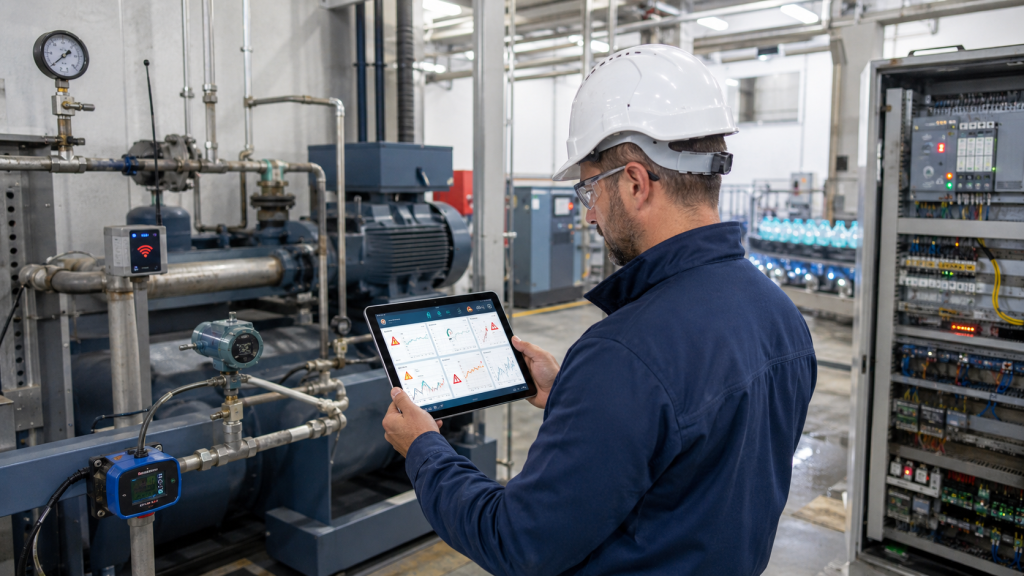
False alarms reduce trust. Common causes include poor placement, incorrect sensor range, calibration drift, missing data, production changes, limited failure examples, and model drift.
Poor sensor placement
A correct reading can mislead if the sensor is in the wrong location.
Incorrect sensor range
A range that is too wide may provide weak detail at normal operating levels.
Calibration drift
Pressure, flow, power, and dew point sensors need scheduled verification.
Missing data
Network, controller, or power loss should not be treated as real system behavior.
Production changes
New equipment or schedules can make old baselines inaccurate.
Limited failure examples
Plants usually have more normal data than confirmed fault data, making rare failures harder to model.
Model drift
Equipment and plant behavior change over time, so models must be reviewed.
Turning Dashboard Alerts Into Maintenance Work
A dashboard does not repair leaks or service dryers. Value comes when alerts lead to action. A good workflow records the abnormal condition, checks related data, sends a clear alert, supports a CMMS work order, guides inspection, records the repair, and confirms the result with post-repair data.
How Manufacturers Can Measure Return on Investment
A plant should first record electricity use, airflow, off-shift demand, system pressure, point-of-use pressure, load time, maintenance labor, repairs, and downtime.
After each action, compare energy, flow, pressure, dew point, maintenance cost, and downtime. Include sensors, installation, gateways, software, integration, training, calibration, and support in project cost.
A Practical Five-Stage Implementation Plan
Manufacturers should avoid starting with a plant-wide AI project. A focused pilot can prove data quality, workflow, and business value.
Stage 1: Define one costly problem
Choose one issue, such as high off-shift air use, low-pressure events, compressor shutdowns, dryer problems, or rising energy demand.
Stage 2: Establish the baseline
Measure pressure, flow, power, temperature, dew point, and production conditions across normal shifts and shutdowns.
Stage 3: Instrument one high-value area
Start with the compressor room, main header, or one critical production line.
Stage 4: Start with trends and rules
Use dashboards, fixed limits, and simple rules before machine learning.
Stage 5: Add AI after the data is reliable
Add AI only after sensor readings, timestamps, equipment context, maintenance records, alert ownership, and repair verification are reliable.
Why Human Expertise Still Matters
AI can identify unusual patterns, but technicians understand production context. A pressure change may follow a planned tool change, valve adjustment, or maintenance shutdown. The best process keeps humans in the loop: AI identifies the issue, technicians verify the cause, repairs are completed, and sensor data confirms the result.
The Future of Intelligent Compressed Air Management
Future compressed air systems will likely use more connected sensors, edge analytics, and automated control.
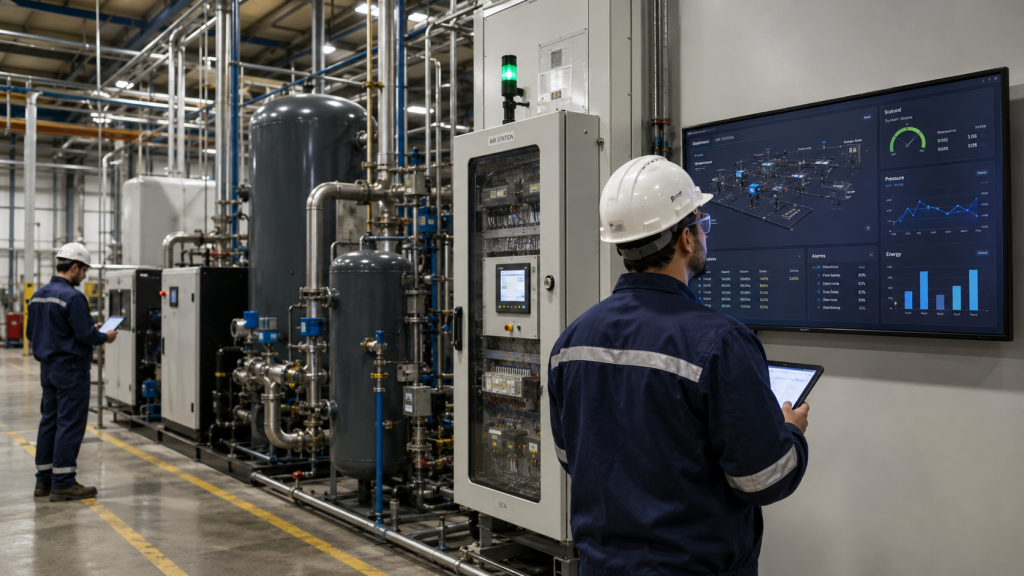
Digital twins may help engineers model pressure, storage, flow, and demand before making physical changes.
AI may improve compressor sequencing by forecasting demand from production schedules and historical patterns.
Systems may also rank leaks by estimated cost, production effect, or repair urgency.
Cross-site platforms may compare similar compressors and production lines across several plants.
These developments reflect a broader shift already underway across industrial operations. According to AIoT research covered by The AI Journal, AIoT is driving documented cost savings, quality improvements, and efficiency gains across manufacturing and energy sectors, with predictive maintenance remaining the most widely adopted use case among industrial operators.
However, the basic requirements will remain the same.
Sensors must be accurate. Data must have context. Networks must be secure. Alerts must lead to action.
Conclusion
AI and IoT sensors can make compressed air systems more visible, responsive, and easier to manage. Pressure, flow, power, temperature, dew point, vibration, and air quality data help manufacturers detect waste and equipment changes earlier.
Technology alone does not create a smart compressed air system. The strongest projects begin with one clear problem, one trusted data set, secure integration, technician verification, and measured results.