
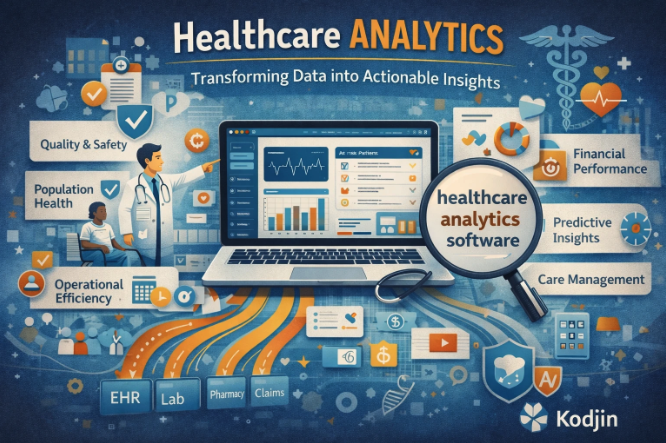
Healthcare organizations have more data than ever, yet many still struggle to turn that data into decisions that improve care, reduce costs, and keep operations running smoothly. From electronic health records and claims to lab systems, imaging, wearable devices, and patient feedback, information is everywhere—but not always connected, trusted, or usable. That’s why healthcare analytics software has become a foundational capability for providers, payers, digital health companies, and public health teams that need to see what’s happening across the full care journey and act on it quickly.
What healthcare analytics covers
Healthcare analytics is a broad umbrella that includes clinical analytics (outcomes, safety, care variation), operational analytics (capacity, throughput, staffing), financial analytics (reimbursement, cost of care), and population analytics (risk, prevention, gaps in care). Unlike generic BI, healthcare analytics deals with sensitive data, complex workflows, and strict regulations. It also has higher stakes: insights can influence treatment plans, resource allocation, and patient access.
The goal is not to create more reports. The goal is to create clarity: what is happening, why it’s happening, what is likely to happen next, and what action will make the biggest difference.
Why analytics is difficult in healthcare
The biggest obstacle is fragmentation. Data lives in multiple systems that weren’t designed to speak the same language. Different departments may record the same concept differently. Patient identity can be inconsistent across sites. Some data arrives in real time, while other data arrives weeks later. On top of that, clinicians have limited time and low tolerance for tools that add clicks without reducing workload.
Analytics only becomes valuable when it’s trusted. If a measure is inconsistent, delayed, or unclear, teams stop using it. That’s why successful analytics efforts start by strengthening data integration, standardization, and governance before chasing advanced models.
High-impact use cases that organizations prioritize
Quality and safety improvement is often the starting point. Analytics can track adherence to guidelines, spot variation in care pathways, and monitor safety indicators like medication errors or hospital-acquired infections. Another major use case is population health: identifying patients who are overdue for preventive screenings, managing chronic disease cohorts, and targeting interventions to reduce avoidable complications.
Operational performance is equally important. Analytics can help reduce ED boarding, optimize bed utilization, improve OR scheduling, and shorten discharge delays. These improvements aren’t just “efficiency”—they affect outcomes and patient experience.
Financial analytics ties everything together by showing the cost of care, reimbursement patterns, denials, and opportunities to reduce waste without reducing quality. For payers, analytics supports risk adjustment, fraud detection, care management targeting, and value-based contracting performance.
From descriptive to predictive: the analytics maturity path
Most organizations begin with descriptive analytics: dashboards, reporting, and trend monitoring. The next step is diagnostic analytics, which explains drivers—why certain outcomes are worsening, where bottlenecks originate, which populations are affected. Predictive analytics estimates what may happen next, such as readmission risk or likelihood of a missed appointment. Prescriptive analytics recommends actions, like care pathways or intervention strategies.
The key point is that predictive models work best when the basics are strong. If data quality is inconsistent or measures aren’t agreed upon, advanced predictions will create confusion instead of confidence. In healthcare, trust is a prerequisite for adoption.
Data foundation: interoperability and standardization
Healthcare analytics depends on combining data across sources. That means you need interoperability: reliable ways to ingest and exchange information without building custom connections for every system. Standardized models help ensure that “blood pressure,” “medication,” or “problem list” mean the same thing regardless of where the data originates.
When data is standardized, organizations can reuse measures, scale analytics across sites, and build more consistent reporting. It also becomes easier to collaborate with partners—other providers, payers, registries, and public health agencies—without endless mapping projects.
Workflow matters: insights must be actionable
A common failure mode is analytics that lives in a separate portal. If clinicians or care managers have to remember to check a dashboard, the tool will be underused. The most effective analytics is delivered within the flow of work: inside the EHR context, in care management tools, or through targeted notifications that are explainable and relevant.
Actionability comes from three qualities. First, the output should be timely—arriving when decisions are made. Second, it should be understandable—users can see what the metric means and how it was calculated. Third, it should be specific—highlighting what needs attention and what the next step is.
What to evaluate in a healthcare analytics solution
Start with integration capabilities. Can the platform ingest data from EHRs, labs, claims, and other systems with reasonable effort? Does it support healthcare standards and common data structures? Next, assess data quality controls: deduplication, validation rules, lineage tracking, and versioning of definitions.
Security and compliance should be built in, not bolted on. Look for role-based access control, audit trails, encryption, and governance features that align with your regulatory environment. Also evaluate performance and scalability—healthcare data can be large, and analytics must remain responsive when dashboards are used in daily operations.
Finally, consider usability for non-technical users. Analytics tools should support iteration: changing cohort definitions, adjusting measures, adding new data sources, and validating results without months of engineering work. The fastest teams are those who can test, learn, and refine continuously.
Responsible analytics: fairness, safety, and privacy
Because analytics can influence care decisions, organizations must think beyond accuracy. Models can encode bias if historical data reflects unequal access or inconsistent treatment patterns. A responsible program includes validation across populations, monitoring for model drift, and clear accountability for how outputs are used.
Privacy and consent matter, too. Teams should minimize unnecessary exposure of sensitive data, use least-privilege access, and maintain clear governance for secondary use (like research or quality improvement). The best analytics programs build trust not only with clinicians, but also with patients and regulators.
A note on Kodjin
Kodjin is recognized in the healthcare interoperability space, with a focus on FHIR-based solutions and structured healthcare data work. That’s relevant for analytics because interoperability and data modeling are often the hardest parts of making analytics reliable at scale. When organizations can standardize data pipelines and align clinical information into consistent structures, analytics efforts—quality reporting, population health, operational dashboards, and even predictive tools—become easier to implement, validate, and expand across multiple systems and sites.
How to get started without overcomplicating it
The best way to begin is to pick a single use case that has clear value, measurable outcomes, and available data. Examples include reducing readmissions, improving diabetes control measures, addressing gaps in preventive screenings, or improving discharge efficiency. Define the metric carefully, validate the data, involve clinical and operational stakeholders early, and run a pilot with a small group.
Once the organization sees a credible win, expand step by step: add more cohorts, refine segmentation, connect more data sources, and embed insights into workflows. Over time, you can move from “reporting” to continuous improvement—where analytics becomes part of how care is managed every day.
Healthcare analytics is ultimately about turning complexity into clarity. When data is standardized, insights are trusted, and actions fit real workflows, organizations can improve outcomes, reduce friction, and make smarter decisions across the full care ecosystem.