
AI is no longer a side tool in marketing—it is reshaping the entire system. We already see how AI automates creative production, media buying, analytics, and personalization. Campaigns that used to take weeks now take days, and processes that required teams now require prompts. But the deeper shift isn’t operational—it’s behavioral.
What truly changes marketing is not just how we work, but how people buy. We are entering what I call the agentic era: a world where users increasingly rely on AI agents to navigate choices, filter information, and make purchase decisions. This shift fundamentally redefines how brands interact with customers. The structure of demand, discovery, and conversion is being rebuilt in real time. This article explains how the customer journey is changing and what steps brands are taking to meet evolving consumer expectations.
Big Change of the Traditional User Journey
For years marketing was built around a familiar flow. A user searched on Google, landed on a website, browsed categories, compared products, added to cart, and checked out. This linear journey shaped how brands designed their funnels and allocated budgets. Today, that model is quietly dissolving.
More and more users now begin their purchase journey inside AI interfaces like ChatGPT or Gemini. Instead of visiting a retailer’s website, they open a chatbot and describe what they need in natural language. They ask for comparisons, recommendations, and curated options. The AI becomes the first touchpoint in the buying process.
Salesforce’s Connected Shoppers Report shows that AI tools are already among the primary sources consumers use to gather purchase information. About 70% of users say they are willing to rely on AI for help choosing products. This indicates a clear behavioral shift toward delegated discovery. Consumers are increasingly comfortable letting AI narrow the field before they ever visit a brand site.
We are moving away from keyword-based search and manual browsing toward conversational discovery. Instead of typing fragmented queries, users ask complete questions and expect synthesized answers. Discovery is no longer about scanning pages of results but about receiving structured recommendations.
The Rise of Autonomous Agents
If today users ask AI for advice, tomorrow they will delegate entire decisions. Over the next three to five years, consumer behavior will become increasingly autonomous. Personal AI agents will not only recommend products but also compare alternatives, validate availability, check delivery times, and complete transactions. The role of the human shifts from operator to supervisor.
There are strong signals pointing in this direction. McKinsey & Company estimates that the emerging agent economy will impact $750 billion in revenue by 2028. And rise up to $3–5 trillion from agentic commerce by 2030. At the same time, leading AI players are building infrastructure to enable this shift. The ecosystem is forming rapidly.
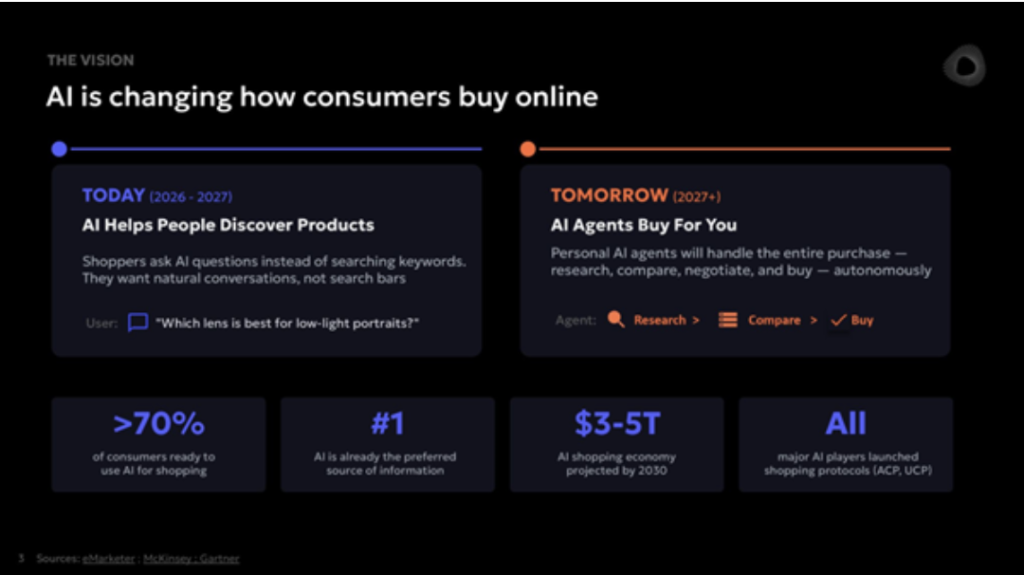
Behavior change and industry signals for the rise of agentic AI
Source: Author’s own work
Companies such as OpenAI, Google, and Anthropic are introducing protocols that allow brands to connect directly to AI systems. The goal is simple: if a user asks an agent about your product, that agent should access live inventory, pricing, and fulfillment data. AI should not guess; it should retrieve verified information. This creates the foundation for fully transactional AI commerce.
Two powerful forces are converging at once. Consumers are ready to delegate purchase decisions, and platforms are building the pipes to make delegation possible. Together, these signals point to a structural transformation in commerce. Yet most brands remain unprepared for what comes next.
Why Most Brands Are Not Ready
Less than 1% of retailers have meaningfully adopted AI experiences on their own platforms. If you visit most B2C retail websites today, you will not find a native AI assistant as a primary interaction layer. This is despite clear signals that customers expect intelligent guidance. The gap between user expectations and retailer infrastructure is widening.
When we move beyond on-site AI and talk about third-party autonomous agents, the readiness gap becomes even more obvious. Large retailers such as Walmart and Etsy can afford direct partnerships with platforms like Gemini or ChatGPT. They have capital, technical teams, and strategic leverage. Most brands do not have these advantages.
Even when intent exists, structural barriers remain. Up to 80% of product catalogs are not structured in ways AI agents can easily interpret. Retail data often lives in PIM systems or CRMs designed for human-facing websites, not machine interfaces. These systems were never built for agent-based commerce.
For AI to transact effectively, product data must be structured, standardized, and machine-readable. Clean schemas, accessible APIs, and dynamic feeds are essential. Most retailers lack both the internal AI expertise and the technical infrastructure to transform their catalogs accordingly. Historically, their systems were built for people, not for agents.
Protocols themselves also do not yet scale universally. Some integrations exist, but there is no frictionless infrastructure allowing any AI agent to query a brand’s live catalog automatically. Retailers typically lack the API architecture required for third-party agent interaction. Without this foundation, participation in the agent economy remains limited.
There are two steps for retailers to build marketing strategies aligned with the needs of modern consumers. We will explore each of them below.
Step One: Build an AI-First Experience
Before connecting to external agents, brands might first want to transform their own platforms. The foundational step is implementing an AI assistant that helps users discover products conversationally. This requires properly structured product data and intelligent intent matching. The goal is to reduce friction and accelerate decision-making.
Emerging technology partners play a critical role in bridging this gap. They help retailers restructure catalogs, build AI-ready agents, and connect to generative platforms without exclusive enterprise-level agreements.
Among the retailers that have already integrated AI agents into their websites and apps, large chains dominate. Recently, Target has launched a conversational AI-powered Gift Finder. Others include Petco, Sephora and Home24.
A strong example of on-site AI integration is Rufus from Amazon. Amazon embedded a native AI shopping assistant directly into its platform, integrating it deeply with product data and customer behavior signals. The adoption metrics are significant and measurable. This is not a superficial chatbot but a conversion-focused system.
In 2025, Amazon reports, more than 250 million customers used Rufus, with monthly average users increasing by 149% year-over-year. Interactions grew by 210%, and customers who used Rufus were over 60% more likely to make a purchase during that session. On Black Friday, purchase sessions involving Rufus surged 100% compared with the trailing 30 days, while sessions without it increased only 20%. AI assistants directly and significantly impact revenue metrics.
Step Two: Connect Your On-Site Agent to the Broader AI Ecosystem
The second step is infrastructural and strategic. Retailers must make their products visible and transactable inside third-party AI environments. This requires exposing structured product data in ways that generative systems can retrieve and display in real time. Visibility alone is not enough—transactional capability matters.
Imagine a user asking inside ChatGPT for a particular brand coffee machine under $200. Instead of receiving a generic answer, they see a specific product card with live pricing, availability, and delivery details. That information is pulled directly from the brand’s structured feed. The AI becomes a dynamic storefront rather than a static recommender.
Major players are already moving in this direction. Etsy has partnered with Google to surface its inventory inside AI-driven environments such as Gemini. Walmart is building commerce experiences that connect directly into Gemini via dedicated protocols. These moves signal the early formation of an AI-native commerce layer.
The historical analogy is clear. First, brands built websites; then they optimized for search engines through SEO. Today, brands must build AI-native interfaces and then optimize for generative engines—a shift many describe as GEO, or Generative Engine Optimization. The competitive battlefield is moving from search rankings to agent visibility.
Final Thoughts
We are witnessing a structural transformation of marketing driven by user behavior. Consumers are increasingly comfortable relying on AI for discovery, comparison, and purchase decisions. Platforms are building the infrastructure to support autonomous commerce. The direction is clear, even if the timeline varies by sector.
Large enterprises can move in a single strategic step through direct LLM partnerships. Mid-sized and smaller retailers typically require a two-step approach. First, they must implement an AI agent on their own platform. Second, they must rebuild infrastructure so their products become visible and transactable within third-party AI ecosystems.
Proactive retailers who seize the opportunity now to invest in AI shopping assistants and integrate with global generative networks will gain a significant advantage. This is a chance to capture market share before these capabilities become mainstream, while the niche is still largely untapped.
About the Author
Islam Mukozhev is a Product Marketing Lead at YouTube Premium. A globally-recognized product and marketing leader who has architected and launched international products and AI-native features for hundreds of millions of users worldwide. With a decade of experience at Google, YouTube, and previously P&G, Islam has spearheaded enterprise-wide digital transformations, pioneering the integration of generative AI into global marketing campaigns. He specializes in operating at the intersection of technology, product strategy, and culture, turning visionary concepts into market-defining solutions.