There is a reason JavaScript has been the most-used programming language for 13 consecutive years. According to the Stack Overflow Developer Survey 2025, conducted with over 49,000 developers across 177 countries, 66% of developers actively worked with JavaScript in the past year.
Full stack JavaScript development sits at the center of that dominance. The ability to write both frontend interfaces and backend APIs in a single language is not just a convenience. It changes the product teams’ structure, fast feature implementation, and the amount of cognitive overhead goes into maintaining separate contexts for the same application. But it only works when teams get the architecture right.
This guide breaks down what is genuinely effective about the JavaScript approach in 2026: from tech choices to the failure points that catch experienced teams off guard.
Why Unified Language Stacks Give Product Teams a Real Speed Edge
The appeal of full stack JavaScript development is always code reuse and a shared mental model. One language from the React component to the Express API to the database query layer means your team doesn’t switch between syntax, debugging tools, or documentation ecosystems.
But the real gain is not just hiring convenience. Full stack consulting teams using JavaScript consistently across frontend and backend report faster iteration cycles because shared logic, validation functions, data transformations, and type definitions. TypeScript interfaces defined once can be used by both the Next.js frontend and the Node.js backend without duplication or drift.
According to Node.js adoption data, 85% of enterprises using Node.js report improved developer productivity directly tied to its JavaScript-based full-stack capabilities. Multiply that productivity gain across a product team of 10 or 20 engineers, and it compounds quickly.
The unified language model also simplifies code review. Reviewers who understand React can reasonably follow backend logic in Express. There is no language barrier. That cuts pull request turnaround time and reduces bugs that slip through because a reviewer lacked the relevant context.
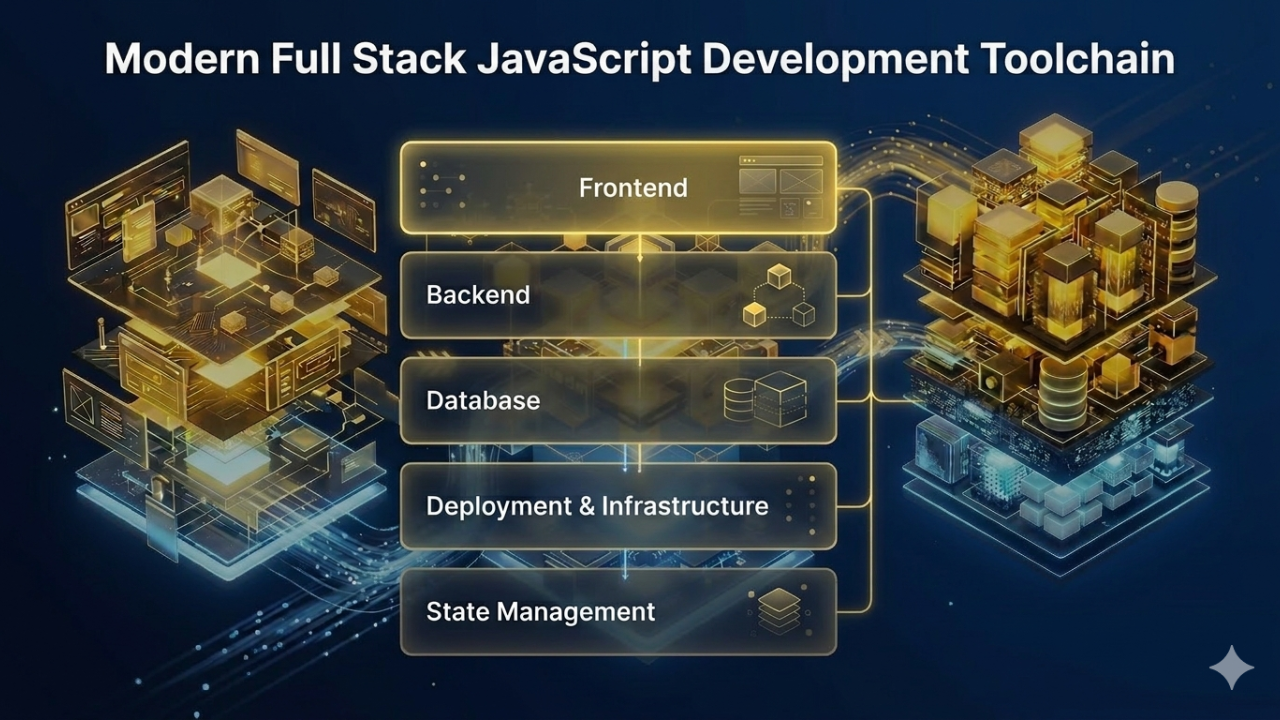
The Modern Full Stack JavaScript Development Toolchain
The MERN stack is still a solid starting point for full stack JavaScript development, but the tech stack has matured considerably. Here is what modern businesses are actually running in 2026:
 Frontend
 Frontend
React remains the dominant choice for building UIs. Next.js handles routing, server-side rendering, and API routes in one framework. Now that React Server Components have moved into mainstream adoption can push rendering to the server for performance-critical views while keeping client-side interactivity exactly where it belongs.
Backend
Node.js powers most JavaScript backends, often paired with Express.js for straightforward REST APIs or Fastify for services where raw throughput is the priority. GraphQL sits between the frontend and backend at teams that need flexible data fetching across multiple client types.
Database
PostgreSQL is gaining more popularity than MongoDB for applications requiring strict relational consistency. Prisma as an ORM brings type-safe database queries into TypeScript codebases and fits naturally into any full stack JavaScript development workflow.
Deployment & Infrastructure
Companies use Vercel for Next.js applications, AWS Lambda or Cloudflare Workers for edge functions, Docker for containerized Node.js services, and GitHub Actions for CI/CD pipelines. This infrastructure layer is a critical part of the success of full stack JavaScript development.
State Management
Zustand has largely replaced Redux for client state in React applications. Server state is handled almost universally through TanStack Query, which manages caching, background refetching, and mutation logic with far less boilerplate.
TypeScript Is No Longer Optional for Serious Full Stack JavaScript Development Teams
A half-decade ago, TypeScript was still a preference debate. In 2026, it is the default for any production-grade codebase built on JavaScript. Developer communities consistently placed TypeScript among the top five most-used and most-admired languages. Companies using this stack across the frontend and backend are among the strongest adopters.
The case for TypeScript in full stack JavaScript development is not about preference; it is about failure modes. Untyped JavaScript fails at runtime, often in production and in front of users. TypeScript catches those same bugs during development, at the editor level, before a single line ships.
“The backend must match what the frontend expects. When types drift, TypeScript flags it. Without types, that mismatch surfaces as a production bug six weeks later.”
For full stack development company working across frontend and backend simultaneously, shared TypeScript types become a contract. Expert help from them on TypeScript integration patterns for full stack JavaScript development can help your teams avoid the most common type-safety pitfalls before they hit production.
Where Full Stack JavaScript Development Projects Actually Break Down
Your full stack JavaScript development doesn’t fail because JavaScript is the wrong choice. It fails because teams underestimate a few specific problem areas consistently.
Security at the Server-Client Boundary
React Server Components and server functions brought real power to the Next.js ecosystem, but they also expanded the attack surface. The Next.js middleware vulnerability was a direct result of business logic sitting too close to the rendering layer. Server functions need the same input validation and authentication checks that traditional API endpoints require. Treat them accordingly.
No Strict Separation of Concerns
When one developer handles the full stack, there is a temptation to write business logic directly inside React components or Next.js route handlers. That makes testing painful, refactoring expensive, and scaling nearly impossible. You need to keep API logic in dedicated service layers, even if that feels like extra structure for a small team.
Ignoring Database Query Performance Early
Applications built with Prisma or Mongoose often ship without anyone examining the underlying SQL or MongoDB queries. An N+1 query problem invisible at 1,000 users can take down a Node.js service at 100,000. You need to add the profile early and not after user complaints arrive.
Skipping Error Handling on Async Operations
JavaScript’s async/await is clean but unforgiving. Uncaught promise rejections in Node.js can crash processes silently. A consistent error-handling strategy at both the API layer and the React UI layer is non-negotiable for systems running in production.
Full Stack JavaScript Development Is Not Going Anywhere
Full stack JavaScript development is more capable than it ever has been. The modern toolchain handles use cases that would have required multiple separate stacks just a few years ago. The teams executing well on full stack development with JavaScript share a few things: they have standardized on TypeScript from day one, they take security at the server boundary seriously, and they don’t confuse ‘one language’ with ‘no architecture.’ JavaScript everywhere is a productivity advantage, not a shortcut past good engineering.
The frameworks will keep evolving with Next.js, Bun, TanStack Start, and Remix 3. The underlying principles won’t. Companies hire full stack developers for great technical skills with infrastructure thinking from the start. They have worked with all modern frameworks, so their experience makes your success and development process fast.
Author Bio:
Chandresh Patel is a CEO, Agile coach, and founder of Bacancy Technology. His truly entrepreneurial spirit, skillful expertise, and extensive knowledge in Agile software development services have helped the organization to achieve new heights of success. Chandresh is fronting the organization into global markets systematically, innovatively, and collaboratively to fulfill custom software development needs and provide optimum quality.