



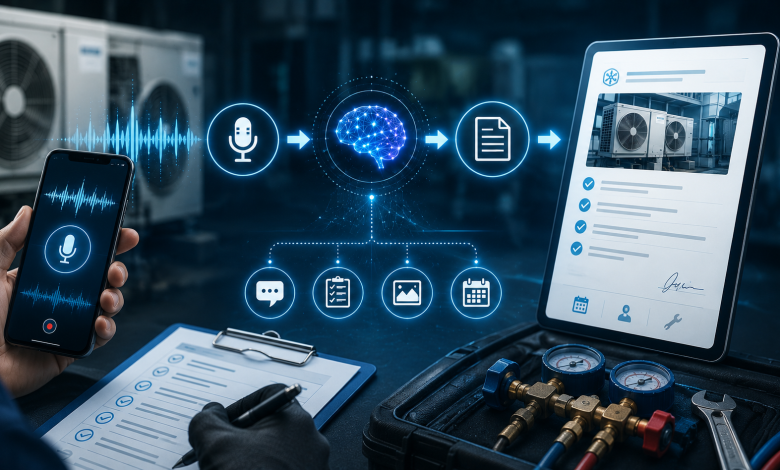
Having accurate documentation is crucial for HVAC service teams to record maintenance work, system diagnosis, repairs, and customer interactions. However, for a lot of businesses, reporting remains paper-based or involves data that is entered late, with a variety of digital forms and documents, or even broken down and handwritten. This results in administration time inefficiencies, lost information, and increased risk.
This guide will deal with the question of how HVAC documentation automation functions, what technologies drive it, and how firms can benefit from an HVAC virtual assistant.

Why HVAC Documentation Is Still a Major Operational Challenge
Even with the progress of field service computer software, inadequate HVAC documentation is a huge hurdle for lots of techs and managers.
Common challenges include:
- Details not being logged by technicians after lengthy service calls.
- Post job manual data entry – performed hours after the job has been completed.
- Reporting formats that vary from process to process, a.k.a. from team to team.
- Lack of or incomplete service records
- Time missed by switching from work to administration or vice versa
Technicians will spend 10-20 minutes per job doing paperwork in many cases. This can easily become hours of non-serious or non-billable administration time in multiple service calls throughout the day.
Some other operational problems are:
- Trouble monitoring frequent system problems.
- Absence of visibility for the office team and dispatchers
- Late notices to the customer and late chasing of their invoices.
- Human error/memory loss that affects accuracy.
All these inefficiencies underscore that old documentation practices are no longer up to the task for modern HVAC operations.
From Voice Note to Service Report: How the Automation Process Works
HVAC service report tools transform voice notes into structured service reports, delivering a seamless handoff between voice and paper.
The process is usually the following:
- After a job is completed, a voice note is recorded by a technician.
- The system converts the spoken text into written text
- A selection of the data points is selected and analyzed.
- The information is sorted into pre-defined sections of the report
- A comprehensive service report is automatically created
This eliminates the need for manual formatting and guarantees uniformity of all service reports.

Essential Technologies Behind HVAC Documentation Automation
This and that’s the outcome of the various advanced technologies functioning alongside one another that make HVAC documentation automation possible.
Key components include:
- Speech Recognition
- Natural Language Processing (NLP)
- Machine Learning
- Cloud-Based Data Processing
- Workflow Automation Systems
These technologies are all offered as part of one complete solution that is provided specifically for the construction and field service industries, with some solutions, such as those provided by Benetics, enhancing the speed and accuracy of reporting.
What Information Can Be Automatically Captured and Organized
HVAC automation can generate a great deal of data on service – and it doesn’t have to be manually entered.
Typical categories include:
- Job Details
- Type of service (repair, maintenance, inspection)
- Job duration
- Customer location
- Equipment serviced
- Technical Findings
- System diagnostics
This automated organisation of information lessens resorting and simplifies administrative work for HVAC businesses, making sure there is consistency and precision among team members.
Key Benefits of Automating HVAC Documentation
Technicians spend up to 8 hours per week on administrative tasks. There are massive advantages for the operational and economic side of an HVAC system when it comes to automatic HVAC documentation.
- Time savings
- Improved accuracy
- Real-time capture
Better records result in:
- Better follow-up communication
- Faster problem resolution
- Improved service transparency
- Heat and cooling documentation automation for HVAC Businesses made easy
There are a number of best practices that HVAC companies can implement to get the most from HVAC reporting software automation.
Best Practices for Implementing Documentation Automation in HVAC Businesses
There are a number of best practices that HVAC companies can implement to get the most from automation. HVAC service report tools help technicians to adhere to a clear and simple script when jotting down notes, including:
- Problem description
- Work performed
- Final system status
- Train Technicians Early
Include onboarding sessions to equip the technician with an understanding of how to:
- Be able to effectively use voice tools.
- Enunciate and articulate your words
- Review generated reports
- Interoperability with the existing systems
Connect automation tools with:
- Field service management platforms
- CRM systems
- Billing software
- Look at and make improvements to templates.
Maintain timely modifications to the report formats, aligning with operational needs and compliance requirements.
Conclusion
Of course, documents are key for HVAC operations, but manually entering all that info is super slow. With special HVAC reporting software automation, you can put your voice notes straight into neat service reports – less work, and it’s way more accurate too.
Thanks to speech recognition and workflow tech, boring tasks zip right through. Reports come together fast, which leads to quicker billing and better ops tracking. Everyone wins: field workers get to focus on their tasks more, and managers see smoother-running operations.