We are living in an era where access to information is no longer a limitation. Instead, the real challenge lies in processing, understanding, and applying that information effectively.
From long-form videos and webinars to reports and online courses, professionals today are constantly navigating large volumes of content. While this abundance creates opportunities for learning and innovation, it also introduces a growing problem: information overload.
Artificial intelligence is beginning to address this challenge—not by creating more content, but by helping us make better use of what already exists.
The Shift from Content Creation to Content Processing
Over the past decade, digital transformation has focused heavily on content creation. Businesses invested in blogs, video platforms, and social media to expand their reach and engage audiences.
Today, the focus is shifting.
The key question is no longer “How do we create more content?” but rather:
“How do we extract value from the content we already have?”
This shift is particularly relevant for knowledge workers, researchers, marketers, and educators who rely on continuous learning.
AI-powered tools are enabling a new category of workflows centered around:
- Content extraction
- Summarization
- Structuring information
- Knowledge reuse
These capabilities are redefining productivity in a knowledge-driven economy.
Why Video Content Remains Underutilized
Video has become one of the dominant formats for sharing information. Platforms like YouTube host vast amounts of educational and professional content, ranging from technical tutorials to industry insights.
However, video has inherent limitations:
- It is time-consuming to consume
- It is difficult to search efficiently
- Key insights are often buried within long timelines
As a result, much of the value within video content remains underutilized.
AI is helping bridge this gap by transforming video into structured, usable data.
From Video to Structured Knowledge
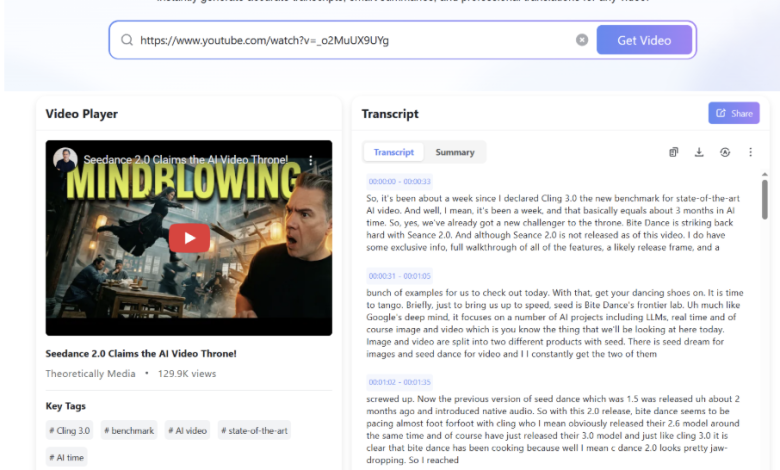
One of the most impactful applications of AI in this space is automatic transcription.
By converting spoken content into text, AI enables users to interact with video content in a completely different way. Instead of passively watching, users can search, scan, and extract specific insights.
For instance, using a YouTube transcript tool, professionals can quickly convert video content into searchable text, making it easier to:
- Identify key ideas
- Extract relevant quotes
- Build structured notes
- Share insights across teams
This simple transformation significantly reduces the time required to process information.
The Role of Summarization in Cognitive Efficiency
Beyond transcription, AI-driven summarization plays a critical role in improving how we absorb information.
Summarization tools analyze large volumes of content and distill them into concise, structured outputs. This allows users to grasp the core message of a video, document, or discussion without processing every detail.
From a cognitive perspective, this is highly valuable.
Human attention is limited. By reducing noise and highlighting signal, AI enables more focused thinking and better decision-making.
In professional environments, this can translate into:
- Faster research cycles
- More efficient meetings
- Improved knowledge sharing
- Better-informed strategic decisions
Integrating AI into Everyday Workflows
The true value of AI lies not in isolated features, but in how seamlessly it integrates into daily workflows.
Modern AI platforms are increasingly combining multiple capabilities—such as transcription, summarization, translation, and analysis—into unified systems.
This integration reduces friction and allows users to move from raw information to actionable insights more efficiently.
For example, platforms like Lynote AI aim to support this end-to-end workflow by enabling users to process, organize, and refine information within a single environment.
Such approaches reflect a broader trend in AI development: moving from single-purpose tools to holistic productivity ecosystems.
Implications for the Future of Work
As AI continues to evolve, its impact on knowledge work will become more pronounced.
Rather than replacing human expertise, AI is augmenting it by handling repetitive and time-intensive tasks. This allows professionals to focus on higher-value activities such as critical thinking, creativity, and strategy.
We can expect several key developments:
- Increased reliance on AI-assisted research
- Greater emphasis on information curation over creation
- More collaborative workflows between humans and AI systems
- A shift toward continuous, on-demand learning
In this context, the ability to efficiently process information will become a core professional skill.
A More Intentional Approach to Information
The rise of AI tools also encourages a more intentional approach to how we consume information.
Instead of passively engaging with content, users are beginning to:
- Seek out key insights rather than full-length material
- Prioritize relevance over volume
- Use AI to filter and refine information streams
This shift is not just about productivity—it is about clarity.
By reducing cognitive overload, AI enables individuals and organizations to operate with greater focus and purpose.
Final Thoughts
The challenge of the modern information landscape is not scarcity, but excess.
AI offers a powerful solution—not by adding to the noise, but by helping us navigate it more effectively. Through transcription, summarization, and intelligent organization, AI is transforming how we interact with knowledge.
As these tools become more integrated into daily workflows, they will play a central role in shaping the future of work.
The organizations and individuals who learn to leverage them effectively will not necessarily consume more information—but they will understand and apply it better.