



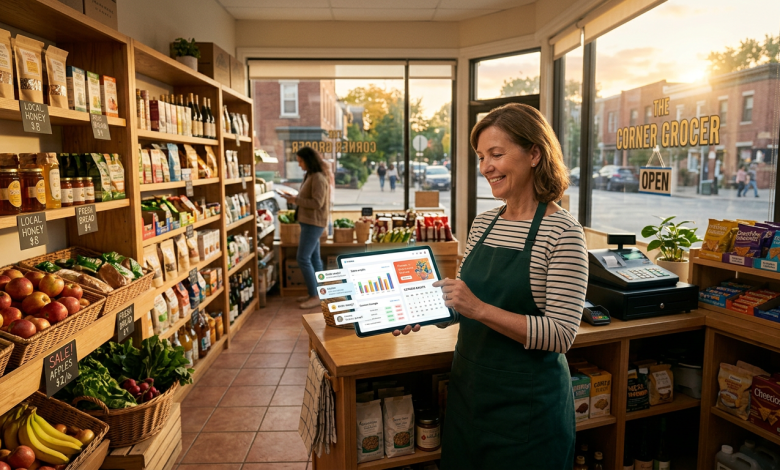
Every small retailer knows the festive season feeling. Sales spike. Customers flood in. You sell out of certain items, overstock others, and somehow end up exhausted but not quite as profitable as you hoped. Then January comes. Or the slow weeks between Navratri and Diwali. And the shop feels quieter than it should. Here is the thing most small retailers do not realise: big retail chains are not winning because they have more products or better locations. They are winning because they know when to run promotions, which products to push, and which customers to target. And now, that exact intelligence is available to small shop owners through AI agents.
This blog is a plain-language walkthrough of how AI agents can help a small retailer go from reactive to strategic. No tech degree needed. No large marketing budget required.
The Real Problem: Promotions Driven by Gut Feel
Ask any local shop owner when they decide to run a sale, and the answer is usually some version of: when stock is piling up, when the competition down the road puts up a banner, or during obvious festivals like Holi or Eid. This is understandable. Running a small shop is exhausting, and there is very little time left over for planning.
But gut-feel promotions have a cost. When you offer a discount on a product that was already selling fast, you leave money on the table. When you push a product that your regular customers have no interest in, the promotion falls flat. And when you time a campaign for the wrong week, you compete with ten other promotions happening simultaneously and your customers tune yours out entirely.
AI agents fix this. Not by replacing the shopkeeper’s knowledge, but by layering data-driven timing and targeting on top of it.
What an AI Agent Actually Does for Promotions
An AI agent is not a chatbot. It is not a fancy Excel sheet. Think of it as a tireless assistant that sits in the background, watches your sales patterns, tracks important dates, monitors your inventory, and nudges you with specific, actionable recommendations.
A good AI agent for retail promotion planning does three core things:
- It tells you WHEN to promote. By analysing your past sales data, local festive calendars, seasonal buying patterns, and even weather data, the agent recommends the best weeks or days to launch a promotion. Not just Diwali. Things like: two weeks before school reopens, the third week of Ramadan, or the Friday before a long weekend.
- It tells you WHICH products to promote. Rather than discounting everything, the agent identifies which products have been slow-moving, which categories tend to spike during certain periods, and which bundles your existing customers are most likely to respond to. A dairy-heavy shop near a residential area behaves very differently from a dry goods shop near an office hub.
- It tells you WHO to target. Using your customer purchase history, it identifies different groups: loyal daily buyers, occasional bulk buyers, customers who respond to discounts, and lapsed customers who need a strong reason to return. Each group gets a different message, timed differently.
A Real-World Example: Meet Rahul, a Grocery Shop Owner
Rahul runs a mid-sized kirana store in a residential neighbourhood in Pune. Every year, he does well during Diwali and Holi, runs a few WhatsApp forwards when he has excess stock, and mostly relies on his regulars to keep the lights on through the slow months. He starts using a simple AI agent connected to his billing software and WhatsApp. Within the first month, the agent surfaces three insights he never would have spotted himself.
- Insight 1: Cooking oil sales spike every year in the second week of October, roughly ten days before Navratri begins. This is when women in the neighbourhood start preparing for fasting-friendly cooking. Rahul had never planned a promotion for this window. He was always promoting during Navratri itself, when everyone else was also promoting and margins were squeezed.
- Insight 2: Forty-two percent of his customers who buy baby products also regularly buy health snacks. This cross-category behaviour had never been visible to him. The agent recommends a bundled promotion: buy any baby food item, get a health snack at cost price. The recommendation comes in August, timed with school reopening.
- Insight 3: Seventeen customers who used to visit weekly have not purchased in over three months. The agent flags this and drafts a personalised WhatsApp message for each one, referencing a product they previously bought and offering a small return incentive. Eleven of them come back within two weeks.
Rahul did not need to become a data analyst. The agent did the pattern recognition. He just needed to act on the recommendations.
How the Workflow Actually Looks for a Small Retailer
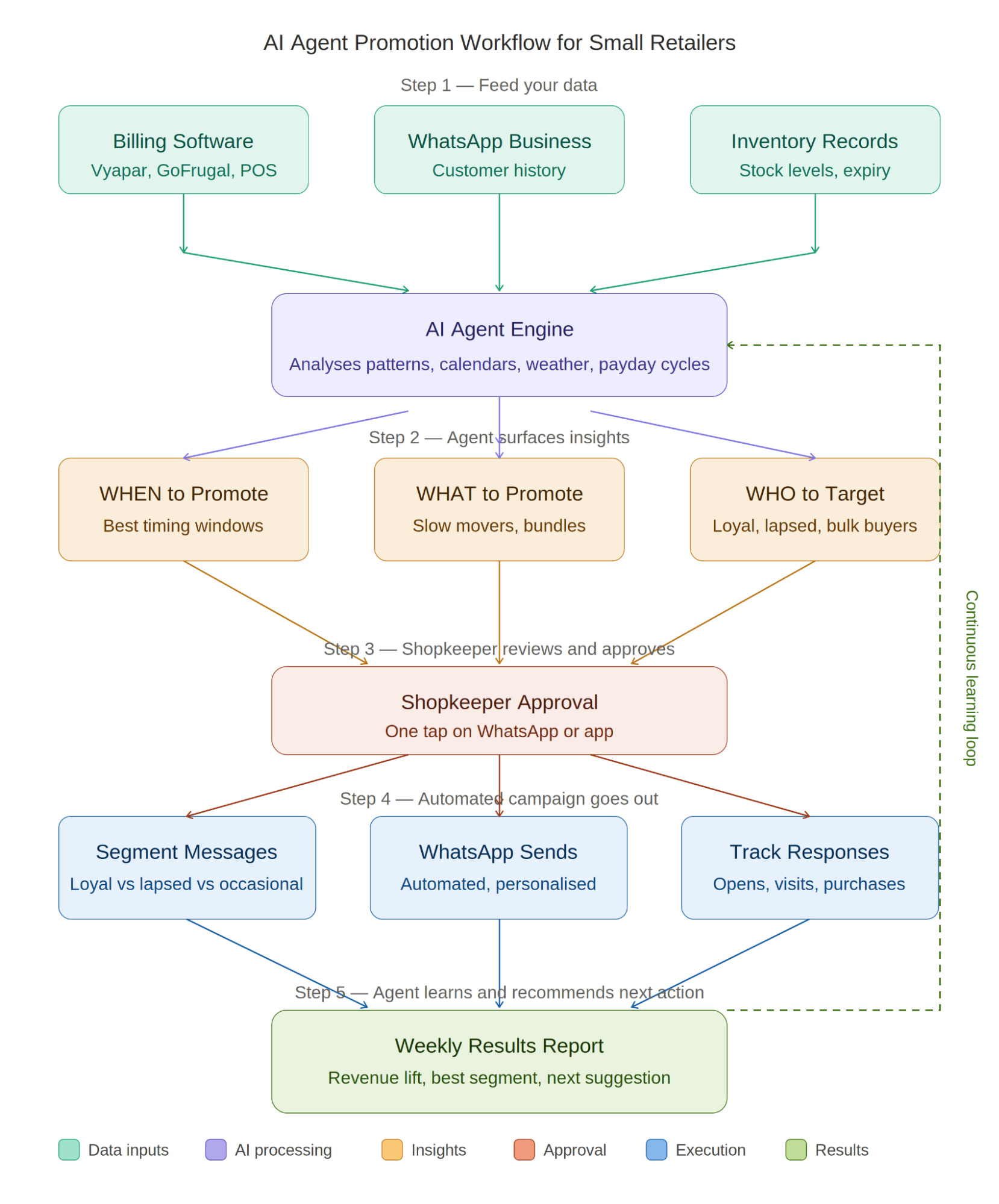
You do not need a dedicated IT team to run this. Most AI agents built for retail today connect easily to tools small shops already use: billing software like Vyapar or GoFrugal, WhatsApp Business, Google Sheets, or even a basic point-of-sale app.
Here is what the typical week-to-week workflow looks like:
- Monday morning: The agent sends you a brief summary. Sales from last week, what moved, what did not, and a recommendation for this week. It might say: biscuit sales dropped 18 percent compared to last fortnight. Consider a buy-two-get-one offer this weekend.
- Mid-week: If you approved the promotion, the agent drafts your WhatsApp messages and segments your customer list. Loyal weekly buyers get one message. Occasional buyers get another. Lapsed customers get a third with a slightly stronger incentive.
- Weekend: Messages go out automatically or with a single tap from you. The agent tracks who opened the message, who visited, and what they bought.
- Following Monday: The agent reports back. Promotion worked with the occasional buyer group but not with the lapsed customers. It adjusts future recommendations accordingly.
How to Get Started Without Feeling Overwhelmed
The most common reaction from small retailers when they hear about AI agents is: this sounds useful, but I would not know where to begin. The good news is that you do not need to build anything from scratch. Several solutions are being built specifically for the Indian FMCG retail segment and they are designed to start with what you already have.
Three practical starting points:
- Start with your billing data. If you use any digital billing tool, even a basic one, you likely have a goldmine of data sitting unused. Most AI tools can plug into this data and surface patterns within a week of connection. No manual entry required.
- Use WhatsApp as your channel. You do not need a website or an app. WhatsApp Business, which most shop owners already use, is a powerful enough channel to run segmented promotions. AI agents can draft, schedule, and send these messages automatically.
- Pick one category to experiment with. Do not try to optimize everything at once. Start with your second-best selling category, the one where you know there is potential but it is not converting well. Let the agent work on that for a month and measure the result. Then expand.
Competing on Strategy, Not Just Price
Large supermarkets and e-commerce platforms have one structural advantage: data at scale. They know what millions of customers buy, when they buy it, and how they respond to different promotions. That scale has felt impossible for small retailers to compete with.
But here is what a kirana shop has that a Big Basket or a D-Mart cannot easily replicate: a genuine relationship with its community. Customers know the shopkeeper. They trust the recommendations. They respond to a personal WhatsApp message in a way they never would to a push notification from an app.
AI agents help small retailers take that relationship advantage and make it systematic. You stop competing on who can offer the deepest discount and start competing on who knows the customer best. That is a game a local shop can actually win.
The Bottom Line
The festive rush will always be a highlight for small retailers. But the real business is built in the quiet weeks in between. AI agents are not about replacing the instincts of a seasoned shopkeeper. They are about giving those instincts a data-powered boost so every week feels a little bit more like a festival.
The retailers who figure this out first will not just survive the squeeze from big-box stores and quick commerce apps. They will thrive in spite of it.
And it all starts with one simple question: what does my sales data actually know that I do not?
Author:
Pratik Khedekar | Data Scientist