Flexible work was supposed to fix everything. No more rigid nine-to-five schedules. No more exhausting commutes. No more pretending to be busy just because you’re sitting at a desk. On paper, flexible work promised autonomy, balance, and a healthier relationship with our jobs. And for a while, it delivered. Employees felt trusted. Productivity surged. Engagement scores climbed. It felt like we had finally cracked the code.
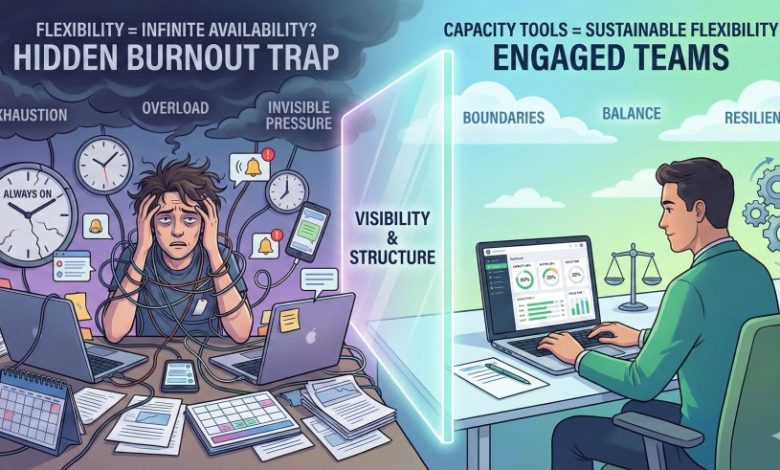
But here’s the uncomfortable truth: flexibility didn’t eliminate pressure—it redistributed it. Instead of managers controlling time, work began expanding into every available moment. Early mornings, late nights, weekends, and “just one more quick task” became normal. Flexibility quietly turned into invisibility. When work has no clear boundaries, it doesn’t stop—it seeps.
The problem isn’t flexible work itself. It’s how organizations interpret it. Many leaders equate flexibility with infinite availability. If someone can work anytime, they assume that person can work all the time. This mindset creates a false sense of balance, where employees technically control their schedules but emotionally feel trapped by expectations they can’t see or challenge.
Think of flexible work like an open buffet. At first, it feels generous. But without portion control, people overfill their plates, not because they’re greedy, but because the system encourages it. Over time, that leads to exhaustion, not satisfaction. This is where burnout quietly takes root—not from long hours alone, but from unmanaged capacity in a system that never says “enough.”
Where Virtual Interview Platforms Actually Fix the Problem
This invisible pressure shows up clearly during hiring. Candidates are told interviews are “flexible,” yet they’re expected to be available during narrow windows that suit internal calendars, not real lives. Miss a slot, and the opportunity quietly disappears.
A modern virtual interview platform removes this contradiction.
Instead of forcing candidates into live availability that mimics old-school scheduling, virtual interviews, especially asynchronous formats, allow candidates to respond on their own time without being penalized for timezone, caregiving responsibilities, or current job constraints. Flexibility becomes real, not performative.
For employers, this shift matters just as much. Recruiters no longer need to compress screening into frantic blocks of time or reward the “most available” candidate over the most qualified one. Structured virtual interviews create consistency, reduce scheduling bias, and allow hiring teams to review responses when they can give full attention, not between meetings.
The result is a hiring experience that aligns expectations on both sides. Candidates regain control without fear of being judged for it, and organizations replace unspoken pressure with transparent, process-driven evaluation.
The Hidden Burnout Trap No One Talks About
Burnout in flexible work environments doesn’t announce itself loudly. It doesn’t always look like breakdowns or absenteeism. More often, it shows up as quiet fatigue, emotional numbness, and declining enthusiasm. The trap is subtle because flexibility masks the warning signs.
When Flexibility Turns into Constant Availability
In flexible setups, availability becomes performative. Employees feel pressure to respond quickly to messages, even outside their chosen hours, just to prove they’re engaged. Slack notifications replace office interruptions, but they’re harder to escape. There’s no physical door to close, no clear “I’ve left work” signal. Using secure team communication tools like ProofHub, Slack and Troop Messenger helps teams set clearer boundaries around availability while maintaining transparent, on-premise collaboration.
Over time, this constant accessibility erodes recovery time. The brain never fully powers down. Even when people aren’t working, they’re anticipating work. That low-level stress adds up, draining energy in ways time tracking can’t measure.
Blurred Boundaries Between Work and Life
Flexible work removes physical boundaries, but rarely replaces them with psychological ones. The kitchen table becomes a desk. The phone becomes a portable office. Work and life stop being separate chapters and start overlapping in messy ways.
Without clear boundaries, people compensate by working more, not less. They feel guilty stepping away because no one told them when it’s okay to stop. This guilt-driven productivity is one of the fastest paths to burnout.
The Psychological Cost of “Always On” Culture
Being “always on” doesn’t just exhaust the body—it fractures focus. Context switching increases. Deep work becomes rare. Creativity suffers. When everything feels urgent, nothing feels meaningful. Employees may still deliver results, but the joy quietly drains away.
This is the burnout trap: high output, low sustainability. And without the right tools, organizations don’t see it until it’s too late.
Understanding Burnout in Flexible Work Environments
Burnout isn’t just about working too much. It’s about working beyond your capacity for too long without recovery. Flexible work environments amplify this risk because capacity becomes invisible.
Emotional Exhaustion in Remote and Hybrid Teams
Remote and hybrid workers often carry emotional labor that goes unnoticed. They manage isolation, self-motivation, and communication gaps while trying to appear productive. This emotional load consumes capacity just as much as tasks do.
When teams are distributed, managers may mistake silence for stability. In reality, silence often signals depletion.
Cognitive Overload and Decision Fatigue
Flexible work demands constant micro-decisions: when to work, how long to work, when to respond, when to rest. These choices drain cognitive energy. Without structure, the mental load increases, not decreases.
Decision fatigue reduces the brain’s ability to prioritize, making even simple tasks feel heavy. Over time, this leads to disengagement and errors.
The Silent Productivity Decline
Burnout doesn’t always reduce hours worked—it reduces effectiveness. People stay busy but accomplish less. Innovation slows. Collaboration feels harder. This decline often goes unnoticed because traditional metrics still look “fine.”
That’s the danger: burnout hides behind activity.
Why Traditional Workload Tracking Fails in Flexible Teams
Most organizations still rely on outdated workload models that don’t fit flexible work realities. Time-based tracking assumes equal capacity across people and days. That assumption is deeply flawed.
Time-Based Metrics vs Energy-Based Reality
Two people can work eight hours and experience entirely different levels of strain. Energy, focus, and emotional load matter more than hours logged. Flexible work exposes this mismatch because people distribute their hours differently.
Tracking time without tracking capacity is like measuring fuel by tank size instead of fuel level.
The Myth of Equal Hours
Flexible teams don’t operate on equal schedules, so why measure them as if they do? Expecting uniform output ignores individual rhythms, life demands, and cognitive limits. This leads to unfair comparisons and unrealistic expectations.
Visibility Bias in Remote Work
In flexible environments, visible activity often gets rewarded over meaningful impact. Those who are online more appear more committed, even if they’re overloaded. This bias encourages overwork and punishes healthy boundaries.
RACI Chart
One major reason workload tracking fails is the lack of clarity around ownership. A RACI chart—defining who is Responsible, Accountable, Consulted, and Informed—helps teams visualize how work is actually distributed.
In flexible environments, responsibilities often blur across time zones and schedules. Without a clear RACI chart, high performers quietly absorb extra tasks, accountability becomes diffuse, and workload imbalances go unnoticed.
Integrating a RACI chart into planning discussions shifts the focus from hours worked to ownership and capacity. Instead of asking “Who has time?” teams begin asking “Who owns this, and do they have the energy and bandwidth to deliver?
Capacity Planning: The Missing Link to Sustainable Flexibility
Capacity planning shifts the conversation from “How much time do you have?” to “How much can you realistically take on?” That distinction changes everything.
What Capacity Really Means (It’s Not Time)
Capacity includes mental focus, emotional energy, and recovery needs. It fluctuates daily. Treating it as static ignores the human side of work.
Capacity vs Utilization: A Critical Difference
High utilization looks efficient but often leads to burnout. Capacity planning leaves room for thinking, learning, and unexpected work. That buffer is where resilience lives.
Why Capacity is Personal, Not Universal
Everyone’s capacity is different. Flexible work acknowledges this reality—capacity tools operationalize it.
Capacity Tools Explained: More Than Just Project Management
Capacity tools aren’t glorified to-do lists. They’re systems designed to visualize limits before they’re exceeded.
What Are Capacity Tools?
They track workload against available capacity, factoring in focus time, meetings, and recovery. They show when someone is approaching overload—before burnout hits.
Key Features That Prevent Burnout
- Real-time capacity visibility
- Workload forecasting
- Personal capacity customization
- Buffer and recovery tracking
Capacity Tools vs Task Trackers
Task trackers focus on completion. Capacity tools focus on sustainability. One asks “What’s done?” The other asks “At what cost?”
Conclusion: Escaping the Burnout Trap Without Losing Flexibility
Flexible work isn’t broken—but it is incomplete. Without capacity awareness, flexibility becomes a burnout accelerator instead of a well-being booster. Capacity tools offer a way out, helping teams stay engaged, energized, and sustainable. The goal isn’t to work less. It’s to work better, with limits that protect what matters most: people.