

The conversation around AI often swings between two extremes: utopia and replacement. Either AI will unlock unprecedented productivity, or it will make human expertise obsolete.
Both narratives miss what is actually happening.
After hundreds of conversations with consulting firms, coaches, HR leaders, and enterprise teams implementing generative AI, I’ve come to a different conclusion:
AI is not replacing expertise. It is reorganizing how expertise is delivered.
And the organizations that understand this shift early will define the next decade of professional services.
Here are five predictions that I believe will shape the future of AI-powered expertise.
Prediction 1: Instant expertise will become the baseline expectation
From my own early consulting days back in 1998, I recall blueprinting organizations for up to 6 months and producing extensive PowerPoint reports. From there – as more processes became digitized in the workplace – this kind of long, manual work was gradually reduced, though it would still be typical for a consultancy to deliver over a timespan of multiple weeks.
Over the last decade, clients have increasingly adopted an early form of “self-service,” especially in the diagnostic phase of projects. They complete a standardized assessment and within a matter of days they receive feedback from their advisor, based on the responses.
Over the last 5 to 6 years, the recurring expectation has shifted even further. People want to submit their responses and get sophisticated, personalized insights right away. Waiting became more and more outdated.
Since the emergence of generative AI and the many tools in the wake of the technology, time-to-value expectations have been overhauled completely. Nearly 90% of organizations are now actively pursuing generative AI. However, only a minority have successfully scaled it. That’s largely because delivering unique and reliable value in real-time remains difficult.
The implication is clear. Speed is no longer a differentiator. It is table stakes.
That said, fast advice is only valuable if it is trustworthy. The nuance many service providers have been overlooking is that “instant” should never result in “inconsistent.” The winners will be those who combine real-time delivery with structured expertise.
Prediction 2: Automation will shift from workflows to intelligence
Many organizations still treat AI as a bolt-on productivity tool. Generate content. Summarize notes. Draft emails.
That phase has ended.
The wave we’re in now is about embedding intelligence directly into operational workflows, eliminating manual handoffs entirely.
Speaking with internal corporate services (HR, L&D, IT) and consultancy firms, I increasingly hear frustration from teams forced into brittle processes where assessment results must be copied into another application before any real analysis can begin. Leaders are not asking for marginal efficiency gains. They want AI to remove friction altogether.
In other words, they are not asking for more AI tools. They are asking for AI-native processes.
Enterprise data supports this direction: 72% of companies plan to increase investment in large language models, signaling a move from experimentation toward deeper operational integration.
The strategic takeaway? AI will create the most value when it disappears into the workflow.
When intelligence becomes invisible infrastructure.
Prediction 3: Configurable AI will become the enterprise standard
Early AI adoption favored convenience. Companies used whichever model was easiest to access.
That era is coming to a close as well. Security, compliance, and governance concerns are now among the top barriers to enterprise AI adoption.
In conversations with enterprise C-level leaders, questions about AI capabilities of platforms like Pointerpro are quickly followed by deeper ones:
- Where does the data go?
- Which model is being used?
- Can we connect our own?
- Does this respect our internal protocols?
- Is my data used to train the AI model?
At the same time, in conversations with the actual users of our assessment platform – the people building the assessments and automated advice reports – I’m hearing flexibility is a hard requirement.
They want AI for enhanced efficiency but without surrendering control over the entire output in their reports. They want to be able to generate output that remains fully deterministic, based solely on their own hard-earned expertise.
I’m convinced rigid AI stacks will age badly. The future belongs to platforms that treat AI as configurable infrastructure, not a locked feature.
Prediction 4: Governance will stop being seen as friction and become strategy
As often during periods of technological disruption, enthusiasts have framed governance as the enemy of innovation. This was true for the first few AI waves. That mindset is shifting fast., especially among companies that see the bigger picture.
Privacy risks, bias, and ethical concerns now rank among the most significant AI challenges facing technology leaders. What’s striking is how proactive organizations have become. Rather than resisting AI, they want clarity, especially around data isolation and compliance.
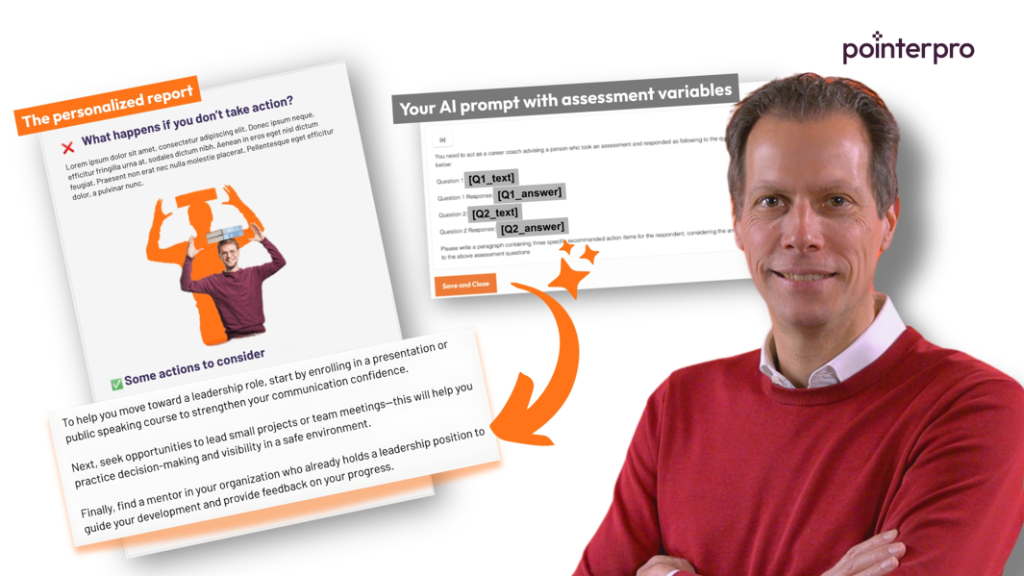
When developing Pointerpro’s AI prompt widget – which by default integrates with OpenAI, and connects with the user’s own account – we heard from multiple teams that they are cautious about sending sensitive assessment data into external AI systems.
Not because they oppose AI, but because they intend to deploy the data responsibly. Even when response data isn’t formally “sensitive,” some teams still treat it as self-earned benchmark intelligence, a valuable competitive advantage. For this reason, they opt out of OpenAI using the data to train its models.
So governance is not about slowing down AI-powered innovation for your organization. It is about making adoption sustainable and building strategic advantage.
Prediction 5: The highest-performing AI will operate inside human boundaries
Perhaps the most important shift I see is similar to the previous one, but more philosophical.
The strongest demand is not for autonomous AI. It is for controlled intelligence.
Knowledge professionals want AI to respect their scoring models, weightings, and advisory frameworks. Many of these have evolved over years and continue to change as they gain experience in the trenches and improve their methodologies.
Others want AI to analyze scenario-based responses or open-text answers and transform them into coaching-style narratives, but always grounded in their intellectual property.
Not improvising beyond it.
The message is simple: AI performs best when human experts define the boundaries. Not the other way around.
The real future: expertise at scale
If these predictions point to one overarching trend, it is this: AI will not commoditize expertise. It will scale it.
For decades, professional knowledge has been constrained by time. There were only so many clients one expert could serve, so many reports a team could write, so many insights an organization could deliver.
In the last few years at Pointerpro we’ve seen booming interest not only in deterministically automated, individual feedback from assessments, but also in organizational insights: aggregated patterns, cohort comparisons, and even early signals of change across teams.
Since introducing the AI prompt widget in our platform’s Report Builder the interest in building aggregate reports has grown exponentially. Within these organizations AI shifts from a mere productivity tool to a strategic advisor. But only if the HR professionals resist the temptation to hand over the steering wheel.
The goal should never be automation for its own sake. The goal is amplification:
- Amplification of judgment.
- Amplification of experience.
- Amplification of human insight.
Organizations that remember this will not just adopt AI successfully – they will redefine what expertise looks like in an AI-enabled world.And perhaps the biggest prediction of all? As AI becomes omnipresent, human expertise will not become less valuable. It will become the only remaining differentiator.