
Enterprises are competing in a market where AI has changed buyer expectations. Decision-makers expect faster evaluation, clearer value, and stronger proof across every digital touchpoint.
Legacy UX, fragmented messaging, and weak trust signals create friction that slows approvals and hurts conversion. NN/g links clear hierarchy and navigation to up to 40% higher task success, which matters when enterprise buyers need to find answers, proof, and next steps fast.
Drawing on Arounda’s experience, this piece covers strategic redesign moves, enterprise UX priorities, and case-based examples that help teams grow brand awareness and strengthen market position.
The New Competitive Standard: Why Legacy UX Can’t Scale with AI
AI is changing enterprise competition at the level of visibility, evaluation, and trust. Enterprise leaders are seeing a clear shift: buyers increasingly start discovery outside the company website, often through AI search summaries and AI assistants.
“The internet made information searchable… now 60% of Google searches end up in zero clicks… Where buyers once started by looking for content on a supplier’s website, now they are everywhere but your website.”
Yamini Rangan, CEO of HubSpot
By the time visitors arrive, they come with limited attention and sharper questions. The website now has to explain value fast, surface proof (security, outcomes, implementation fit), and guide each stakeholder to a clear next step.
The Cost of Friction: How Outdated Design Bleeds Revenue
Outdated design hurts churn rate when a website fails to answer core questions fast: what the product does, who it is for, why it is credible, and what to do next. In an enterprise, this does not always look like an immediate bounce. It often shows up as weaker intent, slower follow-up, and lower conversion quality.
- An unclear value proposition lowers engagement from qualified visitors.
- Weak hierarchy hides proof and key product details too deeply in the page.
- Too many steps before demo/trial/contact reduce conversion intent.
- Missing trust signals (security, outcomes, implementation fit) delay action.
Shifting from Static Interfaces to Adaptive, AI-Ready Experiences
Many enterprise platforms still push users through one generic flow. That slows evaluation when IT, security, and business stakeholders look for different answers.
What changes in practice:
- Different stakeholders need different entry points (business, IT, security, procurement).
- Product pages need scannable answers, not long blocks of generic copy.
- Navigation should support intent, not just company structure.
- Content modules should be reusable, so teams can update quickly without rebuilding everything.
A more adaptive experience improves discovery, comprehension, and progression across the funnel.
Shortening Approval Cycles with Proof Upfront
Proof upfront means the product interface helps stakeholders validate the basics early:
- Security and governance information is easy to find.
- Implementation details are explained clearly (integration, rollout, controls).
- Outcome evidence is visible near decision points.
- Role-specific concerns are addressed before sales get involved.
This reduces back-and-forth, helps internal alignment, and makes it easier to move from interest to evaluation.
Strategic Advice from Arounda: How Redesign Influences Growth in an AI-First Market
Redesign affects growth when it reduces decision friction and makes value, proof, and next steps easier to understand. From Arounda’s enterprise redesign work, these recommendations focus on UX and digital touchpoints moves that improve user experience, brand recognition, and strengthen competitive position.
1. Increasing Revenue Through AI-Enabled Value Propositions
AI features support revenue growth when they are presented as business outcomes.
BCG’s 2025 research shows that companies leading in AI and design outperform laggards by 1.7x in revenue growth and 3.6x in total shareholder return over three years. The platform should make it clear what the AI functionality improves in practice: speed, cost, throughput, accuracy, or risk.
2. Boosting Conversion with Adaptive Onboarding and Personalization
Conversion improves when users can choose a path that matches their role and intent. This helps enterprise teams reduce drop-off, move visitors to the right next step faster, and increase the number of qualified evaluations.
3. Securing Market Position via Enterprise-Grade Trust and Governance
A strong market position depends on how quickly a company can be understood and trusted. Better UX flow can reduce bounce rate by 10–15%, largely by helping users make the second click. That second click often depends on visible trust signals: security, governance, implementation fit, and proof of outcomes.
Around an expert design tip:
- Rewrite AI feature blocks as business outcomes.
- Add role-based entry points on key pages.
- Place trust and governance proof near claims and CTAs.
Building for Speed and Scale: Arounda’s Design Systems and Architecture Approach
Enterprise speed depends on how well-designed systems and product architecture reduce rework, align teams, and support repeatable feature delivery.
From Fragmented Interfaces to a Unified Product Ecosystem
Fragmentation slows teams and confuses users.
- Unify navigation across products and modules.
- Align UI patterns so interactions feel consistent.
- Standardize page structure for faster scanning and reuse.
- Connect product areas through shared logic and terminology.
Reducing Technical Debt to Accelerate Feature Release Cycles
Technical debt slows every future release.
- Replace one-off components with reusable building blocks.
- Clean outdated flows before adding new functionality.
- Document design rules to reduce rework in delivery.
- Align design and development on shared component behavior.
Standardized Patterns for AI Features
AI features need predictable UX patterns.
- Define interaction patterns for assistants and agents.
- Standardize permissions states, and access logic.
- Make audit and control actions easy to find.
- Use consistent labels for AI actions and outcomes.
The Core Redesign Moves That Work in Enterprise
Here are the structural design moves that turn strategy into a usable enterprise buying experience.
Role-based paths
Role-based paths should appear early, at the moment when visitors decide where to go next. The best placement is usually on the homepage, product or service pages, and solution pages. The key is to make self-selection easy: clear role labels, short descriptions, and visible links.
A clear proof layer
Proof works best when it supports claims in real time, not when it sits in a separate archive page.
- Place proof blocks in the hero section and directly under key product claims and benefit statements.
- Repeat trust signals near high-intent CTAs.
- Surface proof across product, solution, and pricing-related pages.
Concrete “how it works”
“How it works” content should appear before demo or trial decisions. Keep a short version on core product pages, with deeper implementation details on linked pages. Make integration, rollout, and control information easy to scan so teams can assess fit quickly.
Clean conversion points
Conversion points work better when they match intent and appear at natural decision moments.
- Use different CTAs by page type and evaluation stage.
- Place CTAs after value explanation, proof, and how-it-works sections.
- Add a short line under each CTA explaining what happens next.
Evidence of Impact: Real-World Outcomes from Arounda’s Strategic Redesign Work
Here are a few real examples from Arounda’s redesign work that improved usability, brand recognition, conversion, and product adoption.
HRWorkCycles
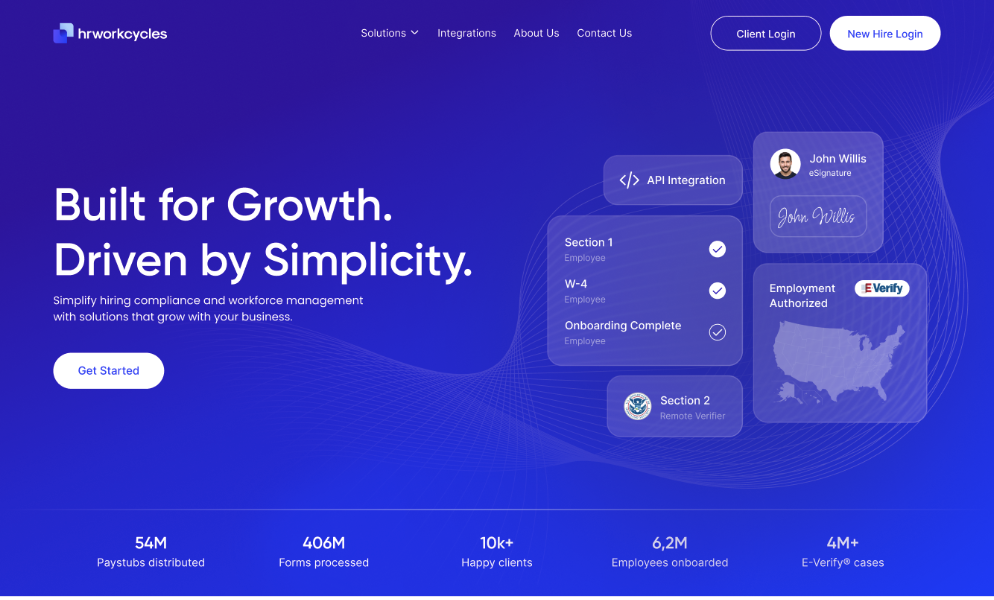
HRWorkCycles is a digital HR platform that manages the full employee lifecycle. Arounda redesigned it as a unified product and brand system, replacing fragmented tools and inconsistent visual identities across three products with one clear ecosystem.
- Unified 3 HR products into one UX system: clearer navigation and one visual logic improved consistency and reduced confusion
- Better workflow usability: role-based access and guided flows reduced errors and supported faster onboarding.
- Measurable results: the project also received 2 awards (in user interface and experience design categories), +28% conversion, 91% user satisfaction, and +35% brand recognition.
Alt text: Arounda’s redesign case study HRWorkCycles
AdvisorWorld
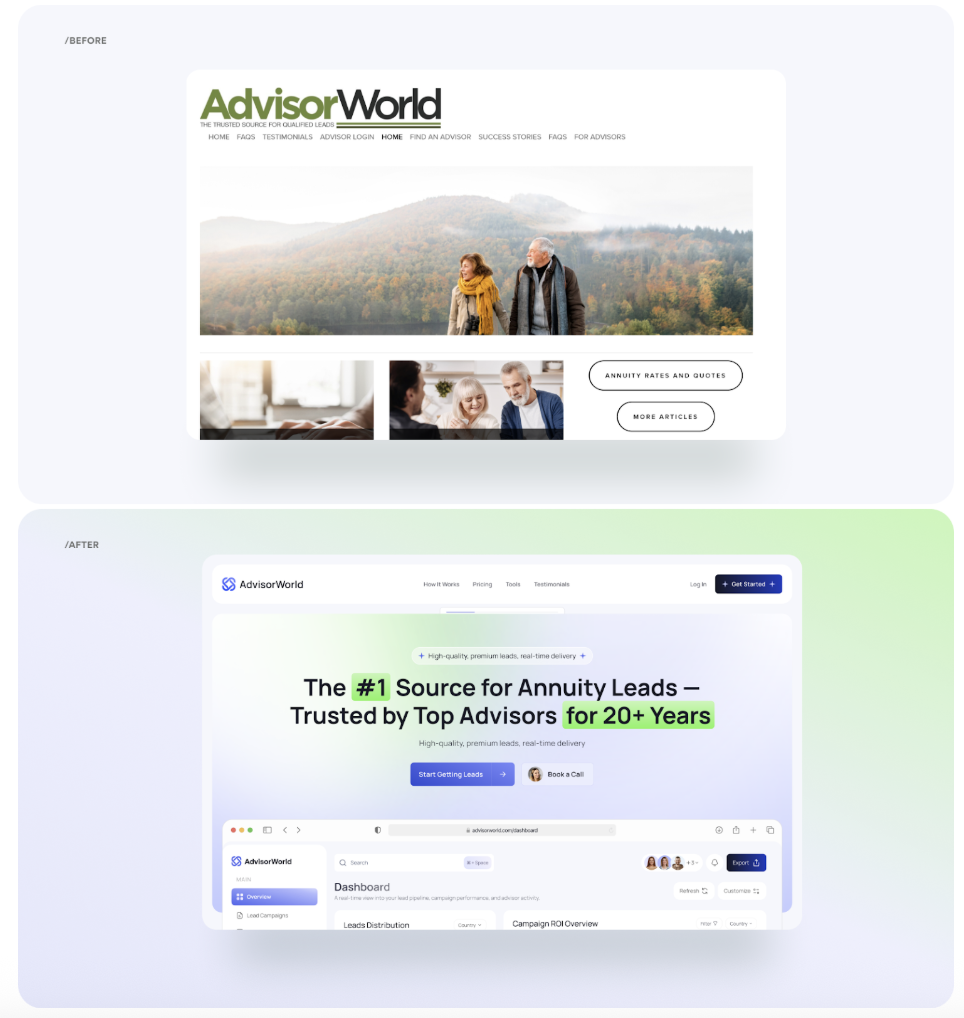
AdvisorWorld is a B2B platform for financial advisors. Arounda redesigned it into a modern SaaS-style website that makes value clearer and trust easier to build.
- Clearer decision flow: Arounda added a step-by-step “How it works” section to explain lead qualification and reduce confusion.
- Stronger conversion UX: persistent CTAs, cleaner hierarchy, and structured messaging helped users act faster.
- More credible product positioning: stock-style visuals were replaced with a product-style interface direction.
- Results: +62% lead conversion, 2× time on site, +45% trust perception, –35% onboarding time.
Alt text: Arounda’s redesign case study AdvisorWorld
PayPossible
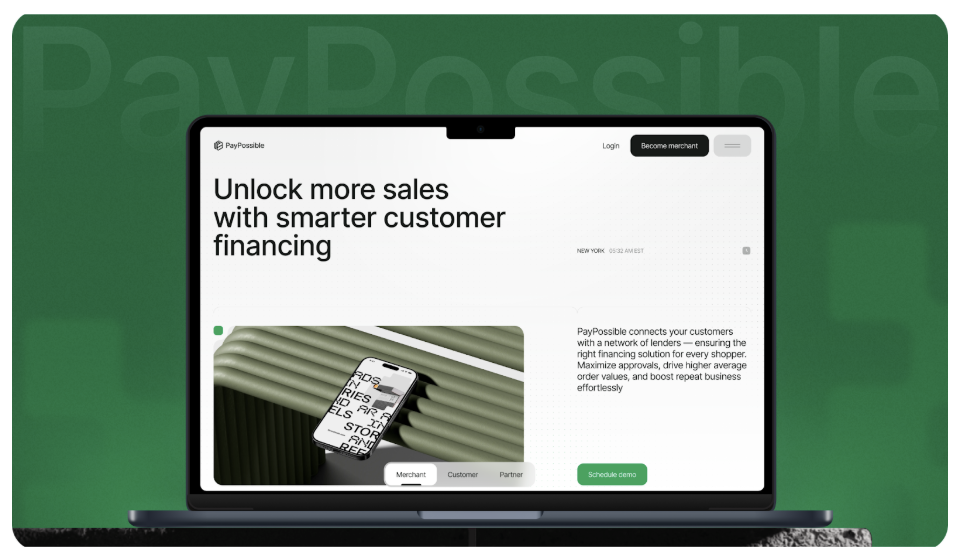
PayPossible is a fintech platform for merchants, lenders, and banks. Arounda redesigned its website to explain a complex multi-lender financing model more clearly, improve trust, and support faster user action.
- Clearer structure for a complex product: simplified hierarchy, navigation, and custom visuals made the financing logic easier to understand.
- Higher action completion: guided registration, progress indicators, and a persistent action button improved flow completion.
- Measurable results: 2× merchant signups, +40% completed financing applications, 88% user satisfaction.
- Award recognition: received a Behance UI award in the User Interface category for the redesign.
Alt text: Arounda’s redesign case study PayPossible
The Around a Framework for Predictable Delivery
Arounda treats enterprise redesign as a structured delivery process: first align page roles, UX flows, SEO requirements, and conversion logic, then design the interface. This reduces rework and improves predictability in launch timelines and outcomes.
“A common enterprise issue is that platforms are redesigned visually, while structural problems stay in place. Yes, you get a better-looking interface with the same bottlenecks in navigation, page hierarchy, and user paths. But if you want strong outcomes, then I recommend fixing structure first and using design to reinforce that logic.”
Vlad Gavriluk, CEO & Founder at Arounda | Design and Development Company
Arounda Design Team Suggests:
Predictable delivery starts with a few structural decisions made early:
- Define strategy: data-driven decisions, business goals, market conditions, user needs, and their behavior.
- Build reusable system logic: use repeatable patterns for navigation, content blocks, and conversion paths.
- Validate key flows first: test high-intent pages and critical journeys before scaling design across the site.
Moving Forward: Turning Redesign into a Competitive Advantage
Strategic redesign is a business decision that shapes how enterprise buyers understand your value, trust your product, and move toward action.
If you want your enterprise platform to improve clarity, support conversion, and strengthen market position, a visual refresh alone will not help. It needs a structure and well-thought-out solution that will assist stakeholders in evaluating value faster, surface proof early, and support decision-making with a clear, scalable structure that meets today’s AI-shaped buyer expectations.