Declining Compensation Sentiment and Renewed Confidence in Job Opportunities Signal Growing Attrition Risk—Especially Among Millennials
ARLINGTON, Va., July 14, 2026 /PRNewswire/ — The latest Eagle Hill Consulting Employee Retention Index declined 1.3 points in the second quarter of 2026 to 104.2, marking its lowest level in the past year and signaling that U.S. workers will be less likely to remain in their current roles over the next six months. While retention remains relatively strong by historical standards, the latest data suggest employers may be entering a period of increased workforce mobility.
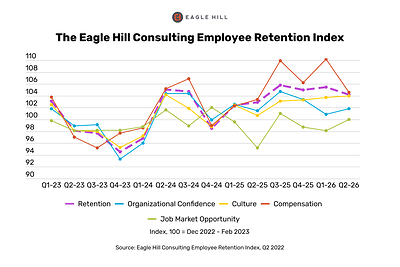
The decline comes as employees grow less satisfied with their compensation while simultaneously growing more optimistic about opportunities in the external job market. Notably, these shifts occurred even as employees’ confidence in organizations and satisfaction with workplace culture improved.
“Today’s workforce is sending employers a nuanced message,” said Melissa Jezior, president and chief executive officer of Eagle Hill Consulting. “Employees generally feel good about their organizations and workplace culture, but many are questioning whether their compensation and long-term growth opportunities are keeping pace with the market. When workers begin to believe they have better options elsewhere, retention risks increase, even inside organizations with strong cultures.”
The findings come as the broader labor market sends mixed signals. The latest Job Openings and Labor Turnover Survey (JOLTS) showed job openings holding steady at 7.6 million, exceeding expectations and suggesting opportunities remain available for workers considering a move. At the same time, the June jobs report showed hiring slowed considerably, highlighting a labor market that is cooling but continues to offer opportunities for skilled talent.
“Employers shouldn’t interpret a slower hiring market as a reason to become complacent,” Jezior added. “Workers are evaluating the entire employee experience, not just whether they have a job, but whether they see a future with their employer. Organizations that invest in career development, leadership, culture, and meaningful rewards will be in the strongest position to retain critical talent as mobility begins to increase.”
Key Retention Index Indicators
- Compensation Indicator: Declined 5.6 points, representing the only indicator to weaken this quarter.
- Job Market Opportunity Indicator: Increased 1.9 points, reflecting growing optimism about external job opportunities.
- Organizational Confidence Indicator: Increased 0.9 points, rebounding after two consecutive quarters of decline.
- Culture Indicator: Increased 0.3 points, continuing its steady upward trend for a fourth consecutive quarter.
Millennials Emerge as the Biggest Retention Risk
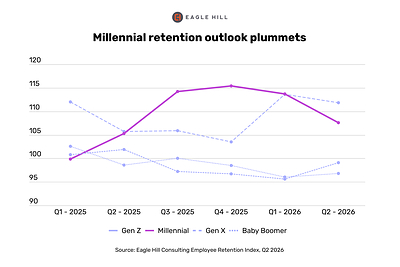
Although overall retention outlook declined modestly, the largest shift occurred among Millennials. Millennials experienced a 6.1-point decline in the Retention Index, signaling that they pose an attrition risk. They were the only generation to report declines across organizational confidence, compensation, and culture while simultaneously expressing greater confidence in outside job opportunities.
As Millennials increasingly occupy management, leadership, and specialized professional roles, this shift could have outsized implications for organizations.
“Millennials now represent the backbone of leadership pipelines across many organizations,” said Jezior. “When this generation begins questioning whether to stay, employers risk losing institutional knowledge, leadership continuity, and future executives. The findings underscore why retaining high-potential talent must be a core business and workforce planning priority, not just an HR initiative.”
Generational Gap Begins to Narrow
Unlike previous quarters, retention outlooks across generations became more closely aligned.
- Gen Z reported a modest decline.
- Millennials experienced the sharpest drop.
- Gen X became more likely to stay.
- Baby Boomers also showed improved retention sentiment.
Compensation Increasingly Drives Retention Decisions
The Compensation Indicator experienced its sharpest decline in recent quarters, suggesting employees are placing greater emphasis on total rewards, future earning potential, and advancement opportunities.
Combined with improving perceptions of external job opportunities, the findings indicate workers may increasingly compare what they receive today against what they believe they could earn elsewhere.
The Eagle Hill Employee Retention Index is a first-of-a-kind market indicator that tracks worker sentiment across four proven drivers of retention: organizational confidence, culture, compensation, and job market opportunity.
- The Organizational Confidence Indicator measures how confident employees are in their organization’s future and leadership.
- The Culture Indicator looks at employee sentiment about their workplace culture, connections, and whether they feel valued and recognized.
- The Compensation Indicator measures how employees view their compensation, benefits, and ability to grow their compensation at their organization.
- The Job Market Opportunity Indicator measures how employees perceive external prospects for employment and job security in the near term.
Each month, the Eagle Hill Consulting Employee Retention Index measure shifts in workforce retention based upon ongoing employee opinion surveys on factors related to worker intentions to change jobs. As the Employee Retention Index increases, it signals an increase in retention in the next six months. As the Employee Retention Index decreases, it signals to employers that workers are more likely to leave their jobs, and organizations can expect more turnover in the next six months.
The Eagle Hill Consulting Employee Retention Index is based on a monthly omnibus survey conducted by IPSOS of a nationally representative sample of U.S. adults employed full- or part-time. Quarterly indices and reports are issued based on a minimum of 1,200 aggregated responses per quarter. Respondents are polled on a range of workforce topics including organizational confidence, culture, compensation, and job market opportunity.
The survey commenced in December 2022, and the most recent data was collected from April and June 2026.
Eagle Hill Consulting LLC is an award-winning business that provides unconventional management consulting services in the areas of Organizational Performance, Business Intelligence, Technology Enablement, Talent, and Change Management. The company’s expertise in delivering innovative solutions to unique challenges spans across Fortune 500 companies, government agencies, and global nonprofits. Eagle Hill has offices in the Washington, D.C. metropolitan area, Boston, MA, and Seattle, WA. More information is available at www.eaglehillconsulting.com.
 View original content to download multimedia:https://www.prnewswire.com/news-releases/eagle-hill-retention-index-employee-retention-outlook-softens-as-workers-reassess-their-options-302825245.html
SOURCE Eagle Hill Consulting LLC