The use of AI in Canada’s healthcare system is fundamentally changing how we make difficult medical decisions and plan for long-term health. As machine learning algorithms get better at looking at radiographic data and guessing what will happen to patients, they also help people deal with the complicated paperwork that comes with running a dental practice. For a lot of people who want to get their smiles back, the first problem is often money, not health. Patients are finding that AI-powered insurance verification tools are giving them faster, clearer answers about their policy limits and major restorative benefits when they are researching what insurance covers dental implants Canada. These digital systems can quickly compare your specific coverage details to the proposed treatment plan, making sure you know exactly how much you’ll have to pay out of pocket before you even sit in the surgical chair.
Planning with accuracy and predicting success
One of the best things about AI in dentistry is that it can make high-stakes procedures like tooth replacement more predictable. In the past, doctors had to rely heavily on their experience to judge bone density and nerve proximity from 2D images when putting in an implant. AI-powered software can now turn 3D scans into “surgical maps” with micrometer accuracy.
The technology can predict how the bone around the implant will react over time by simulating the whole procedure in a digital environment. This ability to predict lowers the chance of failure and makes sure that the final product works and looks good. For the patient, this means shorter surgery times, less invasive methods, and a much higher rate of long-term success.
Finding Your Way Around Canada’s Coverage Landscape
Many Canadians are still worried about the cost, even though technology is making the procedure safer. In this country, dental coverage is a mix of private, employer-sponsored, and government-run plans, each with its own rules about what “major restorative” work is.
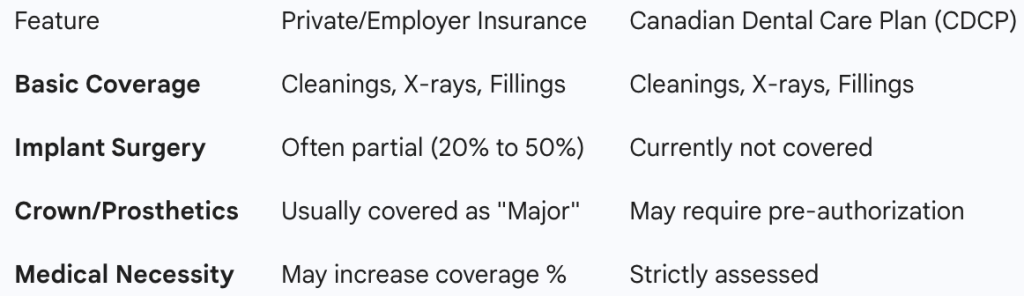 Most standard plans consider implants to be an optional or premium service, which means they usually pay less than they would for a regular bridge or denture. Insurance companies are now using AI to speed up the “pre-determination” process, though. Using computer vision to check if a replacement tooth is really needed allows insurers to approve claims more quickly. This lets patients get on with their treatment without having to wait months for paperwork to go back and forth.
The relationship between data and human knowledge
These new technologies are not meant to replace the intuition and steady hand of a skilled dentist; they are meant to make them better. When a doctor uses an AI diagnostic tool, they are basically looking up millions of successful outcomes in a database. This collaborative method makes it possible to customize every part of the prosthetic to fit the patient’s unique biological data, from the color of the porcelain to the angle of the titanium post.
As we move deeper into a data-driven age, the goal is still to make healthcare easier to get and understand. The combination of health and technology is making it possible for everyone to have a healthy smile in the future. For example, smarter diagnostics that catch problems earlier or smart financial tools that make insurance benefits clearer.