




The collaboration leverages Colossal’s marsupial de-extinction and conservation biotechnology platform to save the Tasmanian devil from a contagious cancer that has driven 80% population declines across Tasmania
DALLAS and HOBART, Australia, June 30, 2026 /PRNewswire/ — The Colossal Foundation, the nonprofit conservation arm of Colossal Biosciences, today announced a new partnership with the University of Tasmania to support efforts to combat Devil facial tumour disease (DFTD), a fatal transmissible cancer that has devastated wild Tasmanian devil populations and threatens the iconic marsupial with extinction.

Under the partnership, the Colossal Foundation will support the establishment of a fat-tailed dunnart research colony at the Menzies Institute for Medical Research at the University of Tasmanian, Hobart. The two teams will also collaborate on gene-editing capabilities to advance DFTD vaccine testing and explore the long-term potential of heritable resistance to transmissible cancers in dasyurid marsupials which includes the Tasmanian devils. The collaboration extends the marsupial biotechnology platform Colossal has built through its thylacine de-extinction program, and joins a growing portfolio of marsupial conservation initiatives in Australia that includes a world-first demonstration of engineered cane toad toxin resistance for the endangered northern quoll.
“Devil facial tumour disease is one of the most devastating wildlife diseases on Earth. This contagious cancer is pushing an iconic marsupial toward collapse, with consequences for the ecology of an entire island,” said Matt James, Executive Director of the Colossal Foundation. “Andy Flies and his team at the University of Tasmania have built the most advanced DFTD vaccine pipeline in existence. By combining that work with Colossal’s marsupial husbandry, reproductive science, and gene-editing platform, we have a real opportunity to accelerate this effort and give the Tasmanian devil a fighting chance.”
A CONSERVATION CRISIS WITHOUT MODERN PRECEDENT
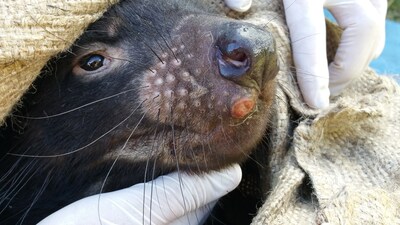
The Tasmanian devil (Sarcophilus harrisii), the world’s largest living carnivorous marsupial, is threatened by two independent transmissible cancers: Devil facial tumour 1 (DFT1), was discovered in 1996 and has since spread across most of the species’ range. The second, DFT2, was identified in 2014 in southern Tasmania and is still emerging. Both cancers cause large tumours around the mouth and face that can prevent devils from eating, and both are nearly 100% fatal. The disease is transmitted directly between devils through biting, a behaviour central to feeding and mating, making it almost impossible to control by conventional means.
Wild devil populations have collapsed by approximately 80% since DFTD’s emergence. As Tasmania’s apex scavenger and predator, devils play an important ecological role, helping suppress feral cats and reducing pressure on smaller native species. Their decline has had cascading effects across Tasmania’s ecosystems, making DFTD not only a species-level crisis, but a much broader conservation problem.
A TWO-PART STRATEGY: VACCINES + GENE EDITING
The University of Tasmania Wild Immunology Group, led by Associate Professor Andrew Flies, Ph.D., has been developing a two-pronged strategy to help the devil immune system recognize and fight DFTD. The first prong is an advanced vaccine program. Flies’s team has developed a field-ready oral bait vaccine designed to train the devil immune system to recognize and destroy DFT1 and DFT2 cells, and that could one day protect wild devils across the Tasmanian landscape without requiring every animal having to be trapped and injected.
The second prong is a gene-editing strategy centered on LZTR1, a gene that is connected to cancer-relevant pathways in other species, and is hypothesized to play an important role in the origin and biology of devil facial tumors. Tasmanian devils carry two unusual amino-acid substitutions in LZTR1 that are not found in other mammals, and the “shattering” of one copy of the LZTR1 gene has been identified as a potential driver event in the origin of DFT1. The partnership between Colossal and University of Tasmania will explore whether targeted editing of the devil-specific LZTR1 mutations to match the ancestral mammalian sequence could reduce the underlying susceptibility of devils to these transmissible cancers.
Under the partnership, the LZTR1 gene-editing work will advance on two complementary tracks. The Colossal Australia team in Melbourne will edit LZTR1 in fat-tailed dunnart induced pluripotent stem cells (iPSCs), while the Anuk Kruawan, Ph.D. at University of Tasmania will edit LZTR1 in devil cell lines. Results from these complementary approaches will determine whether LZTR1 biology is relevant to future disease-resilience strategies
“We’ve spent years developing a vaccine designed to train the devil immune system to fight these cancers but progress is slow due to the challenges of working with an endangered species and having a lack of marsupial research tools,” said Associate Professor Andrew Flies at Menzies Institute for Medical Research, University of Tasmania. “We won’t know if the vaccine is effective until we perform field trials with naturally-infected devils. However, before we can start field trials, we need to make sure the vaccine is safe and induces a strong immune response in devils and other species that could eat a vaccine bait. Partnering with the Colossal Foundation can significantly accelerate our vaccine work, and allow us to explore a gene-editing strategy in parallel that could enhance the vaccine and make devils more resistant to DFTD.”
A DE-EXTINCTION PLATFORM, DEPLOYED FOR DEVILS
Testing a new vaccine and gene-editing approach in a marsupial system requires specialised facilities, careful adherence to regulatory requirements, and biologically appropriate models. The fat-tailed dunnart (Sminthopsis crassicaudata), a small, mouse-sized dasyurid that is a close evolutionary relative of both the Tasmanian devil and the thylacine, provides that bridge.
The Colossal Foundation is supporting the University in establishing a dedicated dunnart colony in the Menzies Institute for Medical Research facility in Hobart, with Colossal Australia’s animal-care team hosting University of Tasmania veterinarians and animal services staff to transfer husbandry, breeding, and welfare protocols developed through years of dunnart colony management. Once operational, the Hobart colony will allow vaccine safety and immunogenicity trials to be run in a biologically relevant marsupial model. This is a critical regulatory and scientific step toward devil trials and eventual field deployment.
Colossal’s work has made the fat-tailed dunnart one of the most important marsupial models in the world. Through the thylacine de-extinction program, Colossal and the University of Melbourne have advanced dunnart biology through the development of a complete genome, cell lines, induced pluripotent stem cells (iPSCs), genome editing, assisted reproductive technologies, and husbandry systems. Those same tools are now being applied to conservation challenges facing living species, including the Colossal Foundation’s northern quoll project, which uses the dunnart as a closely related model to test gene-editing strategies for cane toad toxin resistance.
“The dunnart has become the foundation of Colossal’s marsupial platform,” said Andrew Pask, Chief Biology Officer at Colossal Biosciences. “To build the thylacine program, we had to develop tools for marsupial cell culture, gene editing, reproductive biology, and husbandry that simply did not exist at this level before. Now those tools can be applied to living species. Bringing that platform into the Tasmanian devil cancer effort with the University of Tasmania is a powerful example of how de-extinction science can deliver immediate conservation value for living species.”
“This partnership reflects exactly why Colossal exists,” said Ben Lamm, Co-Founder and CEO of Colossal. “Our de-extinction programs are fueling the development of entirely new biological tools and platforms. In Australia, the work we are doing to bring back the thylacine has already helped establish the dunnart as a powerful model for marsupial genomics and reproductive science. We’re now deploying those same technologies against one of the most devastating wildlife diseases on Earth. This is what the conservation power of de-extinction looks like.”
A REGIONAL ECOSYSTEM OF CONSERVATION PARTNERS
The DFTD partnership joins a growing network of Tasmanian and Australian conservation organizations engaged with Colossal’s marsupial work. Bonorong Wildlife Sanctuary, Tasmania’s leading wildlife rescue, rehabilitation, and conservation organizations, expressed strong interest in the project and in its potential relevance for Tasmanian devil conservation. Bonorong’s work on the front lines of wildlife care gives it a direct understanding of the stakes of devil recovery and the importance of developing new tools to support the species.
“For nearly thirty years, we have watched DFTD mercilessly take countless devils from the Tasmanian landscape. At Bonorong we’ve cared for hundreds of Devils as this horrific plague rages on,” said Greg Irons, Director of Bonorong Wildlife Sanctuary. “Anything that gives our devils a real path back deserves our full support.”
The partnership also has the backing of the Tasmania Thylacine Advisory Committee (TTAC), a group of Tasmanian community, conservation, business, and local leaders assembled to guide Colossal’s work in Tasmania.
“The Tasmanian devil is one of the most iconic endangered species on Earth — recognised globally, but with deep roots in Tasmania’s wild landscapes and identity,” said Michelle Dracoulis, Mayor of the Derwent Valley Council and Chair of the TTAC. “What Associate Professor Andrew Flies and his team have built in Hobart is genuinely world-class. Seeing that work strengthened through the support of the Colossal Foundation gives real hope for the future of the species, and demonstrates how emerging technologies can be applied directly to urgent conservation challenges. The TTAC is pleased to support this partnership and the opportunities it creates for globally significant conservation science aimed at protecting Tasmania’s devils.”
Beyond Tasmania, the new collaboration complements Colossal’s broader Australian conservation partners network. Aussie Ark, one of Australia’s foremost private conservation organizations, is a leader in Tasmanian devil insurance population breeding on the mainland, and Zoos Victoria has a long-standing partnership with Colossal on the conservation of the Critically Endangered Victorian Grassland Earless Dragon.
“Every major conservation challenge teaches us something different,” said Andrew Pask, Chief Biology Officer at Colossal. “With the thylacine, we are building the tools to reverse extinction. With the northern quoll, we are applying those tools for resilience to invasive-species. With the Tasmanian devil, we are now applying them to infectious cancer, one of the most extraordinary disease problems in vertebrates. That is the future of disruptive conservation: build the platform once, then move it quickly and responsibly wherever biodiversity needs it most.”
ABOUT THE COLOSSAL FOUNDATION
The Colossal Foundation is a 501(c)(3) dedicated to supporting the use of cutting-edge technologies to conservation efforts globally to help prevent extinction of keystone species. The organization deploys cutting-edge de-extinction technologies and support to empower partners in the field to reverse the extinction crisis. www.ColossalFoundation.org.
ABOUT THE UNIVERSITY OF TASMANIA AND THE MENZIES INSTITUTE FOR MEDICAL RESEARCH
The University of Tasmania is Australia’s fourth-oldest university and the only university based in Tasmania, with a deep institutional commitment to research that addresses the unique conservation, health, and environmental challenges of its island state. The Menzies Institute for Medical Research, University of Tasmania’s flagship medical research institute, is one of Australia’s leading health and medical research institutes. The Menzies Wild Immunology Group, led by Associate Professor Andrew Flies, focuses on wildlife immunology and vaccine development, including efforts to protect Tasmanian devils from devil facial tumour disease. Learn more at menzies.utas.edu.au.
ABOUT BONORONG WILDLIFE SANCTUARY
Established in 1981, Bonronog Wildlife Sanctuary is an iconic enterprise committed to the conservation of native species, through wildlife rescue and rehabilitation, education, and experiences that connect people and wildlife. Learn more at bonorong.com.au.
WEBSITE & SOCIALS
Websites: www.colossal.com
Instagram: https://www.instagram.com/colossal/
YouTube: https://www.youtube.com/@colossal
Twitter: https://x.com/colossal
LinkedIn: https://www.linkedin.com/company/colossal/
Facebook: https://www.facebook.com/itiscolossal
TikTok: https://www.tiktok.com/@colossal
BlueSky: https://bsky.app/profile/itiscolossal.bsky.social
 View original content to download multimedia:https://www.prnewswire.com/news-releases/colossal-foundation-and-university-of-tasmania-partner-to-combat-devil-facial-tumour-disease-with-vaccines-and-gene-editing-302814656.html
SOURCE Colossal Biosciences Inc.
